
In This Article
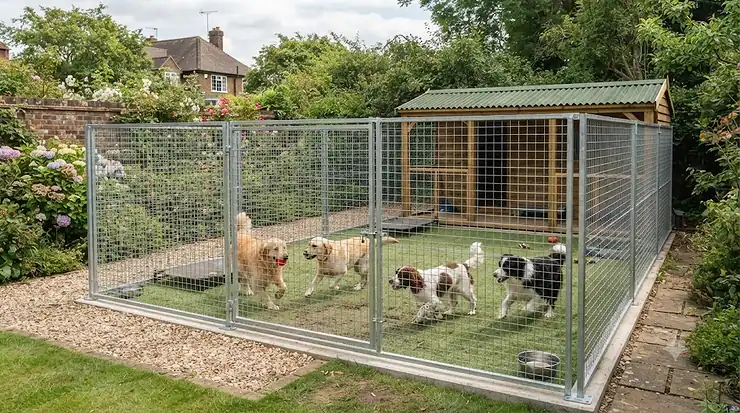
A dog run for multiple dogs is a secure, roofed or partly covered outdoor enclosure sized so that two or more dogs can move, rest and drink at the same time without cornering one another. It differs from a single-dog kennel run in floor area, exit points and the ability to separate dogs when needed.
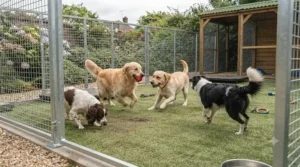
Here’s what the listing pages rarely tell you: most garden kennels are engineered around one dog. Add a second and the maths changes. Floor area, door position and even where the water bowl sits become potential flashpoints. So the smartest question when shopping for a dog run for multiple dogs isn’t “how tough is the mesh?” It’s “can two dogs use this at once without one getting trapped in a corner?”
A quick word on the rules of the game. In England, Defra’s Code of Practice for the Welfare of Dogs expects every dog to have a safe, comfortable, dry and draught-free place to rest. A run is a supplement to exercise, company and human contact, never a substitute. Think of everything below as garden-time management, not storage.
I’ve compared seven real, currently listed options on Amazon UK using their published dimensions, materials and the buyer feedback I could verify. I haven’t tested any of them myself, so this is analysis, not a diary of hands-on trials. Along the way I’ll cover sizing for multiple dogs, the pack dynamics in shared space that catch new owners out, and how dividing dog runs can keep the peace when tempers flare.
Quick Comparison: Which Multi-Dog Enclosure Suits Your Household?
Short on time? This snapshot matches five of the seven picks to the situations they handle best. Full breakdowns follow.
| Pick | Footprint (approx.) | Standout | Best For |
|---|---|---|---|
| Gecheer 382x192x225 Kennel | 3.8 x 1.9 m (about 7.3 m² floor) | Walk-in height and the most floor space | Two large dogs in a roomy garden |
| Dellonda DG281 | 2 x 2 m | 50 mm galvanised frame, padlock-ready door | Two medium dogs on a sensible budget |
| PawHut 2.1 x 1.85 x 1.5m Dog Kennel | 2.1 x 1.85 m | Roof plus 1.5 m walls deter jumpers | Two medium dogs, patio or side-return gardens |
| ZEYUAN Dog House with Run 165x251x181 | 1.65 x 2.51 m | Shelter section built in | Owners wanting run and shelter in one package |
| Tidyard 600x300x150 Walk-In Run | 6 x 3 m (about 18 m²) | Space to split into zones | Big gardens, or dogs needing part-time separation |
Looking at the table, the Gecheer 382x192x225 Kennel is the only kit here that gives two big dogs a genuine floor area to share, while the Tidyard 600x300x150 Walk-In Run wins on sheer zoning potential. The Dellonda DG281 and PawHut 2.1 x 1.85 x 1.5m Dog Kennel sit in the same roughly 4 m² bracket, which suits medium dogs but gets snug with two retrievers. If you’re weighing a multi-dog enclosure, floor area and door placement matter far more than the marketing adjectives.
💬 Just one click — help others make better buying decisions too!😊
Top 7 Dog Runs for Multiple Dogs: Expert Analysis
A note on money before we start. Prices on Amazon shift constantly, so I’ve used price tiers (budget, mid-range, premium) rather than exact figures. Always check current price and availability before you buy.
1. Gecheer 382x192x225 Kennel — biggest floor space, walk-in height
The headline is sheer volume: an overall footprint of 382 x 192 cm under a 225 cm ceiling, which works out at roughly 7.3 m² of floor and about 17 m³ of air.
Inner dimensions of 376 x 186 x 215 cm mean you can stand upright to clean, and the 2 mm chain-link sidewalls keep sightlines open. The door is 45 cm wide by 170 cm tall, which slows a stampede but makes a Labrador pair going through together a squeeze.
On paper, this is the closest thing in this roundup to a true large dog run for two dogs. Each dog can claim a zone without blocking the other’s exit. The fire-resistant polyethylene canopy adds welcome shade too.
I couldn’t verify a large pool of independent reviews for this exact listing, since the same dimensions circulate under other brand names. Read the current Amazon reviews for latch and canopy-fit comments before committing.
Pros:
- ✅ Roughly 7.3 m² of floor space for two dogs
- ✅ Walk-in 2.25 m height makes cleaning painless
- ✅ Lockable latch and UV-protected canopy included
Cons:
- ❌ Narrow 45 cm door restricts big-dog traffic
- ❌ Large flat-pack needs two people and level ground
Premium tier, but per square metre it’s the strongest value here for big pairs. Check current price.
2. Dellonda DG281 — chunky frame, padlock-ready door
The Dellonda DG281 trades headline size for build quality, pairing a 50 mm galvanised steel frame with high-tension chain-link panels in a 2 x 2 x 1.5 m format.
That frame gauge matters. Thicker tubing resists the flex you get when two dogs lean on a panel at once. The door bolt takes a padlock, and the 210D oxford-cloth roof is water-resistant and comes off on elasticated fastenings for summer airflow. The kit weighs around 34.5 kg, which is light enough to assemble alone but also light enough to need anchoring.
Four square metres is fine for two spaniel- or beagle-sized dogs on short supervised stints. Two larger dogs will feel the pinch quickly, and the roof only earns its keep if you pick a shaded spot.
Retailer pages carrying this listing showed no reviews when I checked, so I can’t summarise buyer sentiment honestly. The Amazon page is your best ground truth.
Pros:
- ✅ Sturdy 50 mm frame resists panel flex
- ✅ Padlock-ready bolt door adds security
- ✅ Removable roof cover for summer ventilation
Cons:
- ❌ 4 m² is tight for two large dogs
- ❌ Light kit weight demands ground anchoring
Mid-range tier. It’s a sound choice for medium-dog households who prioritise robustness over space.
3. PawHut 2.1 x 1.85 x 1.5m Dog Kennel — roofed, high-walled, widely reviewed
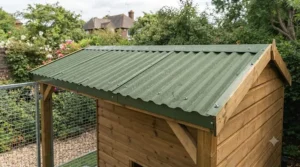
Where the PawHut 2.1 x 1.85 x 1.5m Dog Kennel shines is its all-in package of galvanised steel, a water- and UV-resistant roof and 1.5 m walls. That combination makes jumping out a non-starter for most breeds.
The door is 92 cm high by 55 cm wide, so you’ll duck to enter, but a nose-to-tail pair of terriers will barely notice. The listing suggests it suits dogs up to about 30 kg, which tells you the designers had medium breeds in mind.
Analytically, it’s a patio-friendly compromise: roughly 3.9 m² on paper, enough for two medium dogs to lie apart, but not enough for zoomies. Buyers with escape artists will appreciate the roof.
The Amazon listing displays strong brand-level positive ratings from a large customer base, and one reviewer praised the build, the roof and the jump-proof walls. As ever, skim recent reviews for this specific size.
Pros:
- ✅ Roof and 1.5 m walls deter jumpers
- ✅ Galvanised steel suits British weather
- ✅ Lockable door with a fixed shaft
Cons:
- ❌ Not walk-in, with a 92 cm door
- ❌ 30 kg guidance limits big breeds
Mid-range tier. It’s good value if your dogs are medium-sized and you want a proven brand.
4. vidaXL 2x2x2m Galvanised Dog Cage — two metres tall, mesh all round
The vidaXL 2x2x2m Galvanised Dog Cage stands out for one thing: it’s a full 2 m tall, so you can walk in without stooping.
The listing describes a galvanised steel cage with a roof, mesh construction and a lockable door. That extra height over the standard 1.5 m runs is a genuine safety margin for athletic jumpers such as collies and spaniels. It also gives you an easier time when cleaning or when settling a nervous dog.
The floor area is the same 4 m² as the Dellonda DG281, so it inherits the same limit: fine for medium pairs, snug for big ones. Height is where it wins. Full-height mesh panels also catch the wind, so anchor it properly.
I couldn’t verify a meaningful review pool for this specific listing at the time of research. Check the live Amazon feedback for panel fit and door alignment.
Pros:
- ✅ 2 m height defeats even athletic jumpers
- ✅ Walk-in convenience for owners
- ✅ Mesh sides keep airflow and sightlines open
Cons:
- ❌ 4 m² floor is modest for large pairs
- ❌ Tall panels act like sails in gusts
Mid-range tier. It’s the pick for jumpers, less so for big breeds needing floor room.
5. ZEYUAN Dog House with Run 165x251x181 — shelter and run in one
The ZEYUAN Dog House with Run 165x251x181 bundles a shelter and a run into one galvanised steel structure, which neatly answers the “where do they shelter?” question.
At 165 x 251 x 181 cm overall, the footprint is around 4.1 m², though part of that is the house rather than open run. I couldn’t confirm the exact split from the listing, so check it before buying. The 1.81 m height suits taller dogs and gives you headroom.
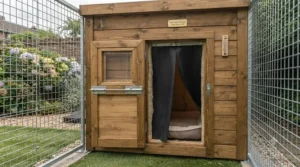
Here’s the catch for a dog run for multiple dogs: a single small shelter can become a guarded resource. Two dogs, one house, and one of them will decide it’s theirs. It’s better suited to compatible pairs who already share a bed happily.
I couldn’t verify enough independent reviews for this exact listing to summarise them fairly, so treat the Amazon feedback as your guide.
Pros:
- ✅ Built-in shelter saves buying a separate kennel
- ✅ 1.81 m height suits taller dogs
- ✅ Galvanised steel with canopy top
Cons:
- ❌ Single shelter invites guarding between two dogs
- ❌ Open run area is smaller than the headline footprint
Mid-range tier. It’s good value if the shelter is what you’d otherwise have to buy separately.
6. PawHut 211 x 141 x 151 cm Play Pen Kennel — rotating bowls for tidy feeding
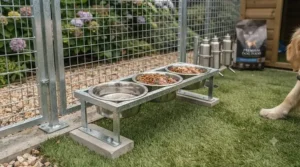
What sets the PawHut 211 x 141 x 151 cm Play Pen Kennel apart is its rotating bowl holders, a small feature with outsized value when you’ve got two dogs and one door.
At 211 x 141 cm the floor is roughly 3 m², topped with a canopy at 151 cm. Rotating holders let you feed through the mesh without opening the gate, which helps enormously with separate feeding and keeps a food-motivated dog from bolting the door.
The trade-off is space. Three square metres suits two small dogs, a puppy pair or a small-plus-medium duo, but it’s undersized for retrievers. Use it for feeding routines and short breaks rather than long stays.
I couldn’t verify a robust review sample for this specific size. Brand-level feedback across the PawHut range looks positive, but check the live listing for the 211 cm variant specifically.
Pros:
- ✅ Rotating bowl holders enable door-free feeding
- ✅ Canopy for shade and rain protection
- ✅ Compact enough for patios and side gardens
Cons:
- ❌ Around 3 m² is small for two big dogs
- ❌ Limited room to separate resources properly
Budget-to-mid tier. It’s affordable and handy, provided your dogs are small.
7. Tidyard 600x300x150 Walk-In Run — 18 m² of room to zone
The Tidyard 600x300x150 Walk-In Run is the outlier: 6 x 3 m, or about 18 m², under a roof. That’s more than four times the floor area of the 2 x 2 m kits.
The listing markets it for dogs and poultry alike, so verify the mesh gauge, panel fixings and the gap at ground level before trusting it with a determined digger or a strong dog. At 1.5 m high you’ll stoop inside, which is a minor annoyance compared with the zoning potential.
This is the run that makes dividing dog runs realistic. You could split it into two 9 m² halves, each with its own shelter, bowls and bed, and still have room for a shared central gate. It’s the best answer here for households where dogs need separating part of the time.
I couldn’t verify a solid review base for this listing, so check current buyer reports for strength and assembly notes.
Pros:
- ✅ Roughly 18 m² floor area
- ✅ Room for dividers and separate shelters
- ✅ Roofed to keep dogs dry
Cons:
- ❌ Dual-purpose design needs mesh-strength checks
- ❌ Large, heavy assembly needing helpers
Mid-to-premium tier. Per square metre, it’s exceptional value if you have the garden.
Side-by-Side Specs
| Product | Overall Size (cm) | Approx. Floor | Price Tier | Best For |
|---|---|---|---|---|
| Gecheer 382x192x225 Kennel | 382 x 192 x 225 | 7.3 m² | Premium | Two large dogs |
| Dellonda DG281 | 200 x 200 x 150 | 4 m² | Mid-range | Two medium dogs |
| PawHut 2.1 x 1.85 x 1.5m Dog Kennel | 210 x 185 x 150 | 3.9 m² | Mid-range | Patio pairs |
| vidaXL 2x2x2m Galvanised Dog Cage | 200 x 200 x 200 | 4 m² | Mid-range | Jumpers |
| ZEYUAN Dog House with Run 165x251x181 | 165 x 251 x 181 | ~4.1 m² incl. house | Mid-range | Shelter seekers |
| PawHut 211 x 141 x 151 cm Play Pen Kennel | 211 x 141 x 151 | ~3 m² | Budget-to-mid | Small dogs, feeding control |
| Tidyard 600x300x150 Walk-In Run | 600 x 300 x 150 | 18 m² | Mid-to-premium | Zoning, big gardens |
Star ratings are deliberately absent because they change daily, so check the live Amazon reviews. The pattern is obvious, though. Four of the seven cluster at around 4 m², which suits two medium dogs but sits below the sizes suggested for large breeds. If you want real space, the Gecheer 382x192x225 Kennel and the Tidyard 600x300x150 Walk-In Run are the standouts. The ZEYUAN Dog House with Run 165x251x181 only makes sense if you value the built-in shelter.
Setting Up a Dog Run for Multiple Dogs: A Practical 30-Day Guide
Buying the kit is the easy bit. What separates a calm shared run from a chaotic one is the set-up.
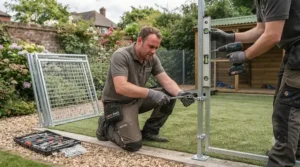
Groundwork first. Level the site and choose a firm, free-draining base. Grass feels kind but gets churned into mud where two dogs pace fence lines, and one UK buying guide points out you can’t disinfect it properly. Paving slabs, or compacted gravel over weed membrane, are worth the effort.
Anchor everything. The Dellonda DG281 weighs around 34.5 kg, and wind treats a roofed frame like a sail. Use ground stakes, slab clamps or heavy weights.
Upgrade the latch. Dogs learn latches fast. Add a second lock or a carabiner clip.
Lay out resources. Put two water bowls in different corners, two beds and one shaded spot. A useful rule is one more resource than you have dogs.
Weeks 1-4:
- Week one: 10-15 minute supervised sessions with both dogs, rewarding calm behaviour.
- Week two: extend to 30-45 minutes, still supervised. Feed separately, ideally through the mesh or with a barrier.
- Weeks three and four: introduce enrichment items one at a time and check fastenings weekly.
Common mistakes: leaving dogs unsupervised on day one, forgetting shade, putting bowls side by side, and ignoring the gap under panels where diggers start.
Real-World Scenarios: Matching a Dog Run for Multiple Dogs to Your Household
Let’s put the picks through three realistic profiles.
Scenario 1: Two adult Labradors, a semi-detached with a long garden, someone home most days. The budget is flexible, use is daily for supervised garden time, and the environment is a lawn. The Gecheer 382x192x225 Kennel gives around 7.3 m² and you can walk in to clean. The narrow 45 cm door is the only compromise. If you have a really big garden, the Tidyard 600x300x150 Walk-In Run gives them more room still.
Scenario 2: A beagle and a cockapoo, a paved patio, a tight budget. Use is a few hours a day. The Dellonda DG281 or the PawHut 2.1 x 1.85 x 1.5m Dog Kennel both suit this. Choose the Dellonda DG281 if durability matters, or the PawHut 2.1 x 1.85 x 1.5m Dog Kennel for its widely reviewed track record.
Scenario 3: Two friendly dogs plus a nervous foster who needs separation. Use is frequent and mixed. This is where dividing dog runs earns its keep. The Tidyard 600x300x150 Walk-In Run lets you create two zones with a divider and separate shelters, so the anxious dog can decompress out of sight. Add solid screening along the dividing line for privacy.
How to Choose a Dog Run for Multiple Dogs
Follow these steps in order and you’ll narrow the field quickly.
- Measure your dogs, not the box. Note length from nose to tail base and shoulder height. Runs should allow each dog to stand, turn and stretch fully.
- Set a floor-area target. For two dogs, aim high. Kits around 4 m² suit medium breeds for short stays; large dogs need considerably more.
- Match height to jumping ability. A 1.5 m wall plus a roof stops most dogs. Athletic breeds may warrant 2 m.
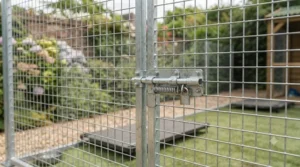
- Inspect the door and latch. Check width, position (never in a corner) and whether it takes a padlock.
- Insist on a roof and shelter. Shade and dry rest areas are essential, and per Defra’s code, the resting place should be dry and draught-free.
- Plan for division. Even if your dogs love each other, illness, heat or a bitch in season can force separation. Bigger runs make that possible.
- Prepare the base and anchoring. Budget time and materials for a firm floor and secure fixings.
✨ Ready to Upgrade Your Garden Setup?
🔍 Take your dog run for multiple dogs to the next level with the options above. Click any highlighted product to check current pricing and availability. These picks will help you create a safe, comfortable outdoor space your dogs will enjoy!
Sizing for Multiple Dogs: How Much Room Is Enough?
Sizing for multiple dogs is where most buying mistakes happen, because listings quote overall dimensions, not usable space.
One UK buying guide suggests a minimum of about 4 x 2 m for shepherd-sized dogs, with roughly 8 to 12 m² typically sufficient for most large breeds. Those are single-dog figures. My analytical reading is that two dogs sharing should treat that range as the entry point, not the ceiling. Otherwise one dog can end up cornered whenever the other decides to patrol.
Compare that with the picks. The 2 x 2 m kits provide 4 m², half the lower end. They’re workable for medium or small dogs, but not a comfortable home base for two large ones. Only the Gecheer 382x192x225 Kennel at about 7.3 m² approaches the bracket, and the Tidyard 600x300x150 Walk-In Run at around 18 m² clears it.
Planning a Large Dog Run for Two Dogs
For a large dog run for two dogs, think in terms of shape as well as area. A run that’s at least 2 m wide lets dogs pass each other without squeezing. A narrow tunnel shape creates pinch points, which are prime flashpoints. Place the door away from corners and give each dog its own retreat.
Bigger isn’t automatically better either. One buying guide notes that very large open enclosures without visual barriers can unsettle some dogs. A screen, a shelter or a planter along one side gives them somewhere to break line of sight.
Pack Dynamics in Shared Space: Keeping the Peace
“Pack” is popular shorthand, though many behaviourists prefer to talk about relationships and resources. Whatever you call it, pack dynamics in shared space come down to who wants what, and where.
Resource guarding is normal. Karen Pryor Clicker Training describes guarding between dogs as extremely common, and recommends management first: removing high-value items and confining dogs separately during feeding. That’s the practical starting point for any dog run for multiple dogs.
The flashpoints are predictable:
- Doorways and gates. Excitement peaks when the gate opens. Have the dogs sit and go through one at a time.
- Corners and dead ends. A dog cornered by another may react defensively.
- Shelters. One house, two dogs, one guardian.
- Water and bowls. Duplicates in separate spots defuse competition.
Setting Up Shared Dog Run Space
Good shared dog run space is about duplication and distance. Provide two of everything (water, beds, shade) and spread them out. Keep chews and high-value toys out of the run unless dogs are separated. Supervise at first, and watch body language for stiffening, freezing or fixed stares. If tension escalates, that’s a signal to separate and consult a qualified behaviourist.
Dividing Dog Runs: When, Why and How
Even the closest pair sometimes need time apart, so dividing dog runs is a feature to plan for, not an afterthought.
Common triggers include feeding time, an injured or recovering dog, a female in season, a nervous rescue and a bout of over-excitement. The East Bay SPCA’s multi-dog guidance is blunt about it: never feed together, and separate dogs during especially exciting moments.
The size arithmetic is unforgiving. Halve the Gecheer 382x192x225 Kennel and each dog gets about 3.6 m², fine for feeding or a quiet half-hour, not for long stays. Halve the Tidyard 600x300x150 Walk-In Run and each side still gets around 9 m². That’s why bigger runs are the only ones where division really works.
Mesh or solid? One UK guide notes that a mesh wall allows sight and contact, which can trigger stress or even fights, while a solid wall blocks visibility. A sensible compromise is mesh at the bottom for airflow, with an opaque screen at dog-eye height where reactivity is a concern.
Practical options: a hinged divider gate, a temporary panel or a double-gate airlock. Give each half its own water, bed and shade.
Multi-Dog Enclosure vs Alternatives: What Actually Works?
Is a multi-dog enclosure really better than the alternatives? It depends on what problem you’re solving.
| Option | Strength | Weakness | Best For |
|---|---|---|---|
| Multi-dog enclosure (kit run) | Flexible, quick separation, roofed | Limited floor area, needs a base | Supervised outdoor time for pairs |
| Secure fenced garden alone | Maximum space | No separation, escape risk if fencing fails | Compatible dogs in a secure garden |
| Indoor crates or pens | Weatherproof, familiar | Small, indoor only | Overnight or short-term settling |
| Two separate single runs | Full separation | Double the cost and footprint | Dogs that can’t share at all |
The table shows why the multi-dog enclosure wins for flexibility. It gives you a controlled outdoor space without committing to the footprint of two separate runs. A fenced garden gives more room but no way to separate dogs when needed. For compatible dogs in a truly secure garden, a run is a useful supplement rather than the main event.
Features That Actually Matter (And Those That Don’t)
Marketing copy loves adjectives. Here’s what actually moves the needle.
Matters:
- Frame gauge and construction. A 50 mm galvanised frame, as on the Dellonda DG281, is a concrete, checkable spec.
- Floor area and shape, not just overall dimensions.
- A roof that’s properly fastened and easy to inspect.
- Door width, position and latch security.
- Ground anchoring options.
- Access to shelter.
Matters less:
- Vague labels like “heavy duty” with no frame dimensions to back them up.
- Colour, unless you’re matching your garden.
- Panel counts, which say nothing about strength.
The PawHut 211 x 141 x 151 cm Play Pen Kennel shows the nuance. Rotating bowl holders sound gimmicky, but for a household practising separate feeding they’re genuinely useful. Judge each feature by whether it solves a problem you actually have.
Long-Term Cost & Maintenance
The sticker price is only part of the story. Total cost of ownership includes the kit, a proper base, anchoring hardware, padlocks, shelters, bedding and eventual roof replacement.
Fabric roofs are usually the first consumable. UV and weather wear them down, so budget for replacing them periodically. Galvanised steel resists rust, but scratched or chipped coatings will corrode over time, so touch up any damage promptly.
A simple maintenance rhythm:
- Weekly: check fasteners, latch operation and roof tension.
- Monthly: wash surfaces, inspect for chew marks or digging.
- Seasonally: check roof fabric, drainage and anchoring.
Spread across several years of daily use, the gap between a mid-range and a premium run shrinks to a small daily cost per dog. A well-chosen dog run for multiple dogs that lasts is usually cheaper than a bargain kit replaced after two winters.
Safety, Welfare and Regulations Guide
A dog run is a management tool, and the law is clear on welfare. Under the Animal Welfare Act 2006, owners must meet their dogs’ needs. The explanatory notes to the Act explain that codes of practice provide non-binding guidance that courts can refer to when judging whether welfare standards have been met.
In practice, that means:
- Rest: provide a dry, draught-free resting place.
- Temperature: shade and water in summer; insulated shelter in cold weather.
- Company: don’t use a run as a substitute for interaction, exercise or attention.
- Supervision: especially early on, and whenever tension appears.
- Neighbours: prolonged barking can cause disputes, so consider placement.
If you own an XL Bully type dog, check the current rules on gov.uk, which include muzzle and lead requirements in public places. This article can’t replace vet or behaviourist advice, so consult a qualified professional if you see aggression.
FAQ
❓ Can two dogs safely share one dog run?
❓ Do I need planning permission for a dog run in my garden?
❓ What floor is best for a shared dog run space?
❓ Can I leave two dogs in a run while I'm at work?
❓ How do I stop two dogs digging out of a run?
Conclusion
Choosing a dog run for multiple dogs comes down to three questions: how much floor do two dogs really need, how will they behave around each other, and how easily can you separate them? Most kits here suit medium dogs at around 4 m². For big dogs, the Gecheer 382x192x225 Kennel and Tidyard 600x300x150 Walk-In Run are the standouts.
If your budget is tight, the Dellonda DG281 and PawHut 2.1 x 1.85 x 1.5m Dog Kennel offer solid value for medium pairs. If jumping is the concern, the vidaXL 2x2x2m Galvanised Dog Cage adds height. Small-dog households will like the feeding convenience of the PawHut 211 x 141 x 151 cm Play Pen Kennel, while the ZEYUAN Dog House with Run 165x251x181 suits owners who want shelter included. Whichever you choose, invest in the base, anchor it well and duplicate every resource.
Recommended for You
- Dog Run vs Kennel Which Is Better 7 UK Picks (2026)
- Secure Dog Run For Garden: 7 Escape-Proof Picks UK 2026
- Outdoor Dog Enclosure For Large Dogs: 7 Best Picks (2026)
Disclaimer: This article contains affiliate links. As an Amazon Associate, I earn from qualifying purchases. If you purchase products through these links, we may earn a small commission at no additional cost to you.
✨ Found this helpful? Share it with your friends! 💬🤗
