
In This Article
Picture this: you’re heading off for a weekend in the Cotswolds with your beloved Labrador, your VW Golf packed and ready. But there’s one problem—how do you keep your furry companion safe, comfortable, and legally compliant during the journey? If you’ve been wrestling with this question, you’re not alone.
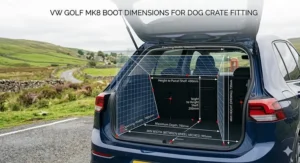
Choosing the right dog crate for VW Golf isn’t just about ticking a box for the Highway Code. It’s about finding that sweet spot where safety meets comfort, where German engineering meets British pragmatism. The Golf’s compact yet practical boot space presents unique challenges—the sloping rear window, the hatchback design, and those dimensions that can make or break your crate choice.
I’ve spent considerable time researching and analysing dog crate for VW Golf options available on Amazon.co.uk and specialist retailers. From crash-tested Swiss engineering to budget-friendly sloped designs, there’s a solution for every Golf owner and their four-legged passenger. Whether you’re driving a Golf MK7 hatchback or a spacious Golf Estate, understanding your options will transform those stressful car journeys into relaxing adventures for both you and your dog. Let’s explore what actually works in real-world conditions.
Quick Comparison Table
| Product | Type | Size | Price (£) | Best For | Rating |
|---|---|---|---|---|---|
| Pet World 36″ Sloped Crate | Steel Cage | 91×63×30-61cm | £129.95-£149.95 | Golf MK7 Hatchback | ⭐⭐⭐⭐ 4.2/5 |
| Travall Dog Guard TDG1409 | Barrier/Guard | Vehicle-Specific | £89.99-£119.99 | All Golf Models | ⭐⭐⭐⭐⭐ 4.7/5 |
| 4pets PRO Size 2 Large | Crash-Tested Cage | 93.5×54.5×54.4cm | £344.95 | Golf Estate/SV | ⭐⭐⭐⭐⭐ 4.8/5 |
| DT Boxes Golf Crate | Plastic Transport | Custom-Fit | £185-£225 | Golf 2013-2020 | ⭐⭐⭐⭐ 4.4/5 |
| Pet World 32″ Premium Small | Steel Cage | 81×58×27-55cm | £129.95 | Small-Medium Dogs | ⭐⭐⭐⭐ 4.0/5 |
| PETPROVED Soft Carrier | Fabric Crate | 70×52×52cm | £30.59-£54.95 | Anxious Dogs | ⭐⭐⭐⭐ 4.4/5 |
| Barjo Bespoke Cage | Custom Steel | Made-to-Measure | £380-£480 | Specific Requirements | ⭐⭐⭐⭐⭐ 4.9/5 |
💬 Just one click – help others make better buying decisions too!😊
Top 7 Dog Crate for VW Golf: Expert Analysis
1. Pet World Large 36″ Sloped Car Dog Crate – The Golf MK7 Specialist
The Pet World Large 36″ Sloped Car Dog Crate represents British engineering at its practical best. Specifically designed for VW Golf MK7 (2013 onwards), this crate tackles the Golf’s unique challenge—that sloping rear window that makes standard rectangular crates utterly useless.
Key Specifications:
- Dimensions: Height 63cm, Depth (top) 30cm, Depth (base) 61cm, Width 91cm
- High-grade steel construction with powder coating
- Emergency escape hatch on top
- Includes free comfort mat
UK buyers consistently praise how this crate maximises boot space whilst fitting snugly against the Golf’s contours. One Labrador owner from Winchester noted, “The exact fit means no wasted space, though you’ll need to assemble it in the boot—it’s too snug to slide in pre-built.”
The sliding door design offers clever practicality for UK car parks where space is at a premium. However, Golf MK8 owners should note the door can protrude slightly when fully open, potentially catching on the tailgate.
✅ Pros:
- Perfect fit for Golf MK7/MK7.5 dimensions
- Emergency escape hatch provides peace of mind
- Folds flat for storage when not needed
❌ Cons:
- Must be assembled inside boot
- Can rattle slightly without dampeners fitted
Price Range: £129.95-£149.95 on Amazon.co.uk
Best For: Golf MK7 owners with medium to large dogs (Labradors, Border Collies)
2. Travall Dog Guard TDG1409 – The Versatile Barrier Solution
If you’re not keen on caging your dog but still need legal compliance, the Travall Dog Guard offers an elegant alternative. Manufactured in Derby—a city with legendary engineering heritage—this vehicle-specific barrier transforms your Golf’s boot into a secure dog zone.
Key Specifications:
- Designed specifically for Golf Hatchback (2012-2020)
- Powder-coated steel mesh construction
- No drilling or permanent fixtures required
- Compatible with parcel shelf (some models)
What sets Travall apart is their obsessive attention to vehicle-specific fit. Unlike universal barriers that rattle and shift, this guard integrates seamlessly with your Golf’s interior. Installation typically takes under 15 minutes, and the lifetime warranty covering manufacturing defects speaks volumes about build quality.
UK buyers particularly appreciate the grey powder coating that complements VW interiors whilst remaining non-reflective for safer driving. The guard also works brilliantly as a luggage barrier during those Ikea runs when Fido stays home.
✅ Pros:
- Tool-free installation in approximately 15 minutes
- Lifetime warranty from UK-based company
- Allows rear seats to fold with guard in position
❌ Cons:
- Parcel shelf compatibility varies by Golf model
- Less containment than full crates for anxious dogs
Price Range: £89.99-£119.99
Best For: Golf owners wanting flexibility between dog transport and general cargo use
3. 4pets PRO Size 2 Large – The Swiss Safety Champion
When safety is non-negotiable, the 4pets PRO Size 2 Large represents the pinnacle of crash-tested dog crate engineering. Swiss-made and TÜV-approved, this aluminium marvel isn’t just a crate—it’s a survival capsule for your furry family member.
Key Specifications:
- Dimensions: 93.5cm long × 54.5cm wide × 54.4cm high
- Anodised aluminium and fibreglass-reinforced plastic construction
- Patented Impact Protection System rear panel
- Safelock burst-proof door mechanism
- Weight: Approximately 18kg, maximum load 50kg
The science behind this crate is genuinely impressive. At 30mph, your dog becomes a projectile with 25 times their body weight—a typical Labrador would hit with three-quarters of a tonne of force. The 4pets PRO’s energy-absorbing rear panel flexes outwards whilst expanding in all directions, dissipating kinetic energy in a controlled manner.
UK Golf Estate and Golf SV owners will find this fits beautifully in their larger boot spaces. The single-handed Safelock operation means you can control your excited dog with one hand whilst opening the crate with the other—a brilliant detail that becomes invaluable in muddy car park situations.
✅ Pros:
- TÜV crash-tested and approved safety standard
- Energy-absorbing materials protect both dog and humans
- Premium build quality with replaceable spare parts
- Excellent driver visibility through vertical bars
❌ Cons:
- Premium pricing reflects Swiss engineering
- Size may be too large for standard Golf hatchback
- Requires careful measurement of boot space
Price Range: £344.95-£390.00
Best For: Golf Estate/SV owners prioritising maximum safety for medium to large breeds
4. DT Boxes VW Golf Dog Travel Crate – The British Plastic Alternative
For those seeking lightweight versatility, DT Boxes offers a distinctly British take on dog transport. Made from super-tough yet lightweight plastic right here in the UK, these crates bring a different philosophy to Golf dog travel.
Key Specifications:
- Custom-fitted for Golf Estate (2013-2020)
- Lightweight plastic construction
- Easy lift-in/lift-out design
- Available in multiple sizes for different dog breeds
The beauty of the DT Boxes approach lies in its simplicity. Where steel crates demand in-situ assembly, these plastic units slide in and out with ease. Perfect for those who use their Golf for varied purposes—dog transport on weekends, general cargo during the week.
UK buyers appreciate the non-corrosive plastic that won’t rust in our damp climate and doesn’t get searingly hot or freezing cold like metal alternatives. The moulded design also means no rattles or squeaks, creating a quieter journey for sensitive dogs.
✅ Pros:
- Lightweight for easy installation and removal
- No assembly required
- Weather-resistant plastic construction
- UK-made with good customer support
❌ Cons:
- Less ventilation than wire cages
- Not crash-tested to same standard as 4pets PRO
- Limited size options compared to adjustable crates
Price Range: £185-£225
Best For: Golf Estate owners wanting convenient, multi-purpose boot solutions
5. Pet World 32″ Premium Small Sloped Car Dog Cage – The Compact Option
Not every dog needs sprawling space, and the Pet World 32″ Premium Small caters brilliantly to smaller breeds and compact Golf boots. This zinc-coated steel crate brings the same sloped design philosophy as its larger sibling but in a package suited to Spaniels, Terriers, and compact breeds.
Key Specifications:
- Dimensions: 81cm wide × 58cm high × 27-55cm depth (sloped)
- Zinc-coated steel for enhanced corrosion resistance
- Sliding door mechanism
- Removable waterproof base tray
- Suitable for Golf 2015 onwards
The sliding door deserves special mention—in tight UK car parks where boot space is limited, this side-opening design proves infinitely more practical than traditional swing-open doors. One Polo owner noted it fits perfectly in their smaller boot, highlighting the versatility across VW’s hatchback range.
The waterproof base tray addresses a common UK concern: muddy paws after those inevitable rainy walks. Simply remove, hose down, and you’re ready for the next adventure.
✅ Pros:
- Zinc coating provides superior rust protection
- Sliding door perfect for tight spaces
- Removable waterproof base for easy cleaning
- Lighter than 36″ version for easier handling
❌ Cons:
- Too small for large breeds
- Some buyers report feeling cramped for medium dogs
- Comfort mat could be more substantial
Price Range: £129.95
Best For: Golf owners with small to medium dogs (Cocker Spaniels, Beagles, French Bulldogs)

6. PETPROVED Soft Fabric Dog Carrier – The Anxiety Solution
Sometimes the best dog crate for VW Golf isn’t a crate at all—it’s a soft sanctuary. The PETPROVED Soft Fabric Carrier represents a completely different approach, prioritising psychological comfort for anxious travellers.
Key Specifications:
- Medium size: 70×52×52cm (Large: 91×61×61cm also available)
- Breathable mesh panels with padded interior
- Foldable design for space-saving storage
- Suitable for dogs up to 9kg (Medium size)
- Top and side pockets for treats and essentials
UK buyers with nervous rescue dogs often discover that traditional metal crates amplify anxiety. The PETPROVED’s soft walls and cave-like interior create a den environment that naturally calms stressed animals. The breathable mesh ensures excellent ventilation—crucial for dogs prone to car sickness or overheating.
One Jack Russell owner from Manchester shared a transformative experience: “My dog was an absolute nightmare in the car—panting, pulling, choking herself on the harness. In this soft crate, she actually lay down. We were all amazed.”
The collapsible design means it stores in your Golf’s boot corner when not needed, and the fleece pad provides genuine comfort for longer journeys.
✅ Pros:
- Significantly reduces anxiety for nervous dogs
- Lightweight and portable (easy to move between vehicles)
- Foldable storage takes minimal space
- Machine-washable components
❌ Cons:
- Not suitable for determined escape artists or chewers
- Some buyers report zipper quality issues
- Less crash protection than rigid crates
- Size limitation for larger breeds
Price Range: £30.59-£54.95
Best For: Small to medium anxious dogs, rescue dogs, or as a secondary indoor crate
7. Barjo Bespoke Dog Cage – The Custom Solution
When nothing off-the-shelf quite fits your unique requirements, Barjo offers the ultimate solution: hand-crafted, bespoke cages designed by skilled Berkshire engineers specifically for your Golf and your dog.
Key Specifications:
- Custom dimensions to maximise your specific Golf model’s boot
- 2″×2″×10swg weldmesh with strong steel frame
- One or two entry doors available
- Emergency escape door behind rear seats
- Black powder-coated finish
- Includes anti-slip rubber matting
What distinguishes Barjo is their engineering approach. Rather than offering standard sizes, they design each cage to utilise maximum available space in your particular Golf variant. For Golf owners with unusual boot configurations or specific requirements, this bespoke service proves invaluable.
The build quality reflects traditional British craftsmanship—these cages are individually made by hand, not churned out by machines. The robust weldmesh construction provides excellent ventilation whilst maintaining security, and the escape door offers genuine peace of mind in emergency situations.
UK buyers particularly value the customer service, with the Berkshire-based team offering fitting advice and technical support throughout the process.
✅ Pros:
- Perfectly tailored to your specific Golf model and year
- Hand-crafted British quality with attention to detail
- Maximum space utilisation
- Optional double-entry configuration with removable divider
- Foldable design for storage
❌ Cons:
- Premium pricing reflects bespoke manufacturing
- Lead time for custom fabrication
- Overkill for casual users
Price Range: £380-£480
Best For: Golf owners with specific requirements, multiple dogs, or those wanting absolute maximum boot space utilisation
✨ Don’t Miss These Exclusive Deals!
🔍 Take your dog travel experience to the next level with these carefully selected products. Click on any highlighted item to check current pricing and availability on Amazon.co.uk. These tools will help you create authentic safe journeys your family will love!
Understanding Your VW Golf’s Boot Space Dimensions
Before splashing your hard-earned pounds on any dog crate for VW Golf, you absolutely must understand your specific model’s dimensions. The Golf family isn’t one-size-fits-all, and what works brilliantly in a Golf Estate will simply not fit in a standard hatchback.
Golf Hatchback Boot Measurements
The standard VW Golf hatchback (MK7/MK7.5/MK8) presents interesting challenges. With rear seats up, you’re working with approximately 380 litres of space—but it’s the shape that matters more than volume. The sloping rear window reduces usable height towards the back, which is precisely why sloped crates like the Pet World range exist.
Typical measurements:
- Boot floor width: approximately 100cm
- Maximum height (at seats): 65-70cm
- Height at tailgate (due to slope): 30-40cm
- Depth with seats up: 75-85cm
This sloping geometry means traditional rectangular crates either waste enormous amounts of space or risk cracking your rear window. UK-designed sloped crates specifically address this challenge, following the rake of your back seat to maximise comfort whilst maintaining clearance.
Golf Estate Boot Measurements
The Golf Estate transforms the equation entirely. With approximately 605 litres of boot space (seats up), you gain both volume and consistent height throughout the load area. This opens up options for larger, rectangular crates like the 4pets PRO or DT Boxes ranges.
Typical measurements:
- Boot floor width: approximately 100cm
- Consistent height: 70-75cm
- Depth with seats up: 100-110cm
Estate owners can confidently consider crash-tested cages and larger solutions that hatchback drivers simply cannot accommodate. The flat load floor also makes installation considerably easier.
Critical Measurement Tips for UK Buyers
According to UK Highway Code Rule 57, your dog must be “suitably restrained” in vehicles. This doesn’t just mean having a crate—it means having the right crate that won’t shift, doesn’t obstruct your view, and genuinely protects your dog.
Before purchasing any dog crate for VW Golf:
- Measure your boot floor position: Many Golfs have adjustable boot floors. Decide whether you’ll use the upper or lower position, as this dramatically affects available height.
- Account for the spare wheel bump: Some Golf variants have a noticeable bump in the boot floor where the spare wheel or tyre repair kit sits. This can reduce effective depth by several centimetres.
- Consider the parcel shelf: If you plan to keep your parcel shelf in place, ensure your chosen solution (particularly dog guards) accommodates this.
- Test with the dog: Measure your dog’s sitting height and lying-down length. Add 5-10cm in each dimension for comfortable movement. A cramped dog becomes an anxious, noisy passenger.
Safety Features That Actually Matter in UK Conditions
Let’s talk about what separates a proper dog crate for VW Golf from a glorified cage. Safety isn’t just about ticking boxes for insurance purposes—it’s about genuine crash protection, everyday security, and meeting UK legal requirements.
Crash-Test Standards: What TÜV Approval Really Means
The German TÜV (Technischer Überwachungsverein) testing represents the gold standard in dog crate safety. Products like the 4pets PRO undergo rigorous crash simulation that mimics real-world collision forces. At 30mph—standard urban speed—your 32kg Labrador effectively weighs 800kg in a collision. That’s a potentially lethal projectile aimed at your head.
TÜV-approved crates feature energy-absorbing materials that deform in controlled ways, dissipating kinetic energy rather than transmitting it directly to your dog’s body. The 4pets PRO’s Impact Protection System, for example, flexes outwards whilst expanding in all directions, creating what engineers call “controlled deformation zones.”
For UK drivers navigating M25 traffic or winding Scottish highland roads, this engineering makes the difference between minor injuries and tragedy.
Emergency Escape Hatches: British Pragmatism
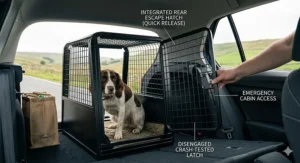
Many UK-designed crates, including Pet World models, incorporate top-mounted emergency escape hatches. In rollover scenarios or situations where standard doors become inaccessible, these hatches provide critical alternative exit routes.
The RSPCA recommends considering worst-case scenarios when selecting pet transport equipment. An emergency escape hatch allows you (or emergency services) to reach your dog quickly if main doors are jammed or blocked.
Door Lock Mechanisms: Burst-Proof Design
Here’s something many buyers overlook: in a collision, your crate door can burst open, ejecting your dog into the vehicle cabin or even out of broken windows. The 4pets Safelock system specifically addresses this, designed to resist burst forces both inward and outward.
Standard latches on budget crates often fail under impact forces, transforming your dog from safely contained to dangerously loose in microseconds. Look for spring-loaded or quarter-turn mechanisms that positively lock rather than simple hook-and-eye designs.
Material Selection: British Climate Considerations
Our uniquely damp, variable climate demands thoughtful material choices:
Steel crates (Pet World, Barjo): Powder-coated or zinc-coated finishes resist rust from muddy paws and wet coats. However, bare steel can become uncomfortably cold in winter or scorching in summer sunshine.
Aluminium cages (4pets PRO): Anodised aluminium doesn’t rust, doesn’t get extremely hot or cold, and weighs considerably less than steel—important when manoeuvring crates in and out of boots. The trade-off is higher cost.
Plastic crates (DT Boxes): Non-corrosive, maintain moderate temperatures, and are genuinely lightweight. However, plastic can become brittle in freezing temperatures and may crack under extreme impact forces.
Fabric carriers (PETPROVED): Breathable, comfortable, and anxiety-reducing, but offer minimal crash protection. Best suited as secondary containment or for particularly nervous small dogs on short journeys.
Ventilation: More Critical Than You Think
UK summers may not rival Mediterranean heat, but trapped in a stationary car in a sunny Tesco car park, even 20°C outside can create lethal interior temperatures. The RSPCA warns that at 22°C external temperature, car interiors reach 47°C within an hour.
Proper crate ventilation—wire mesh sides, ventilation holes, or breathable fabric—allows air circulation even when the car is stationary. This becomes absolutely critical during those unexpected traffic jams on the M6 or when waiting in vet car parks.
Installation Guide: Getting Your Dog Crate for VW Golf Right First Time
You’ve chosen the perfect dog crate for VW Golf, it’s arrived, and now you’re staring at components spread across your driveway. Here’s how to get it installed properly without the frustration many first-timers experience.
Pre-Installation Preparation
Before you start assembling anything, prepare your Golf’s boot properly:
- Clean thoroughly: Remove all debris, vacuum corners, and wipe down surfaces. Dog crates work best on clean, dry surfaces.
- Decide on boot floor position: Most modern Golfs have height-adjustable boot floors. The upper position provides easier dog access (less lifting over the boot lip) but reduces vertical space. Lower position maximises height but creates a deeper step.
- Remove or secure loose items: The parcel shelf, boot cover, and any loose cargo nets should be removed or secured. These can interfere with crate placement.
- Have tools ready: Phillips screwdriver, Allen keys (usually provided), and a rubber mallet for persuading stubborn components. Barjo cages typically require no tools, whilst Pet World crates need basic assembly.
Step-by-Step Installation for Sloped Crates (Pet World Models)
The Pet World sloped crates designed specifically for Golf require in-boot assembly due to their precise fit:
Stage One: Frame Assembly
- Lay out all components and identify the base frame pieces
- Connect the base frame inside your boot—attempting pre-assembly outside wastes time, as it won’t fit through the hatch opening
- Ensure the sloped section faces towards the rear window
Stage Two: Vertical Supports
- Attach vertical corner posts to the base frame
- The front posts (nearest seats) will be taller than rear posts (near tailgate) due to the slope
- Hand-tighten initially—you’ll need adjustment flexibility
Stage Three: Top Frame and Mesh
- Connect top frame pieces to vertical posts
- Attach mesh panels, ensuring they’re taut but not over-stretched
- Install the sliding door mechanism last, as this requires the frame to be rigid
Stage Four: Securing and Finishing
- Tighten all connections fully once you’re satisfied with positioning
- Fit rubber dampeners if provided (highly recommended to prevent rattling)
- Test the door mechanism slides smoothly
- Add the comfort mat and any bedding
Time Required: 30-45 minutes for first-time installation
Installing Dog Guards (Travall Models)
Travall guards offer simpler installation with no permanent modifications:
- Position the main frame: The guard slots between boot floor and roof lining using adjustable feet and top supports
- Adjust height: Extend or compress vertical supports until the guard fits snugly
- Lock into position: Tighten the securing mechanisms—usually thumb screws or quick-release clamps
- Test stability: The guard shouldn’t wobble or rattle when pushed firmly
The beauty of Travall installation is reversibility. For those occasional trips when you need full boot space for furniture or luggage, removal takes perhaps five minutes.
Common Installation Mistakes UK Buyers Make
Mistake #1: Not checking boot floor compatibility Some crates specify upper boot floor position. Installing with the floor in the wrong position leads to poor fit, wasted space, or the crate not fitting at all.
Mistake #2: Over-tightening connections Yes, you want security, but over-tightening can strip threads or crack plastic components. Hand-tight plus a quarter turn with tools is usually sufficient.
Mistake #3: Ignoring the manual’s vehicle-specific notes Pet World and other manufacturers include specific fitting notes for different Golf generations. The MK7 fitment differs subtly from MK8—follow the correct instructions for your model.
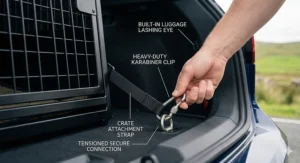
Mistake #4: Forgetting to secure the crate itself The crate holds your dog, but what holds the crate? In a collision, an unsecured crate becomes a projectile. Use the boot’s existing tie-down points or luggage retention systems to anchor larger crates.

UK Legal Requirements: What Highway Code Rule 57 Actually Demands
Let’s demystify the legal side of dog travel in the UK, because the consequences of getting this wrong extend beyond fines—they can invalidate your insurance and create genuine danger.
Rule 57 Explained in Plain English
The Highway Code Rule 57 states: “When in a vehicle make sure dogs or other animals are suitably restrained so they cannot distract you while you are driving or injure you, or themselves, if you stop quickly.”
“Suitably restrained” is deliberately broad, giving you flexibility in approach:
- Seat belt harness
- Pet carrier or crate
- Dog cage
- Dog guard/barrier
What matters is preventing distraction and injury. A Chihuahua carrier meets different requirements than a German Shepherd cage, and Rule 57 acknowledges this reality.
Penalties for Non-Compliance
Whilst Rule 57 itself isn’t directly enforceable with fixed penalties, failure to restrain your dog properly can lead to charges under broader traffic offences:
Driving without due care and attention: Fines up to £5,000, 3-9 penalty points, possible driving ban
Careless or dangerous driving: If your unrestrained dog causes or contributes to an accident, charges can escalate to dangerous driving with potential jail time
The Highway Code isn’t just advisory—courts use it to establish standards of reasonable care. If you crash because your unrestrained Labrador leapt into your lap, you’ll face serious consequences even if you weren’t speeding or breaking other rules.
Insurance Implications: The Hidden Risk
Here’s what many UK dog owners don’t realise: your car insurance policy almost certainly requires Highway Code compliance. The small print typically states something like “the policyholder must comply with legal requirements and recommended safety practices.”
If you crash whilst your dog is unrestrained and your insurer discovers this, they can:
- Refuse to pay your claim entirely
- Deny third-party injury claims (leaving you personally liable)
- Void your policy retroactively
Even if your dog didn’t cause the crash, simply failing to restrain them as Rule 57 requires provides grounds for rejection. We’re potentially talking tens of thousands of pounds in personal liability for serious accidents.
What “Suitable Restraint” Actually Means
The RSPCA and British Veterinary Association offer clearer guidance on what makes restraint “suitable”:
For small dogs (under 10kg): Secure carrier or crate, ideally fastened with seatbelt or secured to ISOFIX points
For medium dogs (10-25kg): Crate secured in boot, or crash-tested harness attached to seatbelt in rear seats
For large dogs (over 25kg): Robust crate or guard system in boot area, with proper anchoring to prevent movement
The key word is “secure”—your restraint system must prevent your dog from:
- Reaching the driver’s area
- Moving freely around the vehicle
- Becoming a projectile in emergency braking or collisions
- Distracting the driver through movement or noise
Front Seat vs Boot: The Legal Position
Technically, no UK law specifically prohibits dogs in front seats. However, the Highway Code strongly discourages it due to:
- Airbag deployment risks (potentially lethal for dogs)
- Driver distraction from dogs in peripheral vision
- Access to controls and gear stick
If you must transport a dog in a front seat:
- Disable passenger airbag (if possible)
- Use crash-tested harness attached to seatbelt
- Move seat as far back as possible
- Never allow dogs on the driver’s lap whilst moving
Boot transport with proper crating represents the safest, most legally defensible option.
Choosing the Right Size: Measuring Your Dog Properly
Getting size right makes the difference between a content, comfortable dog and an anxious, cramped passenger. Here’s how to measure accurately and select appropriate dimensions.
The Standing-Height Measurement
Have your dog stand naturally (not stretched) on a flat surface. Measure from the floor to the top of their head or ears, whichever is highest. Add 5-10cm for comfort.
This determines minimum crate height. Dogs should be able to sit upright without ducking their head—a fundamental comfort requirement for longer journeys.
Top tip: If your dog has particularly long ears (like Basset Hounds or Beagles), measure to ear tips. Those ears need clearance too.
The Lying-Down Length
Encourage your dog to lie in their natural sleeping position—most dogs curl up, some stretch out completely. Measure from nose tip to tail base (not tail tip) and add 10-15cm.
This determines minimum crate length/depth. Your dog should be able to turn around comfortably and adopt their preferred resting position without squashing against walls.
Breed consideration: Giant breeds (Great Danes, Irish Wolfhounds) rarely fit comfortably in standard Golf hatchback crates, even sloped ones. You’ll need either a Golf Estate or a larger vehicle entirely.
The Sitting-Up Width
With your dog sitting, measure across their shoulders at the widest point. Add 5-10cm for comfortable turning space.
Most dog crate for VW Golf options provide adequate width—the sloped rear design limits depth more than width. However, particularly broad-chested breeds (Rottweilers, Boxers) may need careful checking.
Growth Considerations for Puppies
If you’re buying for a puppy who’ll grow significantly, you face a dilemma: buy for current size and replace later, or buy for adult size and make it uncomfortable now?
Practical UK solution: Buy for adult size but use dividers or strategic bedding placement to create a smaller functional space. As your pup grows, expand the usable area. Many crates (particularly fabric carriers) include adjustable dividers for exactly this purpose.
Breed-Specific Guidelines
Small Breeds (under 10kg): Jack Russells, Miniature Dachshunds, Yorkies
- Recommended: Pet World 32″ Small, PETPROVED Medium Carrier
- Typical dimensions: 60-80cm length
Medium Breeds (10-25kg): Cocker Spaniels, Border Collies, Bulldogs
- Recommended: Pet World 32″ Small to 36″ Large, depending on build
- Typical dimensions: 75-95cm length
Large Breeds (25-40kg): Labradors, Golden Retrievers, German Shepherds
- Recommended: Pet World 36″ Large, 4pets PRO Size 2, DT Boxes (Estate only)
- Typical dimensions: 90-110cm length
Giant Breeds (over 40kg): Great Danes, Bernese Mountain Dogs, St Bernards
- Recommended: Golf Estate required with 4pets PRO Size 4 or bespoke Barjo solution
- Typical dimensions: 110-130cm+ length
The “Five Freedoms” Test
The UK’s Animal Welfare Act 2006 establishes five freedoms for animals, including freedom from discomfort. Your chosen crate should allow your dog to:
- Stand at full height without crouching
- Turn around completely without difficulty
- Lie down in natural sleeping position
- Enter and exit without squeezing or ducking excessively
- Maintain good air circulation and temperature regulation
If your dog can’t achieve all five comfortably, the crate is too small regardless of what size labels suggest.

Material Comparison: Steel vs Aluminium vs Plastic vs Fabric
The material your dog crate for VW Golf is constructed from dramatically affects safety, comfort, durability, and price. Let’s examine each option through the lens of real-world UK use.
Steel Crates: The Traditional Choice
Examples: Pet World range, Barjo bespoke cages
Steel remains the most common material for car dog crates, particularly in the UK market. Modern powder-coating or zinc-coating addresses the historical rust concerns that plagued older steel cages.
Advantages:
- Exceptional strength: Withstands determined escape attempts from anxious dogs
- Affordability: Generally the most budget-friendly rigid crate option
- Proven durability: Steel crates last decades with minimal maintenance
- Wide availability: Extensive choice of designs and sizes
Disadvantages:
- Weight: Heavier than alternatives, making installation/removal more strenuous
- Temperature extremes: Bare steel becomes cold in winter, hot in summer sunshine
- Potential for rust: Despite coatings, chips or scratches can lead to corrosion in UK’s damp climate
- Noise: Metal-on-metal contact can create rattles unless dampeners are fitted
Best for: Budget-conscious buyers, permanent installations, or dogs who enjoy chewing and scratching
UK-specific consideration: Check coating quality carefully. Salt from winter roads and constant damp conditions test protective finishes. Zinc coating typically outlasts powder coating in harsh British winters.
Aluminium Cages: The Premium Option
Examples: 4pets PRO range, Thule Allax
Aluminium represents the aerospace approach to dog crates—light, strong, and engineered for performance. Anodised finishes resist corrosion without adding weight.
Advantages:
- Lightweight construction: Typically 30-40% lighter than equivalent steel crates
- No rust: Aluminium oxidises but doesn’t rust, perfect for wet British conditions
- Temperature stability: Doesn’t get as cold or hot as steel
- Modern aesthetics: Clean, contemporary appearance suits VW Golf interiors
Disadvantages:
- Higher cost: Expect to pay 2-3× more than comparable steel crates
- Potential for dents: Softer than steel, can dent from impacts
- Limited designs: Fewer manufacturers work with aluminium due to cost
Best for: Owners prioritising weight savings, willing to invest in premium safety features, or frequently installing/removing crates
UK-specific consideration: The weight advantage really matters if you’re a solo owner regularly moving crates between vehicles or into storage. A steel crate requiring two people to manoeuvre becomes a one-person job in aluminium.
Plastic Crates: The Practical Alternative
Examples: DT Boxes range, various generic carriers
Modern fibreglass-reinforced plastics offer surprising strength whilst maintaining the traditional benefits of plastic construction.
Advantages:
- Truly lightweight: Often the lightest option for equivalent internal dimensions
- Weather resistant: Immune to rust, won’t deteriorate in damp conditions
- Easy cleaning: Smooth surfaces wipe clean, no mesh gaps to trap dirt
- Quiet operation: No metal rattles or vibrations
- Comfortable temperatures: Moderate thermal properties
Disadvantages:
- Lower crash protection: Generally not crash-tested to same standards as metal cages
- Potential brittleness: Can crack in freezing temperatures or heavy impacts
- Ventilation challenges: Requires careful design to ensure adequate airflow
- Less visibility: Solid panels mean less driver visibility and less light for the dog
Best for: Frequent crate removal, multi-purpose boot use, or owners wanting minimal weight and hassle
UK-specific consideration: Quality varies enormously. Premium UK-made options like DT Boxes use robust polymers that withstand British winters. Cheap imported plastic crates can crack in cold Scottish temperatures or warp in rare heatwaves.
Fabric Carriers: The Comfort Option
Examples: PETPROVED, Amazon Basics Soft Crate, Pecute carriers
Soft-sided fabric crates represent a fundamentally different philosophy—prioritising psychological comfort over crash protection.
Advantages:
- Anxiety reduction: Enclosed, den-like environment calms nervous dogs
- Ultra-portable: Lightest option by far, easily moved between cars
- Collapsible storage: Folds flat when not needed, minimal storage space
- Affordable: Generally the cheapest option for small to medium dogs
- Versatile use: Works in cars, homes, hotel rooms, anywhere
Disadvantages:
- Minimal crash protection: Fabric offers almost zero impact resistance
- Unsuitable for chewers: Determined dogs can destroy fabric in minutes
- Less secure: Zip failures occur more frequently than latch failures
- Size limitations: Rarely suitable for large breeds
- Durability concerns: Typical lifespan 2-3 years vs 10+ for metal crates
Best for: Small, calm dogs on short journeys; secondary/portable crate; anxious or elderly dogs needing comfort over containment
UK-specific consideration: Fabric’s breathability becomes a liability in cold, damp conditions. Your dog may become chilled on winter journeys. Consider adding thermal bedding or limiting use to milder months.
Hybrid Approaches
Some manufacturers combine materials strategically:
- Aluminium frames with plastic panels (4pets PRO)
- Steel frames with fabric sides
- Plastic bases with metal mesh tops
These hybrids attempt to capture advantages from multiple materials whilst minimising individual weaknesses.
Budget Options vs Premium: What You Actually Get for Your Money
The dog crate for VW Golf market spans from £30 fabric carriers to £480 bespoke steel solutions. That 16× price difference demands examination—what are you actually paying for?
Budget Tier: £30-£80
Typical Products: PETPROVED Soft Carrier (£30.59), Pet World 32″ Small (£129.95), generic wire crates
This tier delivers basic functionality: your dog is contained, you meet minimum Highway Code requirements, and you won’t break the bank.
What you get:
- Fundamental containment
- Legal compliance (assuming proper size)
- Basic ventilation and accessibility
- Short-term durability (2-5 years typical)
What you don’t get:
- Crash testing or safety certification
- Custom fit for your Golf model
- Premium materials or sophisticated engineering
- Comprehensive warranty or customer support
Best for: Occasional users, small calm dogs on short journeys, tight budgets, or those uncertain about long-term dog ownership
UK reality check: A £30 fabric carrier from Amazon.co.uk will absolutely work for a 6kg terrier on weekly trips to the local park. It won’t provide meaningful protection in a motorway pile-up, but then neither will most budget rigid crates. Set expectations appropriately.
Mid-Range Tier: £100-£200
Typical Products: Pet World 36″ Sloped Crate (£149.95), Travall Dog Guard (£119.99), DT Boxes (£185-£225)
This sweet spot offers vehicle-specific design, robust construction, and UK-based support without premium pricing.
What you get:
- Designed specifically for Golf models
- Higher-quality materials and construction
- Better fit and finish
- UK-based customer service
- Reasonable durability (5-10 years expected)
- Emergency features (escape hatches, secure latches)
What you don’t get:
- Independent crash testing certification
- Premium materials like anodised aluminium
- Bespoke customisation
- Lifetime warranties
Best for: Regular users, medium to large dogs, owners wanting proper Golf-specific fit, those balancing cost against quality
UK reality check: This tier represents the mainstream UK market. Products are designed by engineers who understand the Golf’s quirks, manufactured to decent standards, and supported by companies you can actually contact if problems arise. For most Golf owners, this tier delivers optimal value.
Premium Tier: £300-£500
Typical Products: 4pets PRO (£344.95), Barjo Bespoke (£380-£480), Thule Allax
Premium pricing buys engineering excellence, crash testing, and bespoke solutions that transcend basic transportation.
What you get:
- Independent crash testing (TÜV, MGA, etc.)
- Energy-absorbing materials and sophisticated design
- Premium construction (anodised aluminium, reinforced plastics)
- Bespoke customisation options
- Comprehensive warranties (often lifetime for structural elements)
- Replaceable components for long-term maintenance
- UK-based manufacturing and support
What you don’t get:
- Guaranteed protection in all crash scenarios (no crate is invincible)
- Significantly different day-to-day experience for calm dogs on routine journeys
Best for: Safety-conscious owners, valuable pedigree dogs, frequent long-distance travellers, those with specific medical or behavioural requirements
UK reality check: The 4pets PRO at £345 costs nearly 3× more than the Pet World at £130. What does that extra £215 buy? Primarily peace of mind. In a serious collision, the TÜV-tested energy absorption might save your dog’s life. But for routine 10-minute trips to the local beach, both crates function identically.
The Law of Diminishing Returns
Here’s the uncomfortable truth: beyond the mid-range tier (£100-£200), you encounter rapidly diminishing returns for most users.
A £130 Pet World crate provides 90% of the safety and functionality of a £345 4pets PRO for 38% of the cost. That final 10% improvement costs 162% more.
When premium makes sense:
- You regularly drive long distances at motorway speeds
- Your dog is a valuable show/breeding animal
- You’ve experienced a dog-related traffic incident before
- Your dog has anxiety or medical conditions requiring optimal comfort
- You simply value absolute maximum safety regardless of cost
When mid-range makes sense:
- Regular weekly to daily use in varied conditions
- Normal family pet without special requirements
- Balance between cost and quality matters
- You want proper Golf-specific fit and UK support
When budget makes sense:
- Occasional use only
- Small, calm, healthy dog
- Short journeys at lower speeds
- Temporary solution whilst deciding on long-term approach
Maintenance Tips to Extend Your Crate’s Lifespan
A quality dog crate for VW Golf should last years, but only with proper care. Here’s how to maximise your investment.
Weekly Maintenance: The Basics
Remove and clean the bedding: Wash mats, blankets, and any fabric components weekly (or immediately after muddy walks). British weather means dirty paws are inevitable—don’t let grime build up.
Vacuum thoroughly: Dog hair, dirt, and debris accumulate in crate corners and mesh gaps. A handheld vacuum reaches places wiping misses.
Inspect for damage: Check for:
- Loose screws or connections
- Bent mesh or bars
- Cracked plastic components
- Worn door latches
- Rust spots on steel crates
Catching small issues early prevents catastrophic failures later.
Monthly Deep Clean
For steel/aluminium crates:
- Remove from vehicle completely
- Mix warm water with pet-safe detergent
- Scrub all surfaces with a soft brush (avoid abrasive materials that damage protective coatings)
- Rinse thoroughly with clean water
- Dry completely before reinstalling (crucial to prevent rust on steel)
For plastic crates:
- Wipe down with antibacterial spray or mild disinfectant
- Clean ventilation holes with cotton buds or pipe cleaners
- Check corners for crack development
- Apply UV protectant spray if crate sits in direct sunlight (prevents plastic degradation)
For fabric carriers:
- Remove all panels and components
- Machine wash fabric elements (check manufacturer guidance for temperature)
- Wipe frame with damp cloth
- Air dry thoroughly before reassembly—never store whilst damp
Seasonal Maintenance: British Weather Considerations
Autumn/Winter:
- Apply protective wax or spray to steel crates after cleaning (creates barrier against salt and damp)
- Check that drainage holes (if present) aren’t blocked by leaves or debris
- Inspect rubber seals and dampeners for cold-weather brittleness
- Consider storing fabric carriers indoors during freezing conditions
Spring/Summer:
- Deep clean to remove winter grime and salt residue
- Check for rust spots—sand and re-coat immediately if found
- Lubricate moving parts (hinges, door mechanisms) with appropriate lubricant
- Inspect for UV damage on plastic components left in sunny boot
Lubrication: The Often-Forgotten Task
Moving parts need occasional lubrication:
- Door hinges: Drop of light machine oil every 3-4 months
- Sliding mechanisms: Silicone spray for smooth operation
- Latches and locks: Graphite powder (doesn’t attract dirt like oil does)
Avoid over-lubricating—excess oil attracts dirt and hair, creating sticky buildup.
Rust Prevention for Steel Crates
British climate is steel’s worst enemy. Fight back:
- Touch-up paint: Keep manufacturer-matched touch-up paint for addressing chips and scratches immediately
- Rust converter: At first sign of surface rust, apply rust converter before it spreads
- Protective coating: Annual application of clear protective spray adds sacrificial layer
- Dry storage: When not in use for extended periods, store in dry garage rather than damp boot
When to Replace vs Repair
Definite replacement indicators:
- Structural cracks in weight-bearing components
- Severe rust affecting more than 20% of surface
- Door latches that won’t secure reliably
- Significant mesh gaps that could trap paws or allow escape
- Deformation that prevents proper installation
Repairable issues:
- Minor rust spots (sand, treat, repaint)
- Loose screws (tighten or replace)
- Torn fabric panels (many manufacturers sell replacement panels)
- Broken door hinges (usually available as spare parts)
- Cracked non-structural plastic (can often be repaired with proper adhesive)
Most quality manufacturers, particularly UK-based companies like Barjo and Pet World, offer spare parts. A £15 replacement panel beats a £200 new crate purchase.
Odour Management
Even well-maintained crates can develop lingering smells from anxious dogs or motion sickness. Combat this:
- Baking soda: Sprinkle inside crate, leave overnight, vacuum thoroughly
- Enzyme cleaners: Specifically designed to break down organic odours rather than masking them
- Activated charcoal bags: Hang inside crate between uses to absorb moisture and smells
- Sunshine: UV light naturally kills odour-causing bacteria—occasional outdoor airing works wonders
Insurance and Warranty Tracking
Keep your purchase documentation safely:
- Original receipt (proof of purchase for warranty claims)
- Warranty card (note expiry dates and covered components)
- Assembly instructions (often needed for correct maintenance)
- Manufacturer contact details (UK companies usually provide excellent support)
Set calendar reminders for warranty expiry dates so you can assess condition whilst still covered.

Frequently Asked Questions About Dog Crate for VW Golf
❓ What size dog crate fits VW Golf hatchback boot?
❓ Are dog guards legal in UK for VW Golf?
❓ Can I use crash-tested dog crate in Golf hatchback?
❓ How do I stop my dog crate rattling in VW Golf?
❓ What's the best dog crate for anxious dogs in VW Golf?
Conclusion: Making the Right Choice for Your VW Golf and Your Dog
Choosing the perfect dog crate for VW Golf ultimately comes down to understanding your specific circumstances. The £130 Pet World sloped crate delivers exceptional value for hatchback owners with medium to large dogs, whilst the £345 4pets PRO represents the safety pinnacle for Estate owners who prioritise crash protection above all else.
Your Golf’s model (hatchback vs Estate), your dog’s size and temperament, your typical journey distances, and your budget all converge to point toward different solutions. There’s no single “best” option—only the best option for your unique situation.
What matters most is that you’re taking dog travel safety seriously. Every product discussed in this guide dramatically improves upon letting your dog roam freely in the car, which remains astonishingly common on UK roads despite clear Highway Code requirements.
Remember that proper installation matters as much as product selection. A premium crate installed incorrectly provides less protection than a budget option fitted properly. Take time to follow manufacturer instructions, secure the crate adequately, and ensure your dog has sufficient space to travel comfortably.
The investment you make today—whether £30 for a fabric carrier or £480 for a bespoke Barjo cage—represents your commitment to your dog’s safety and your family’s wellbeing. That’s a decision you’ll never regret when you’re sharing the roads with distracted drivers, navigating congested motorways, or simply enjoying peaceful journeys knowing everyone’s secure.
Your Golf’s boot space awaits transformation from simple cargo area to safe canine sanctuary. Choose wisely, install carefully, and travel confidently.
Recommended for You
- 7 Best Affordable Crash Tested Dog Crates UK 2026
- Thule vs VarioCage Dog Crate: 7 Best Crash-Tested UK 2026
- 7 Best VarioCage Crash Tested Crate Options UK 2026 Review
Disclaimer: This article contains affiliate links. If you purchase products through these links, we may earn a small commission at no additional cost to you. Prices shown are approximate and may vary.
✨ Found this helpful? Share it with your mates! 💬🤗
