
In This Article
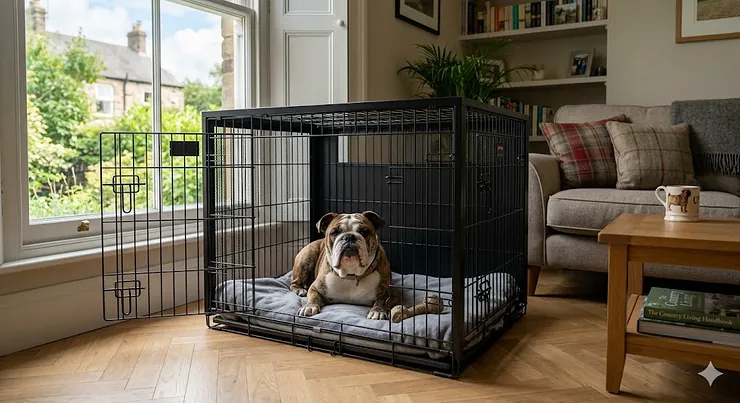
When you’re choosing a crate for your bulldog, the spec sheet might list “wire construction” or “ventilation holes” — but what your dog actually experiences inside is quite different from those clinical descriptions. English Bulldogs, French Bulldogs, and other brachycephalic breeds don’t regulate heat the way a Labrador or Collie does. Their compressed airways mean they’re already working harder with every breath, and a poorly ventilated crate can transform from a safe den into a genuine health risk in under an hour.
The challenge with bulldog crate breathability features isn’t just about having airflow — it’s about having the right kind of airflow in sufficient quantity, positioned correctly, and maintained regardless of how you’ve positioned the crate in your home. A crate with excellent side ventilation becomes a liability the moment you push it against a wall. One with only top vents won’t help when you’ve draped a blanket over it to reduce anxiety. What British bulldog owners need is a ventilation system that works even when you’re not thinking about it, because overheating in brachycephalic dogs can escalate from “uncomfortable” to “emergency vet visit” whilst you’re simply making a cup of tea.
In this guide, we’ll examine seven crates available on Amazon.co.uk that genuinely prioritise breathability for bulldogs. More importantly, we’ll explain what each design choice means for your dog’s actual comfort in a British home — where central heating can turn a November living room into a furnace, and summer means unpredictable humidity spikes rather than reliable heat waves. By the end, you’ll know exactly which ventilation features matter, which are marketing fluff, and how to match the right crate to your specific bulldog’s needs.
Quick Comparison Table
| Crate Model | Wire Spacing | Ventilation Score | Price Range (£) | Best For |
|---|---|---|---|---|
| MidWest iCrate Double Door | 5cm grid pattern | Excellent (360°) | £45-£70 | All-round breathability |
| Amazon Basics Wire Crate | 4.5cm standard | Very Good | £30-£50 | Budget-conscious buyers |
| Ellie-Bo Medium Standard | 4mm thick bars | Excellent | £35-£55 | UK-made reliability |
| MidWest Ultima Pro | Heavy-gauge 6mm | Very Good | £80-£120 | Anxious bulldogs |
| Yaheetech Double Door | Standard grid | Good | £25-£45 | First-time owners |
| New World Folding Crate | 5cm spacing | Very Good | £40-£65 | Frequent travellers |
| EliteField Soft Crate | Full mesh panels | Excellent | £35-£60 | Lightweight portability |
From the comparison above, wire spacing matters less than total ventilated surface area — a crate with 4mm bars spaced at 5cm intervals provides better airflow than one with 6mm bars at 3cm spacing, simply because there’s more open area. For British bulldogs dealing with our damp climate, you’ll also want to consider rust resistance in the wire coating, as condensation from your dog’s panting can accumulate surprisingly quickly in a poorly ventilated space.
💬 Just one click — help others make better buying decisions too!😊
Top 7 Bulldog Crates: Expert Analysis
1. MidWest iCrate Double Door Folding Crate
The MidWest iCrate has earned its reputation as the go-to choice for brachycephalic breeds, and it’s readily available on Amazon.co.uk with Prime delivery. The 76cm (30-inch) model suits most English Bulldogs perfectly, whilst the 91cm (36-inch) version accommodates larger specimens or those who prefer sprawling out.
What sets this crate apart for bulldogs is the complete 360-degree wire construction — every single panel is ventilated mesh, meaning airflow isn’t dependent on crate orientation. Position it against a wall, tuck it under a staircase, or place it in a corner, and your bulldog still benefits from cross-ventilation. The wire spacing sits at roughly 5cm intervals, which provides excellent visibility and air movement whilst still preventing paws from getting stuck. In British homes with radiators, this matters tremendously — heat rises and pools against walls, and a crate with solid panels traps that warmth right where your dog sleeps.
The dual-door design (front and side access) proves particularly useful for managing airflow. During cooler months, you can position the crate so the side door faces away from draughts. Come summer, rotate it so both doors catch any cross-breeze from open windows. UK buyers should note this crate ships with a leak-proof plastic tray that’s genuinely easy to slide out for cleaning — important when your bulldog has drooled through a hot afternoon.
Customer feedback from UK Amazon reviews consistently praises the crate’s sturdiness. One reviewer in Manchester noted their English Bulldog slept through an entire heatwave in August 2025 without distress, crediting the “brilliant airflow from all sides.” Another in Bristol mentioned the powder-coated finish has held up well to three years of British damp without rusting.
Pros:
✅ Complete 360° ventilation regardless of placement
✅ Dual doors optimise airflow positioning
✅ Leak-proof tray simplifies drool management
Cons:
❌ Larger 91cm model can dominate smaller UK living rooms
❌ Wire spacing allows bedding to slip through gaps
Price: Around £45-£70 depending on size — excellent value considering the ventilation engineering. For a bulldog owner in the UK dealing with unpredictable weather, this represents the safest all-season investment.
2. Amazon Basics Metal Wire Dog Crate
The Amazon Basics Wire Crate (76cm medium size) might seem like the budget compromise, but for bulldog breathability, it punches well above its price point. Available on Amazon.co.uk typically in the £30-£50 range, this crate uses a 4.5cm wire grid that provides marginally tighter spacing than the MidWest — theoretically reducing airflow, but in practice the difference is negligible for a resting bulldog.
Where this crate excels is reliability. It’s manufactured to consistent specifications, and the single-door model (cheaper) or double-door variant (around £10 more) both feature identical wire density on all panels. What you sacrifice compared to premium options is the wire gauge thickness — these are thinner bars that can flex slightly under pressure. For a bulldog, that’s rarely an issue unless you’ve got an escape artist, but it does mean the crate feels less substantial when you’re setting it up.
The ventilation story here is straightforward: it’s a wire box. Air moves through it. There are no clever engineering tricks, no optimised panel angles, just honest-to-goodness mesh construction. For a British bulldog living in a temperature-controlled home, this simplicity is often enough. The crate doesn’t claim to be revolutionary; it claims to be functional, and it delivers.
UK customer reviews mention the included divider panel as surprisingly useful — you can section off part of the crate during colder months to create a cosier den whilst maintaining ventilation on three sides. One reviewer in Leeds noted their French Bulldog “never overheated once” during a summer with the crate positioned near a fan, though they emphasised the importance of not covering it with blankets.
Pros:
✅ Exceptional value for money at under £50
✅ Consistent wire spacing across all panels
✅ Divider panel allows seasonal space adjustment
Cons:
❌ Thinner wire gauge less suitable for anxious chewers
❌ Single-door model limits airflow positioning options
Price: Typically in the £30-£50 range on Amazon.co.uk — if you’re confident your bulldog won’t test the structural limits and you simply need reliable ventilation without frills, this is the sensible choice.
3. Ellie-Bo Medium Standard Two-Door Crate
Since 2004, Ellie-Bo has been manufacturing dog crates specifically for the UK market, and their understanding of British homes shows in the design details. The medium 76cm (30-inch) model, available on Amazon.co.uk around £35-£55, is explicitly listed as suitable for Bulldogs, which means they’ve actually considered the breed’s ventilation needs rather than just copying American specifications.
The wire construction uses 4mm thick bars — noticeably sturdier than budget options — and the spacing is optimised for what Ellie-Bo calls “maximum visibility and airflow.” In practice, this translates to roughly 5cm gaps that allow your bulldog to see out clearly (reducing anxiety) whilst ensuring constant air circulation. The powder-coated finish is specifically tested for UK humidity levels, which matters when you’re dealing with a breed that pants heavily and creates condensation.
What British owners particularly appreciate is the included training guide written for UK conditions. It addresses concerns like crate placement near radiators (common in British homes, less so in American ones with central air), managing draughts from sash windows, and adjusting ventilation for our mild but damp climate. The metal tray is described as “chew-proof,” which for bulldogs primarily means drool-proof — the seamless design prevents moisture accumulating in corners.
Customer reviews from UK buyers highlight the crate’s collapsibility as genuinely tool-free, unlike some competitors that require pliers despite claims otherwise. One Scottish reviewer mentioned using it for a Staffordshire Bull Terrier (similar build to English Bulldogs) and noted “never once worried about overheating, even in the car boot during summer trips to the Highlands.”
Pros:
✅ UK-designed for British climate and housing
✅ Robust 4mm wire resists bending and wear
✅ Powder coating tested specifically for UK humidity
Cons:
❌ Slightly heavier than equivalent imports when collapsed
❌ Availability can be inconsistent on Amazon.co.uk during peak seasons
Price: Around £35-£55 on Amazon.co.uk — for a UK-made crate that genuinely understands British bulldogs and British homes, this represents excellent value and supports a British family business.
4. MidWest Ultima Pro Triple-Door Crate
The MidWest Ultima Pro is what happens when you design a crate for dogs that really, really want out — and in the process, you accidentally create exceptional ventilation. Available on Amazon.co.uk in the £80-£120 range depending on size, this crate uses 6mm heavy-gauge wire that’s primarily marketed for anxious or destructive dogs, but the engineering choices benefit bulldogs tremendously.
The triple-door configuration (front, side, and top access) sounds excessive until you realise what it means for airflow management. You can open the top panel on warm days to create natural chimney-effect ventilation — hot air rises and escapes through the top whilst cooler air is drawn in through the lower panels. For a brachycephalic breed that generates significant body heat from laboured breathing, this passive cooling is invaluable. During British winters, you simply keep the top door closed and use the front/side access normally.
The wire spacing is tighter than the standard iCrate — around 4cm intervals — which some might assume reduces breathability. In reality, the heavier gauge wire creates more rigid structure, preventing the walls from flexing inward and actually maintaining more consistent air gaps. UK reviewers note the crate “feels bombproof,” which for a 25kg English Bulldog means it won’t shift or rattle when they turn over at night, reducing anxiety-driven panting that exacerbates breathing issues.
What you’re paying extra for here isn’t just ventilation — it’s peace of mind. The Ultima Pro won’t fail. It won’t bend. If your bulldog has separation anxiety that leads to overheating from stress-panting, this crate’s ability to withstand pressure without compromising ventilation could prevent a vet visit. One London reviewer specifically mentioned their French Bulldog with BOAS (Brachycephalic Obstructive Airway Syndrome) sleeps noticeably more peacefully in this crate compared to their previous wire model, attributing it to “better airflow and less crate movement.”
Pros:
✅ Triple-door design enables advanced airflow management
✅ Heavy-gauge construction maintains consistent ventilation
✅ Top-access panel creates chimney-effect cooling
Cons:
❌ Significantly more expensive than standard wire crates
❌ Heavier weight (around 15kg for the 91cm model) complicates moving
Price: In the £80-£120 range on Amazon.co.uk — this is specialist equipment for bulldogs with breathing difficulties or anxiety issues where ventilation directly impacts health, not just comfort.
5. Yaheetech Double Door Folding Wire Crate
The Yaheetech range represents the budget segment done competently. Available on Amazon.co.uk typically between £25-£45, the 76cm (30-inch) double-door model provides adequate ventilation for bulldogs in controlled environments. The wire spacing is standard — around 5cm intervals — and the construction is exactly what you’d expect at this price point: functional but unremarkable.
Where Yaheetech crates find their niche is first-time bulldog owners who aren’t sure yet what features they’ll actually need. The breathability is sufficient for a dog sleeping in a temperate room with some ambient air circulation. It’s not engineered for extreme conditions, and the thinner wire gauge (approximately 3.5mm) means panels can flex slightly, potentially reducing ventilation efficiency if the crate is bumped or shifted.
What UK buyers should know is that “adequate” ventilation for a bulldog means something quite specific. This crate will work fine in autumn and spring when ambient temperatures hover around 15-18°C. During a British “heatwave” (anything above 25°C), you’ll need to supplement with active cooling — a fan positioned near (not directly at) the crate, or moving it to the coolest room in the house. Winter presents the opposite concern: the all-wire construction provides too much ventilation in draughty Victorian houses, requiring a breathable cover to prevent chilling without blocking airflow entirely.
Customer feedback from UK Amazon reviewers is practical rather than enthusiastic. Multiple mentions of “does the job,” “good starter crate,” and “fine for the price” — hardly ringing endorsements, but honest assessments. One Birmingham reviewer noted their English Bulldog had no overheating incidents during a moderate summer, but they were “always conscious of room temperature” in a way they hadn’t been with a more premium crate.
Pros:
✅ Low entry price for testing crate training with bulldogs
✅ Double-door configuration aids initial airflow positioning
✅ Widely available on Amazon.co.uk with quick delivery
Cons:
❌ Thinner wire gauge may flex and reduce ventilation efficiency
❌ Requires more active monitoring of ambient temperature
Price: Around £25-£45 on Amazon.co.uk — if you’re new to bulldogs and crates, this is a reasonable starting point, but plan to upgrade if your dog shows any heat sensitivity.
6. New World Folding Metal Dog Crate
The New World crate, manufactured by MidWest under a different brand label, offers near-identical ventilation to the standard iCrate at a slightly lower price point. Available on Amazon.co.uk around £40-£65 for the 76cm model, this represents the “same factory, different badge” scenario that savvy UK buyers can exploit.
The wire construction uses the same 5cm spacing and similar gauge thickness to the MidWest iCrate, providing equivalent 360-degree breathability. The dual-door design is functionally identical. Where New World distinguishes itself is weight — it’s marginally lighter (by perhaps 500g) due to slightly thinner corner reinforcements, which makes it more portable but fractionally less rigid when assembled.
For British bulldogs, the ventilation performance is indistinguishable from the MidWest equivalent in real-world use. Your dog won’t notice the difference. What matters is whether you value the marginal cost saving (typically £5-£15 less than the iCrate) or prefer the established brand reputation. UK customer reviews often compare the two directly, with most concluding “essentially the same crate for less money.”
The leak-proof tray is marketed as “enhanced security,” which for bulldogs means it’s designed to contain drool and prevent it escaping under the crate edges — a consideration if you’ve got carpet or wooden floors. One Edinburgh reviewer specifically praised this feature, noting their English Bulldog is a “champion drooler” and the tray has prevented floor damage for two years.
Pros:
✅ Near-identical ventilation to MidWest iCrate at lower cost
✅ Marginally lighter weight aids portability
❌ Slightly less rigid corner construction
❌ Brand recognition lower than MidWest for resale value
Price: Around £40-£65 on Amazon.co.uk — functionally equivalent to the MidWest iCrate but less expensive, making it the smart choice for value-focused buyers who understand it’s the same factory producing both.
7. EliteField Soft-Sided Three-Door Crate
The EliteField soft crate challenges conventional wisdom about bulldogs needing wire crates. Available on Amazon.co.uk around £35-£60 for the large model, this uses mesh panels on all six sides (yes, including the base and top) to create what’s essentially a breathable fabric box supported by a flexible steel frame.
For bulldog breathability, the mesh provides superior airflow compared to even wide-spaced wire — every square centimetre is permeable. The three-door configuration (front, side, and top) means you can position the crate for optimal air circulation and still access your dog easily. During hot weather, you can unzip the top panel entirely, converting it into an open-topped pen with maximum ventilation whilst maintaining the den-like security on three sides.
The challenge with soft crates for bulldogs isn’t breathability — it’s durability. These are designed for gentle, crate-trained dogs, not anxious chewers. An English Bulldog who decides the mesh looks interesting can create an escape hole in under five minutes. However, for bulldogs who are reliably calm in crates, the ventilation benefits are significant. The mesh doesn’t conduct heat the way metal does, meaning it won’t radiate warmth from nearby radiators. UK buyers appreciate that soft crates don’t develop the cold-to-touch chill that wire crates get in draughty rooms.
What makes EliteField particularly suitable for British bulldogs is portability. At around 2kg fully assembled, you can move this crate between rooms effortlessly to follow the coolest spots in your home throughout the day. One Surrey reviewer mentioned rotating their French Bulldog’s crate from the kitchen (coolest in mornings) to the living room (cooler in afternoons) to the bedroom (coolest at night) during a summer heatwave, something impractical with a 12kg wire crate.
Pros:
✅ Maximum breathability from complete mesh construction
✅ Ultra-lightweight enables repositioning for optimal cooling
✅ Mesh doesn’t conduct heat from radiators or cold from draughts
Cons:
❌ Unsuitable for bulldogs who chew or scratch at crate walls
❌ Less structured — won’t contain a determined escape artist
Price: Around £35-£60 on Amazon.co.uk — if your bulldog is crate-trained and calm, this provides the absolute best ventilation in the lightest, most portable package available.
How Bulldogs Regulate Heat (And Why It Matters for Crate Choice)
Here’s what the breed guides don’t always make clear: your bulldog isn’t just “a bit worse” at cooling down than other dogs. They’re fundamentally compromised in ways that make crate ventilation a genuine health consideration rather than a comfort preference. English Bulldogs, French Bulldogs, and Pugs have been bred for appearance characteristics — flattened faces, shortened snouts, compressed nasal passages — that make breathing harder even under ideal conditions.
When a Labrador overheats, they pant more rapidly, drawing air across their tongue and through their nasal passages to evaporate moisture and shed heat. This is remarkably effective: a healthy Labrador can regulate body temperature in ambient conditions up to about 28°C before showing serious distress. Your bulldog, with nasal passages perhaps half the size, can only move half the air. They’re working twice as hard to achieve half the cooling, and the physical exertion of panting itself generates more body heat. The RSPCA notes that for many brachycephalic dogs, breathing is a chronic struggle—they snort, snore, gag, and gasp even when resting.
In a poorly ventilated crate, this becomes a vicious cycle. Your bulldog gets slightly warm. They pant to cool down. The panting generates heat and humidity. The humidity raises the effective temperature inside the crate. They pant harder. More heat. More humidity. Within 20-30 minutes, what started as mild discomfort at 21°C can escalate to genuine distress at an effective temperature of 26-27°C inside the crate, even though your room thermostat still reads 21°C.
This is why wire spacing and total ventilated area matter so much for brachycephalic breeds. A crate with solid panels on two sides might work perfectly for a Springer Spaniel — they can pant effectively and the reduced ventilation simply means they’re slightly warmer. For a bulldog, those solid panels can mean the difference between comfortable sleep and a trip to the emergency vet. When you’re choosing a crate, you’re not just picking furniture — you’re choosing a respiratory support system.
UK vets particularly emphasise this because our climate creates false confidence. British temperatures rarely soar to the extremes that make American owners vigilant about heat, but our humidity is often higher, and humidity is what actually kills. Research from the Royal Veterinary College found that the median ambient temperature for heat-related illness in UK dogs was just 16.9°C — what most of us would consider a pleasant spring day. A damp 22°C British afternoon with 80% humidity feels worse to a bulldog than a dry 25°C California day at 40% humidity, because their panting can’t evaporate moisture effectively when the air is already saturated. Your crate needs ventilation that works in British weather conditions, not just specification sheet conditions.
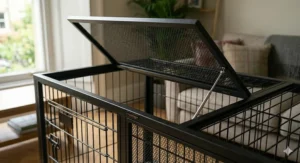
Common Mistakes When Buying Crates for Bulldogs in the UK
The first mistake is treating the crate size guide as gospel. Those charts that say “30-inch crate for 25-40 lb dogs” were written for leggy, proportional breeds. Your 25kg English Bulldog is barrel-shaped, not greyhound-shaped. They need length for sprawling (bulldogs love spreading out to dissipate heat through body contact with cool surfaces) and height for sitting up without their head touching the ceiling (which restricts airflow around their face).
When UK buyers measure their bulldog and order “one size up” from the chart recommendation, they’re often still undersizing. That 76cm (30-inch) crate that should theoretically fit your 23kg English Bulldog? In practice, it forces them into a curled position that compresses their already-compromised airways. The 91cm (36-inch) model gives them space to fully extend, reducing respiratory effort and improving ventilation around their body. This isn’t about luxury — it’s about physiology.
The second mistake is impulse-buying crate covers without understanding their impact on breathability. Yes, covers reduce anxiety for many dogs by creating a den-like environment. Yes, they can help with crate training. But a thick blanket draped over your perfectly ventilated wire crate transforms it into a greenhouse. UK buyers seem particularly prone to this during winter, reasoning that “it’s cold, my dog needs warmth,” without recognising that bulldogs overheat far more easily than they chill.
If you must use a cover, it needs to be specifically designed for breathability — cotton canvas or cotton-linen blend, never polyester or fleece. Leave at least one full side uncovered to maintain cross-ventilation. Better yet, invest in a cover with mesh windows or rollable panels that you can adjust seasonally. Several UK reviewers on Amazon have mentioned discovering their bulldog’s “breathing problems” were actually overheating caused by well-meaning but misguided blanket usage.
The third mistake is positioning. You’ve bought a brilliant, fully ventilated crate. Then you push it against a wall, under a staircase, or into a corner because that’s where it fits aesthetically in your British Victorian terrace. Congratulations — you’ve just blocked 50% of the ventilation. Wire crates need clearance on at least two sides (ideally three) to maintain airflow. If space is genuinely limited, choose which two sides will remain open and orient the crate accordingly.
British homes, particularly older properties, have additional positioning challenges. Radiators along external walls are standard, but placing a crate near one creates a heat trap. Draughty sash windows seem ideal for ventilation until you realise that in January, that draught is 4°C air that can chill a wet bulldog fresh from drinking. The ideal position is away from direct heat sources, away from draughts, with clear space on multiple sides — which in a typical British living room leaves you with approximately one viable location. Plan this before buying the crate.
Understanding Wire Spacing and Airflow Physics
Let’s talk about why a 5cm wire grid moves more air than a 3cm grid, even though logically you’d think smaller gaps would channel airflow better. It’s about resistance. When air moves through an opening, it experiences friction against the edges. More bars mean more edges mean more friction. A crate with 5cm spacing has fewer bars, fewer edges, less resistance, and consequently better total airflow even though each individual gap is the same size.
The wire gauge thickness matters too, in ways that aren’t immediately obvious. Thicker wire (like the 6mm bars on the MidWest Ultima Pro) retains and radiates heat differently than thinner 3.5mm wire on budget models. In a British centrally heated home, this creates microclimates. Thicker wire warms up from ambient room heat and radiates that warmth inward slightly. Thinner wire remains closer to ambient temperature. For a bulldog who’s already overheating from inadequate panting, that extra radiated warmth from thick wire can be the tipping point.
However, thick wire also maintains structural rigidity better, preventing the crate walls from flexing when your dog moves. A flexing wall temporarily reduces the effective ventilation area — imagine pushing in on a wire fence; the gaps narrow. Thin wire flexes more, thick wire less. For a restless bulldog who shifts position frequently at night, thick wire maintains more consistent ventilation. There’s no perfect answer; it’s a trade-off between thermal mass and structural stability.
The powder coating adds another variable. Quality powder coating (like that used on Ellie-Bo and MidWest crates) is applied in a thin, even layer that doesn’t significantly affect the wire’s thermal properties. Cheap powder coating can be thicker and uneven, creating spots that retain heat. You’ll notice this if you touch the crate after it’s been near a radiator — quality coating feels uniformly warm, cheap coating has hot spots. For a bulldog pressed against the bars, hot spots create local overheating even if the overall crate temperature is acceptable.
UK buyers should specifically consider rust resistance in powder coating. Our climate is damp. Your bulldog pants heavily, creating condensation. Over months and years, moisture exposure will corrode poorly coated wire, creating rough spots that snag fur and eventually compromising structural integrity. Crates designed for the UK market (like Ellie-Bo) or those from manufacturers with experience in humid climates (like MidWest, whose US market includes humid states) use rust-resistant coating formulations. Cheaper imports from dry-climate regions often don’t, and you’ll discover this when the crate develops orange spots after six months in a British home.
Crate Positioning for Maximum Breathability in UK Homes
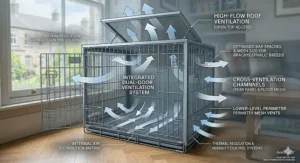
British houses are brilliantly designed for keeping rain out and heat in, which unfortunately creates challenges for bulldog crate ventilation. Your typical Victorian terrace, Edwardian semi, or modern new-build all share common features: external walls with radiators, internal walls without significant airflow, and windows positioned more for light than ventilation. Here’s how to work with (not against) this architecture.
First, avoid external walls during winter. Yes, the radiator seems like it would keep your bulldog cosy. In practice, it creates a 26-28°C microclimate right where they sleep, whilst the room overall remains a comfortable 19°C. Your thermostat says everything’s fine; your bulldog is quietly overheating. Position the crate on an internal wall, at least 1.5 metres from any radiator. During British winters, the ambient room temperature will be adequate without needing radiated heat.
Second, utilise natural convection. Hot air rises, cool air sinks. If you’ve got a two-storey home, the coolest sleeping spot for a bulldog is often the ground floor, even if you’d prefer them upstairs in the bedroom. Heat accumulates upstairs in British homes because our staircases act as chimneys. A bulldog crate on the landing of a Victorian terrace can be 3-4°C warmer than an identical crate downstairs, simply due to rising heat from the ground floor radiators.
Third, consider seasonal rotation. This sounds excessive until you live through a British summer with a brachycephalic breed. In June-August, that north-facing room you never use because it’s too cold nine months a year suddenly becomes the ideal crate location. It stays 2-3°C cooler than south-facing rooms, which for a bulldog is the difference between comfortable and distressed. Moving the crate seasonally isn’t neurotic — it’s practical thermal management.
For flats and maisonettes, you’re often limited to a single room. Here’s where crate choice becomes critical. If you can’t move the crate away from heat sources, you need a design with maximum ventilation to compensate. The EliteField mesh crate works brilliantly in confined spaces because mesh doesn’t conduct heat the way wire does. Alternatively, the MidWest Ultima Pro’s top-opening panel lets you create vertical airflow that helps mitigate proximity to radiators.
One final British-specific consideration: room doors. We habitually close doors between rooms to manage heating efficiency. This destroys cross-ventilation. If your bulldog’s crate is in a room with a closed door, you’ve created a sealed environment where their panting raises humidity without any escape route. Either keep the door ajar (using a draft excluder at the base to maintain heating efficiency) or install a simple vent grille in the door. This is particularly important in bedrooms overnight — a closed bedroom with a panting bulldog can reach 70%+ humidity by morning.
Why Plastic Crates Are Dangerous for Bulldogs (Usually)
Walk into any British pet shop and you’ll see IATA-approved plastic travel crates marketed for “security and comfort.” These work perfectly for most breeds. For bulldogs, they’re often disasters waiting to happen, and understanding why saves you from expensive mistakes.
Plastic crates have ventilation holes, certainly — usually a grid of 1-2cm diameter holes punched around the perimeter and sometimes in the door. The total ventilated area in a medium plastic crate is typically 15-20% of the surface area. A wire crate of equivalent size has 70-80% ventilated area. That 50-60% difference is the distinction between adequate airflow and suffocation risk for a brachycephalic breed.
The plastic itself creates additional problems. Unlike wire, plastic is an insulator. It doesn’t conduct heat away; it traps it. On a warm British summer day (say, 24°C ambient), the interior of a plastic crate can be 28-30°C within 30 minutes if there’s no active airflow, simply from your dog’s body heat and respiration. Wire crates don’t insulate, so they remain much closer to ambient temperature.
But here’s the nuance: plastic crates aren’t universally terrible for bulldogs. If you’re using one for air travel (where it’s legally required), the key is active management. Don’t place the crate in direct sun. Don’t leave it in a stationary car. Don’t cover it with blankets. Position it where ambient air can circulate through those ventilation holes. For a 30-minute car journey to the vet in spring or autumn, a plastic crate is adequate. For overnight sleeping in your living room, it’s entirely inappropriate.
UK buyers sometimes choose plastic crates because they’re marketed as “weatherproof” for outdoor use. This logic is backwards for bulldogs. Yes, plastic sheds rain, but your bulldog doesn’t need to be outside in rain in a crate. They need to be indoors with proper ventilation. If you’re using a crate outdoors (say, in a garden whilst you’re gardening), wire is more suitable because it provides better airflow in already-humid British weather.
The one scenario where plastic makes sense for bulldogs in the UK is noise reduction. Plastic dampens sound better than wire, which benefits noise-sensitive dogs. If your bulldog has genuine noise phobia (fireworks, thunderstorms) and you need to reduce auditory stimulation, a plastic crate with supplemental cooling (a small USB fan directed at the ventilation holes) can work as a temporary solution. But even then, you’re compromising breathability for acoustic management — make that trade-off knowingly.
Heat Regulation Accessories That Actually Help
You’ve bought the perfect wire crate with excellent ventilation. Now you want to optimise it further. Some accessories genuinely help bulldog heat regulation; others are marketing ploys that waste money or actively make things worse.
Cooling mats are the single most effective accessory. These are gel-filled pads that activate when pressed, creating a surface 5-10°C cooler than ambient temperature. Place one in the crate and your bulldog gets instant contact cooling for their belly — the area with the least fur and best heat transfer. British buyers should choose cooling mats designed for damp climates (look for waterproof covers), as condensation from the cold surface plus bulldog drool creates a puddle situation with cheaper models. The British Veterinary Association emphasises that adequate ventilation and cooling measures are essential for heat-prone breeds during British summers.
The mistake people make is covering the entire crate floor with cooling mat. This prevents your dog from choosing — some bulldogs want coolness, others just want comfortable. Split the crate floor: cooling mat on one half, regular bedding on the other half. Your bulldog will self-regulate by moving between zones, which is healthier than forcing them onto a cold surface when they don’t need it.
Crate fans are controversial. Small clip-on fans designed to attach to wire crates can improve air circulation, and on moderately warm days (22-26°C), they make a noticeable difference. But they’re not magic. If your room is 28°C, the fan is circulating 28°C air, which doesn’t cool your dog much — it just prevents that air from becoming stagnant and even hotter from their body heat. Think of crate fans as breathability enhancers, not air conditioning replacements.
UK-specific consideration: battery-powered crate fans eat batteries alarmingly fast. One reviewer calculated their battery costs over a summer exceeded the cost of the fan itself. Rechargeable USB fans are more economical, but then you need access to power near the crate. Weigh convenience against running costs before buying.
Raised crate beds sound counterintuitive — won’t elevation reduce contact cooling? Actually, they create airflow underneath your dog, preventing heat accumulation between their body and the crate floor. This matters particularly in wire crates where the plastic tray can absorb and radiate heat. A simple mesh-fabric raised bed (around £15-£25 on Amazon.co.uk) creates a 2-3cm air gap that maintains cooling without preventing contact cooling through the mesh. Your bulldog gets the best of both options.
What doesn’t help: Frozen water bottles placed in the crate. These create localised cold spots that bulldogs either avoid (making them useless) or press against too enthusiastically (risking localised hypothermia and condensation messes). Ice packs in towels have the same problem. Evaporative cooling towels sound promising but require the dog to wear them, which most bulldogs tolerate for about four minutes before removing. Misting systems just increase humidity in an already-humid British climate. Save your money.
Seasonal Ventilation Adjustments for British Climate
British weather isn’t just unpredictable — it’s schizophrenic. A March day can start at 6°C, reach 17°C by afternoon, drop to 9°C by evening, and hover at 12°C overnight. Your bulldog’s crate ventilation needs to adapt to these swings without requiring you to rebuild the setup every six hours.
Spring and autumn are the challenging seasons. Daytime temperatures are often perfect (15-18°C), but overnight chilling can drop to 8-10°C. A wire crate positioned for excellent daytime ventilation becomes a draughty cold box by 3 AM. The solution isn’t to cover the crate entirely — it’s to use breathable, repositionable covers.
Cotton canvas crate covers with rollable panels work brilliantly here. Roll up three sides during the day for maximum ventilation. At night, roll down two sides (leaving front and one side open) to reduce draughts without blocking airflow. This maintains the 50% ventilated surface area your bulldog needs whilst preventing direct exposure to cold air circulation. UK buyers should specifically choose covers with moisture-wicking properties — cotton naturally absorbs humidity from your dog’s breathing and releases it into the room, preventing that clammy dampness that cheaper polyester covers trap.
Summer (June-August) is when breathability becomes critical. British summer temperatures rarely exceed 28°C, but humidity often hits 70-80%, and this combination is what stresses brachycephalic breeds. According to UK veterinary research, French Bulldogs can start overheating at temperatures as low as 21°C — a pleasant late spring day that wouldn’t concern most dog owners. Your crate needs maximum ventilation, but direct sun exposure through windows can create greenhouse effects even with full wire construction.
The positioning trick is to use reflective surfaces nearby. A white wall or light-coloured furniture adjacent to the crate reflects heat rather than absorbing it. Dark furniture or walls near the crate can raise local temperature by 2-3°C through radiated heat. If your crate must be near a window, position it perpendicular to the window (so sun hits one side) rather than facing it (so sun hits the front and heats the interior). Even better, use a light-filtering blind on the window to diffuse direct sun whilst maintaining brightness.
Winter (November-February) creates false confidence. Surely your bulldog is more comfortable in winter? Actually, British central heating creates the opposite problem. Your living room might be a comfortable 20°C for humans, but that’s because you’re wearing clothes. Your naked-skinned bulldog is experiencing that 20°C plus radiated heat from nearby radiators, creating an effective 24-26°C microclimate around their crate.
Winter ventilation strategy is about managing heat sources rather than promoting airflow. Keep the crate at least 2 metres from any radiator. If that’s impossible due to room layout, use a radiator reflector panel (those silvery bubble-wrap sheets designed to reduce heat loss through walls) positioned between the radiator and crate to deflect radiated heat. This maintains your heating efficiency whilst protecting your bulldog from localised overheating.
One uniquely British consideration: underfloor heating. Increasingly common in new-builds and renovations, it creates invisible heat sources that steadily warm whatever sits above them — like your bulldog’s crate. The wire construction that provides excellent ventilation does nothing to mitigate heat rising from below. If you have underfloor heating, you must use a raised crate bed or place an insulating layer (like a cork mat) under the crate. Otherwise, you’re effectively cooking your bulldog from underneath whilst congratulating yourself on excellent ventilation.
FAQ
❓ Can I use a crate cover on a bulldog's wire crate during British winters?
❓ What's the minimum wire crate size for an English Bulldog in the UK?
❓ Are mesh soft crates suitable for French Bulldogs in UK summer?
❓ Do I need a crate fan for my bulldog in the UK?
❓ How can I tell if my bulldog's crate has inadequate ventilation?
Conclusion
Choosing bulldog crate breathability features in the UK means understanding that you’re not buying furniture — you’re selecting a respiratory support system for a dog whose breathing is compromised by design. The flattened faces that make bulldogs adorable also make them vulnerable to overheating in conditions that barely register for other breeds. A 22°C British afternoon might seem mild to you, but for your English or French Bulldog struggling to move air through compressed nasal passages, it’s the threshold where comfort tips into distress.
The crates we’ve examined — from the MidWest iCrate’s reliable 360-degree ventilation to the EliteField’s maximum-breathability mesh construction — all recognise this fundamental truth: bulldog crates must prioritise airflow above all else. Size matters, but not for the reasons typical breed charts suggest. Your bulldog needs space to sprawl for heat dissipation and room to sit upright without airflow restriction around their face. Wire spacing, gauge thickness, and total ventilated area combine to create (or destroy) the air circulation that keeps your dog safe.
British conditions add unique challenges. Our damp climate demands rust-resistant coatings. Our centrally heated homes create hidden heat traps near radiators. Our weather’s unpredictability requires ventilation solutions that work equally well at 8°C in March and 26°C in July. The crates designed for the UK market (like Ellie-Bo) or tested in humid climates (like MidWest and Amazon Basics) understand these requirements in ways that generic imports often don’t. The UK Government’s Animal Welfare Act 2006 places a legal duty of care on all animal owners to provide suitable environments for their pets.
If you take one thing from this guide, let it be this: adequate ventilation for a bulldog is non-negotiable. Compromise on brand, on price, on aesthetics — but never on breathability. Your bulldog’s laboured breathing is already asking their body to work harder than nature intended. The least we can do is ensure their crate doesn’t make that job even harder.
Recommended for You
- 7 Best Staffordshire Bull Terrier Crates UK 2026
- 7 Best Beagle Proof Dog Crates UK: Expert Guide 2026
- 7 Best Springer Spaniel Crate Amazon UK Options 2026
Disclaimer: This article contains affiliate links. As an Amazon Associate, I earn from qualifying purchases. If you purchase products through these links, we may earn a small commission at no additional cost to you.
✨ Found this helpful? Share it with your mates! 💬🤗
