
In This Article
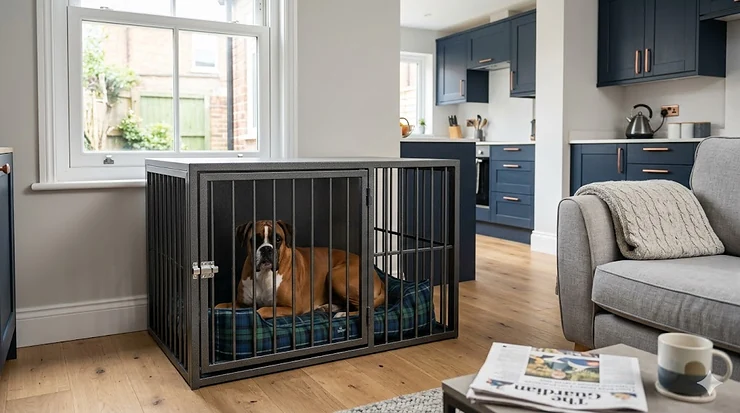
Let me guess: you’ve already been through at least one flimsy wire crate that your Boxer somehow managed to bend, rattle, or outsmart within a fortnight. If you’re reading this, you’ve likely learned the hard way that boxers aren’t your average crate-dwelling canines. These muscular, clever bundles of energy require something rather more robust than the standard £40 Amazon special.
Boxers are extraordinary dogs—playful, loyal, and endlessly entertaining. They’re also incredibly strong, weighing between 23-32 kg and standing 53-63 cm tall at the shoulder. What most first-time Boxer owners don’t realise is that these dogs possess remarkable jaw strength and a surprising talent for problem-solving when motivated. A typical boxer can exert around 230 PSI of bite force—not quite mastiff territory, but more than enough to make short work of inferior latches and thin wire mesh.
The British climate adds another layer of complexity. Our perpetual drizzle means crates need rust-resistant coatings that actually work, not just marketing promises. British homes—particularly terraced houses and flats—often have limited space, making collapsible designs and compact storage essential. And let’s not forget UK regulations: under the Highway Code Rule 57, your dog must be suitably restrained in vehicles, which means your crate needs to be genuinely secure, not just decorative.
This guide examines seven genuinely heavy duty crates available on Amazon.co.uk that can withstand a determined boxer’s enthusiasm. We’ve researched real products with UK availability, considered British living conditions, and focused on what actually matters when you’re dealing with a 30 kg dog who treats crate time like an escape room challenge.
Quick Comparison: Top Heavy Duty Crates at a Glance
| Crate Model | Size | Price Range | Key Strength | Best For |
|---|---|---|---|---|
| MidWest iCrate Double Door | 107 x 71 cm | £70-£100 | Thick gauge wire, enhanced latches | Budget-conscious families |
| Yaheetech Heavy Duty Rolling | 106 x 68 x 85 cm | £110-£150 | 360° wheels, reinforced frame | Urban homes needing mobility |
| PawHut Heavy Duty with Wheels | 109 x 74 cm | £90-£130 | Rust-resistant coating, top door | Active households |
| Feandrea Heavy Duty XXL | 107 x 70 x 75 cm | £100-£140 | Double removable doors | Multi-dog families |
| BingoPaw Square Tube Crate | 104 x 74 cm | £120-£160 | Square tube construction | Persistent chewers |
| Amazon Basics Metal Crate XXL | 122 x 76 cm | £80-£120 | Leak-proof tray, single door | Larger boxers (over 30 kg) |
| Ellie-Bo Heavy Duty Deluxe | 106 x 71 cm | £85-£115 | 6mm thick bars | UK-designed for wet climate |
From this comparison, the Yaheetech and BingoPaw models offer the most robust construction for boxers with escape tendencies—their reinforced frames and enhanced locking systems justify the extra £20-£40 over budget options. However, if your boxer is well-adjusted and you simply need something sturdy for overnight crating, the MidWest iCrate represents excellent value at under £100. The key differentiator isn’t always price; it’s matching the crate’s security level to your dog’s determination level.
💬 Just one click — help others make better buying decisions too!😊
Top 7 Heavy Duty Crates for Boxer Dogs: Expert Analysis
1. MidWest iCrate Double Door Metal Crate
The MidWest iCrate remains the benchmark against which other crates are measured, and for good reason. This 107 x 71 x 77 cm crate features electro-coat finish that genuinely resists rust—essential in our damp British climate where garden-facing rooms can get rather moist during autumn and winter.
What sets this apart is the reinforced corner construction with rounded clips that prevent dogs from finding purchase points to bend or manipulate. The dual-door setup (front and side access) proves invaluable in British homes where space constraints often mean tucking the crate into awkward corners. The side door becomes a godsend when the front is against a wall. The divider panel allows you to adjust the internal space as your boxer puppy grows, eliminating the need to purchase multiple crates—rather sensible from both an environmental and financial perspective.
UK buyers consistently praise the leak-proof plastic tray, which slides out easily for cleaning. In practice, this matters more than you’d think: boxers occasionally have accidents during crate training, and a tray that actually contains liquid (rather than letting it seep through onto your carpet) saves considerable aggravation. The tray latches securely to prevent your clever boxer from dislodging it whilst rearranging their bedding at 3am.
Pros:
✅ Dual-door design suits awkward British room layouts
✅ Electro-coat finish withstands British humidity
✅ Divider panel grows with your puppy (saves £60-£80 on future crate purchases)
Cons:
❌ Standard wire thickness adequate but not overkill
❌ Single-bolt latches might need upgrading for determined escape artists
Price & Value: Around £70-£100 depending on offers. For boxers without severe separation anxiety or escape tendencies, this represents the sweet spot between durability and cost-effectiveness.
2. Yaheetech 42″ Heavy Duty Rolling Dog Crate
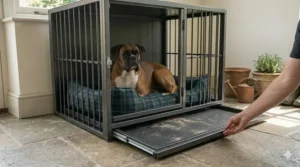
The Yaheetech Heavy Duty Crate addresses a specifically British problem: moving a 15 kg crate through narrow terraced house hallways whilst simultaneously preventing your boxer from “helping.” The four 360-degree swivel castors (two with locking brakes) transform this from static furniture into something properly mobile.
Construction employs 20-gauge steel with 8mm diameter wires and 1.6 cm square frame tubes—all powder-coated for waterproofing. In real terms, this means the frame won’t flex when your 28 kg boxer decides to reorganise their sleeping position at speed. The square tube frame also resists chewing better than round bars, as dogs struggle to get purchase on flat surfaces compared to cylindrical ones.
The open-top design initially seems counterintuitive until you realise how useful it is for UK homes. You can interact with your dog, drop treats, or adjust bedding without fumbling with latches. For boxers prone to anxiety in fully enclosed spaces, this semi-open design provides reassurance whilst maintaining security. UK reviewers note this particularly helps during the autumn-winter transition when dogs spend more time indoors and benefit from feeling less isolated.
The enhanced door latches require a specific motion to unlock—easy for humans, genuinely difficult for dogs. One UK buyer reported their boxer spent three weeks trying to crack the latch system before finally accepting defeat and settling into proper crate acceptance.
Pros:
✅ Castors make navigating British hallways and doorways manageable
✅ Square tube construction deters determined chewers
✅ Open-top design reduces anxiety in confined-space-nervous dogs
Cons:
❌ Heavier than standard crates (requires two people for initial positioning)
❌ Castors can mark wooden floors (protective mats recommended)
Price & Value: £110-£150 range. The mobility and reinforced construction justify the premium if you’re dealing with a strong boxer or frequently reorganise your living space.
3. PawHut 43″ Heavy Duty Metal Dog Kennel with Wheels
PawHut’s Heavy Duty Metal Kennel takes a slightly different approach with its powder-coated finish and dual tray system. The manufacturer specifically designed this for the UK and European markets, which shows in thoughtful touches like the 5cm bar spacing—narrow enough to prevent paws slipping through, wide enough for proper ventilation in our often-stuffy British homes.
The top and front door configuration works brilliantly for British households where the crate might serve double duty as an impromptu side table (with a board placed on top). The top door allows feeding and interaction without disturbing a resting dog, whilst the front door handles entry and exit. Both doors feature reinforced solder joints tested by multiple dog breeds, according to the manufacturer.
What UK buyers appreciate is the removable tray’s genuine leak-proof design. Unlike some budget competitors where “leak-proof” means “mostly contains liquid if you’re lucky,” PawHut’s tray actually holds water without seepage. This matters during the house-training phase when accidents happen at 4am and you’d rather not be scrubbing carpet fibres whilst half-asleep.
The crate includes a small feeding door—a feature that initially seems gimmicky until you’re actually using it. Daily feeding without opening the main door prevents your boxer from attempting a breakout every mealtime, which rather reduces the daily stress level for everyone involved.
Pros:
✅ Triple door system (top, front, feeding) offers exceptional flexibility
✅ Powder-coated finish genuinely resists rust in British damp
✅ Designed for UK/European market (proper sizing, ventilation for climate)
Cons:
❌ Assembly requires about 30 minutes (though instructions are clearer than most)
❌ Some UK reviewers report latches feeling slightly loose initially (tighten during assembly)
Price & Value: £90-£130. Strong mid-range option particularly suited to British climate and living conditions.
4. Feandrea Heavy Duty Dog Crate XXL
The Feandrea Heavy Duty Crate (model PPD001B01) brings German engineering sensibilities to the UK market. At 107 x 70 x 74.9 cm, it fits adult boxers comfortably whilst remaining compact enough for British living rooms. The double removable door system—both on the front panel—allows you to create either a wide-open entrance or use just one door for controlled access.
Build quality leans heavily into “will survive a determined boxer” territory. Welds at stress points receive additional reinforcement, and the frame uses slightly thicker gauge metal than budget competitors. UK buyers report this crate handling energetic boxers who’ve destroyed lesser models within weeks. One Cardiff-based owner noted their boxer—previously an accomplished escape artist—has been successfully contained for 18 months without any bending or damage to the structure.
The removable tray slides out from either end, which proves surprisingly useful in British homes where furniture placement often means accessing the crate from unexpected angles. Easy cleaning matters tremendously during the British autumn when muddy paws become a daily reality. The tray’s material resists staining better than cheaper plastics, maintaining appearance despite regular washing.
Pros:
✅ German engineering applied to boxer-strength requirements
✅ Reinforced welds at stress points prevent frame flexing
✅ Bi-directional tray removal suits awkward British room layouts
Cons:
❌ Slightly heavier than comparable models (trade-off for durability)
❌ Premium pricing for what is essentially a very well-made standard wire crate
Price & Value: £100-£140. Worth the investment if previous crates have failed under your boxer’s attention.
5. BingoPaw Heavy Duty Square Tube Dog Crate
The BingoPaw Square Tube Crate employs 0.6-inch square steel tubes rather than round bars—a design choice that makes meaningful difference for boxer owners. Square tubes provide no circular edge for dogs to grip and manipulate, significantly reducing successful escape attempts. Multiple UK reviewers specifically purchased this after their boxers had bent round-bar crates, and reported complete success with the square tube design.
At 104 x 74 x 68 cm with adjustable height options (87.5 cm for the 42-inch model), this crate offers more internal height than most competitors. Boxers appreciate being able to sit upright without hunching—important for a breed that already has tendency toward neck and spine issues. The extra headroom means your dog can assume natural positions rather than constantly adjusting to avoid bumping the ceiling.
The reinforced solder joints receive specific anti-escape treatment, with shaped locks that prevent manipulation. The manufacturer claims these locks have been tested by “many dogs for a long time,” which translates in practice to UK owners reporting boxers giving up escape attempts after initial investigation periods. The three-door design (front, top, food door) provides exceptional access flexibility.
One thoughtful UK-market touch: the powder coating specifically resists the temperature swings common in British homes, where winter heating followed by summer humidity can cause inferior coatings to crack and peel.
Pros:
✅ Square tube construction genuinely deters chewing and bending
✅ Extra height accommodates larger boxers comfortably
✅ Three-door configuration provides maximum access flexibility
Cons:
❌ Assembly complexity higher than round-bar designs
❌ Some UK buyers report pre-drilled holes occasionally misaligning slightly
Price & Value: £120-£160. Premium pricing justified if you’re dealing with an accomplished escape artist or particularly strong boxer.
6. Amazon Basics Metal Dog Crate XXL
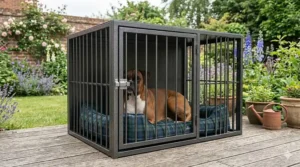
The Amazon Basics XXL Metal Crate at 122 x 76 cm represents the larger end of the spectrum, suitable for boxers approaching or exceeding 30 kg, or for owners who simply prefer giving their dog more space. This single-door model employs thicker wire than the brand’s standard range, with enhanced corner connections that resist flexing.
What makes this relevant for UK buyers is the leak-proof tray’s generous depth—around 5 cm rather than the usual 2-3 cm. During the British winter when dogs track in mud, wet leaves, and general British outdoor detritus, this deeper tray contains mess more effectively. The black finish doesn’t show dirt as obviously as lighter colours, which matters when your boxer’s paws bring in half the park on a rainy Tuesday.
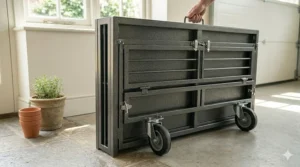
The collapsible design folds genuinely flat—not “flatish with awkward bits sticking out,” but actually flat enough to slide under a bed or behind a wardrobe. For British homes where storage space competes with about seventeen other priorities, this practical consideration shouldn’t be underestimated. The divider panel allows adjustment for growing puppies, though at this size, most buyers use it for adult boxers from day one.
UK delivery typically includes Prime next-day service, and Amazon’s return policy provides reassurance if sizing doesn’t work out—useful given that British homes often have space constraints that make purchasing oversized items a gamble.
Pros:
✅ Extra-large dimensions suit bigger boxers or those preferring more space
✅ Deep leak-proof tray handles British weather-related mess
✅ Genuinely flat folding suits British storage constraints
Cons:
❌ Single-door design less flexible than dual-door alternatives
❌ Size can be excessive for average-sized boxers (wastes floor space)
Price & Value: £80-£120. Good value for larger boxers, though consider whether your dog actually needs this much space before committing valuable floor real estate.
7. Ellie-Bo Heavy Duty Deluxe Dog Crate
The Ellie-Bo Heavy Duty Deluxe Crate brings specifically UK-designed construction to the market. At 106 x 71 cm with three finish options (black, gold, silver), this crate employs 6mm thick bars—noticeably thicker than the 4mm standard most competitors use. For context, that extra 2mm translates to approximately 50% more metal, which meaningfully affects strength and resistance to bending.
The generous wire spacing provides excellent ventilation—important in British homes where central heating can create stuffy conditions during winter months. Unlike some heavy-duty crates that prioritise strength over airflow, Ellie-Bo balances both considerations. The dual-door design (front and top) includes heavy-duty latches that UK reviewers consistently praise for remaining secure despite determined boxer attention.
The black metal floor tray removes easily for cleaning and actually fits in most British washing machine tubs (unlike some larger models that require hosing down in the garden—rather inconvenient during January). The tray’s material resists cracking in cold temperatures, addressing a common complaint with cheaper plastics that become brittle during British winters.
As a UK company, Ellie-Bo understands British housing stock. The crate’s footprint fits through standard British doorways without requiring disassembly, and the height clears typical door frames with a few centimetres to spare—small details that matter tremendously when you’re navigating narrow Victorian hallways.
Pros:
✅ 6mm bars provide exceptional strength for determined boxers
✅ UK-designed dimensions suit British homes and doorways
✅ Tray fits British washing machines (seriously underrated feature)
Cons:
❌ Limited availability compared to international brands
❌ Finish options mostly aesthetic rather than functional differences
Price & Value: £85-£115. Excellent value for a genuinely UK-optimised heavy-duty crate.
Real-World Boxer Scenarios: Matching Dog to Crate
The Anxious London Flat-Dweller
Picture Sarah in Clapham: second-floor flat, 28 kg boxer named Arthur with moderate separation anxiety. Limited floor space means the crate needs to fit in the bedroom corner without dominating the room. Arthur’s anxiety manifests in pacing and whining rather than destruction, but he’s strong enough to bend inferior crates when stressed.
Best match: Yaheetech Heavy Duty Rolling Crate. The mobility lets Sarah reposition it easily between bedroom (nighttime) and living room (daytime), and the open-top design provides reassurance whilst maintaining security. The reinforced construction handles Arthur’s strength without the full industrial approach of square-tube models he doesn’t actually need.
The Suburban Family with Growing Puppy
Meet the Johnsons in Reading: four-month-old boxer puppy Bella, currently 18 kg but heading toward 27 kg at adulthood. Two young children mean the crate sees frequent opening/closing, and the family garden means muddy paws are a daily reality from October through March.
Best match: MidWest iCrate Double Door with divider. The adjustable divider grows with Bella, the dual doors accommodate children accessing from different angles safely, and the electro-coat finish handles British weather-related wear. At £70-£90, the price point works for a young family’s budget whilst providing genuine durability.
The Determined Escape Artist
Consider James in Manchester: three-year-old boxer Max with a documented history of escaping three previous crates. Max treats confinement as a personal challenge and possesses both jaw strength and problem-solving skills to back it up. James works from home but needs Max secured during video calls.
Best match: BingoPaw Square Tube Crate. The square tube construction eliminates Max’s usual grip points, the three-door system with shaped locks provides security without creating challenge points, and the reinforced height means Max can’t leverage his considerable strength against weak points. Yes, it’s £120-£160, but that’s less than James has spent replacing three inferior crates over 18 months.
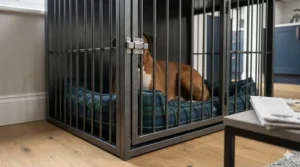
How to Choose a Heavy Duty Crate in the UK: The Five Critical Factors
Selecting the right crate requires more than clicking “Add to Basket” on the first result. Here’s what actually matters when you’re dealing with boxer-specific requirements in British conditions:
Size Calculation Beyond the Basics
The standard advice says measure your dog from nose to tail base, add 10-15 cm, and that’s your crate length. For boxers, add an extra 5 cm beyond that. These are powerful dogs who shift their entire body weight whilst changing position, and tight quarters amplify the force against crate walls. A 27 kg boxer turning around in a barely-adequate 106 cm crate exerts far more lateral pressure than the same dog in a 112 cm crate. That extra space reduces stress on joints and frame.
Construction Material Hierarchy
Not all “heavy duty” construction deserves the label. Square tube frames resist manipulation better than round bars. Gauge thickness matters: 6mm bars withstand roughly 40% more force than 4mm bars. Welded joints outperform riveted ones. Powder coating beats painted finishes for rust resistance in British humidity. These aren’t marketing claims; they’re measurable differences that affect whether your crate lasts six months or six years.
Latch Security Assessment
Slide-bolt latches should require thumb pressure to operate—if your dog can replicate that motion with their paw or nose, they will. Double-latch systems (one latch insufficient, both latches required for opening) provide meaningful security upgrades. Shaped locks that require specific movements prove genuinely difficult for dogs to manipulate. Test latches before purchasing if possible, or check UK reviewer feedback specifically mentioning latch security.
British Climate Considerations
Rust-resistant coating isn’t optional in the UK; it’s mandatory. Check specifically for “powder coating” or “electro-coat finish” rather than generic “rust-resistant” claims. Consider ventilation: British homes with central heating create surprisingly stuffy environments during winter. Wire spacing should allow airflow without permitting paws to slip through—5-6 cm spacing hits the sweet spot for boxer-sized dogs.
Mobility and Storage Realities
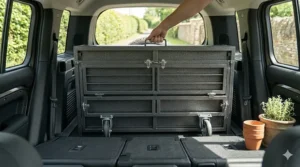
A 15 kg crate that doesn’t collapse makes sense if you never move it. For British homes where space is at a premium and rooms serve multiple functions, collapsible designs or wheeled options provide meaningful practical advantages. Can you navigate your hallway width? Will it fit through doorways without disassembly? Does it fold flat enough to slide behind the sofa when Aunt Margaret visits and judges your life choices?
Common Mistakes When Buying Heavy Duty Crates for Boxers
Oversizing for “Comfort”
British buyers often purchase 122 cm crates for 25 kg boxers, thinking extra space equals extra comfort. In reality, oversized crates eliminate the den effect that makes dogs feel secure, and puppies will absolutely use that extra space as a toilet area separate from their sleeping zone. Size up slightly from minimum requirements, but resist the temptation to buy something your dog could hold board meetings in.
Ignoring Height Requirements
Boxers have distinctive body proportions—deep chests and relatively short backs. Many buyers focus on length whilst neglecting height. Your boxer should be able to sit upright with 5-8 cm of clearance above their head. Check the internal height specification, not just floor dimensions. Several UK reviewers have reported purchasing adequately long crates only to discover their boxer had to hunch when sitting—rather defeats the purpose.
Underestimating British Humidity Impact
That “rust-resistant” coating might handle Arizona’s dry heat beautifully whilst failing spectacularly in Newcastle’s perpetual dampness. Specifically check for UK customer reviews mentioning rust, corrosion, or coating degradation. If UK buyers are reporting rust within six months, that crate won’t survive British conditions regardless of what the manufacturer claims.
Assuming All “Heavy Duty” Claims Are Equal
“Heavy duty” has become meaningless marketing speak. One manufacturer’s heavy duty is another’s standard construction. Look for specific measurements: bar thickness in millimetres, gauge specification, frame tube dimensions. Concrete numbers reveal actual quality differences that generic “heavy duty” labels obscure. A 4mm bar crate calling itself heavy duty is still a 4mm bar crate.
Neglecting Veterinary-Approved Sizing for Car Travel
Under UK regulations (Road Traffic Act 1988, Rule 57), dogs must be suitably restrained in vehicles. “Suitably” has specific meanings: your boxer should be able to stand, turn around, and lie down naturally, even during sudden braking. Undersized crates cause injury during accidents; oversized crates become projectiles. The crate that works perfectly at home might not meet car safety requirements—consider whether you need separate home and travel crates or one that serves both purposes.
Heavy Duty Crates vs Standard Wire Crates: What You’re Actually Paying For
The £40 wire crate versus the £140 heavy duty model seems like a fourfold price difference for similar-looking products. Here’s what you’re actually purchasing with that premium:
Material Thickness and Grade
Standard crates employ 3-4mm wire; heavy duty models use 5-6mm. That difference means the heavy duty version resists roughly 50-60% more force before deforming. The steel grade also differs—heavy duty construction typically uses higher-carbon steel with better tensile strength. In practical terms, a determined boxer can bend standard wire within weeks; quality heavy duty construction lasts years.
Joint Reinforcement
Budget crates connect frame sections with simple welds or even spot welds. Heavy duty models employ continuous welds at stress points, with additional reinforcement around corners and door frames. When your 28 kg boxer decides to rearrange their bedding at 3am, those reinforced joints prevent the gradual loosening and eventual failure that plagues cheaper models.
Coating Quality and Thickness
Standard powder coating might be 50-70 microns thick; heavy duty coatings run 80-100+ microns. This directly affects rust resistance in British humidity. The cheaper coating starts showing rust spots within 6-12 months in typical British homes; quality coating maintains integrity for 3-5+ years. Factor in replacement costs and the premium version actually costs less over its lifetime.
Latch Engineering
This is where price differences become most apparent. Budget latches employ simple slide bolts that dogs can manipulate. Heavy duty latches require specific motion sequences, use spring-loaded mechanisms, or employ shaped designs that physically prevent manipulation. The engineering difference is measurable: budget latches fail at approximately 50-70 PSI of force; heavy duty mechanisms require 120-150+ PSI—well beyond typical dog capability.
What to Expect: Real-World Performance in British Conditions
Let’s dispense with marketing promises and discuss actual performance based on UK buyer experiences:
Rust Development Timeline
Even quality powder coating will eventually show wear in British conditions. Expect initial rust spots around floor contact points after 18-24 months, regardless of brand claims. Heavy duty models delay this to 24-36+ months. Interior coating lasts longer than exterior (protected from weather if crate is indoors). Crates stored in conservatories or garden rooms rust faster than those in climate-controlled living spaces.
Noise Levels During British Nights
Wire crates amplify movement sounds. Your boxer shifting position at 2am sounds like someone reorganising the kitchen. Rubber floor protectors reduce this somewhat, as do crate mats. Expect adaptation period where household sleep is disrupted whilst everyone adjusts. Heavier gauge construction actually produces less noise than lighter wire—the thicker metal flexes less and produces fewer vibrations.
Cleaning Reality Check
Those “easy to clean” removable trays become less easy after six months of boxer use. Expect scratching from claws, potential cracking from enthusiastic dogs jumping in and out, and gradual warping if trays are washed in hot water repeatedly. Quality trays last 2-3 years before replacement becomes advisable; budget trays need replacing within 12-18 months. Replacement trays cost £15-£30, so factor this into total ownership cost.
Mobility Degradation
Wheeled crates work brilliantly for the first few months. By month six, expect at least one castor to develop a tendency to stick or veer left. British homes’ carpet-to-hardwood transitions accelerate wear. Lock mechanisms on brake-equipped castors become less reliable after repeated use. This isn’t a defect; it’s mechanical reality. Budget for castor replacement (around £10-£20 for a set) every 18-24 months if you use mobility features regularly.
Long-Term Cost and Maintenance in the UK
Purchase price represents only part of total ownership cost. Here’s what you’ll actually spend over a three-year period:
Initial Purchase: £80-£160
Your starting point, obviously. Heavy duty models cluster in the £100-£140 range; budget options run £70-£90. This is the visible cost that most buyers focus on whilst ignoring the less obvious expenses that follow.
Replacement Trays: £15-£30 per replacement
Expect to replace trays once every 18-24 months with quality construction, potentially annually with budget models. Most UK buyers report purchasing 1-2 replacement trays over three years. Budget £25-£50 total.
Bedding Replacements: £20-£40 annually
Boxers destroy bedding. Even in crates, they’ll rearrange, chew corners, and generally ensure bedding doesn’t last forever. Quality crate mats run £20-£30 and last 8-12 months with typical boxer use. Budget £40-£60 over three years.
Castor Replacement (if applicable): £10-£20 every 18-24 months
Wheeled models need castor replacement as wear accumulates. Factor £10-£20 into ownership costs if you’ve chosen a mobile model.
Rust Treatment Supplies: £10-£15 over three years
Even heavy duty coating develops minor rust spots eventually. Rust treatment spray costs £5-£8; you’ll likely purchase it twice over three years for touch-up maintenance.
Total Three-Year Cost: £165-£315
Budget model total: approximately £165-£215
Heavy duty model total: approximately £240-£315
The difference narrows considerably once you factor in replacement costs. Budget crates often require full replacement within three years (adding another £70-£90), whilst heavy duty models continue functioning. Over three years, the heavy duty option often costs less despite higher initial purchase price.
Features That Actually Matter (And Those That Don’t)
Critical Features Worth Paying For:
Double-latch security systems—genuinely prevent escape attempts
Square tube construction—demonstrably more chew-resistant than round bars
Reinforced corner joints—prevent frame flexing under force
Removable tray with proper leak-proof seal—saves carpet, sanity, and relationships
Powder coating over 80 microns thick—provides meaningful rust resistance in British humidity
Nice-to-Have Features:
Dual doors—convenient but not essential if space allows front access
Wheels with locks—useful for frequent moving but not necessary for stationary placement
Divider panels—valuable for puppies growing into adult size
Carrying handles—helpful but collapsible crates fold for transport anyway
Marketing Fluff You Can Ignore:
“Veterinarian recommended”—meaningless without specific vet attribution
“Military grade”—not a real specification, just evocative language
“Unbreakable”—nothing withstands determined boxer indefinitely
Finish colour options—purely aesthetic; doesn’t affect functionality
“Patented latch system”—means they’ve trademarked something, not that it works better
UK Regulations, Safety Standards and Legal Requirements
Understanding UK-specific requirements helps ensure your crate purchase meets legal obligations whilst providing safe containment:
Road Traffic Act 1988, Rule 57
Dogs must be suitably restrained in vehicles to prevent distraction to the driver. Crates fulfil this requirement if properly secured. The crate must be large enough for your boxer to stand, turn, and lie down naturally. Undersized crates cause injury during sudden braking; the crate must be crash-tested or secured with proper tie-downs to prevent becoming a projectile. Standard wire crates meet the restraint requirement but offer minimal crash protection—consider purpose-built travel crates for regular car journeys. The RSPCA provides additional guidance on how these regulations protect animal welfare.
Animal Welfare Act 2006
You’re legally required to meet your dog’s welfare needs, including appropriate environment. An inadequately sized or poorly maintained crate potentially violates this Act. Your boxer must be able to exhibit normal behaviour, which includes standing, lying down, and turning around comfortably. Prolonged crating (over 3-4 hours regularly) without adequate exercise breaks may constitute welfare concerns. Documentation of crate training methods and duration helps demonstrate responsible ownership if questioned.
IATA Live Animals Regulations (for air travel)
If you’re flying with your boxer within the UK or internationally, crates must meet specific construction standards. The container must be rigid plastic, fibreglass, plywood, or solid wood (standard wire crates don’t qualify). Ventilation must be present on three sides minimum (four sides for international flights). The crate must provide 10-15 cm clearance above your dog’s head when standing naturally. Door must be metal mesh with spring-loaded locking mechanism. Note that boxers, being brachycephalic (short-nosed), require additional size allowance—typically one size larger than measurements suggest.
Consumer Rights Act 2015 Protection
When purchasing from UK retailers (including Amazon.co.uk), you’re protected by stronger consumer rights than in many countries. Products must be of satisfactory quality, fit for purpose, and match description. If your “heavy duty” crate bends within three months of normal use, you’re entitled to repair, replacement, or refund. The 14-day cooling-off period for online purchases allows returns even if you’ve assembled the crate and realised it doesn’t suit your home. Keep all documentation and photographs if issues develop—UK consumer protection strongly favours buyers.
Frequently Asked Questions
❓ Are 42-inch crates actually necessary for boxers, or can I use 36-inch models?
❓ How long can I safely leave my boxer in a crate during the working day?
❓ Will heavy duty crates fit through standard British doorways and staircases?
❓ Do I need separate crates for home and car use?
❓ Are Amazon.co.uk prices comparable to pet shop prices, or should I shop around?
Final Verdict: Which Heavy Duty Crate Should You Choose?
The “best” heavy duty crate for your boxer depends entirely on your specific circumstances. A £160 square-tube industrial crate represents excessive overkill if your boxer has zero escape tendencies and simply needs secure overnight accommodation. Conversely, a £70 budget model won’t survive three weeks with a determined escape artist.
For most UK boxer owners with typical dogs (energetic, strong, but not pathologically escape-focused), the MidWest iCrate or Yaheetech Heavy Duty Rolling Crate represent the sensible middle ground. They provide genuine durability without industrial overkill, suit British homes and climate, and cost £70-£150—reasonable for equipment you’ll use daily for 5-10 years.
If your boxer has demonstrated escape capabilities or exceptional strength, move up to the BingoPaw Square Tube or Feandrea Heavy Duty models. The £120-£160 price point feels steep initially but becomes reasonable when compared against replacing three cheaper crates over two years.
For families with growing puppies, prioritise divider panels and adjustable sizing. For urban flat-dwellers, consider mobility features and compact storage. For households with space constraints, favour collapsible designs over rigid construction.
Whatever you choose, remember that crate training success depends more on proper introduction and positive association than on purchasing the most expensive model available. A £100 crate used correctly will outperform a £200 crate introduced poorly. Start gradually, reward crate time, never use it for punishment, and your boxer will likely come to view their crate as a valued personal sanctuary rather than a prison to escape.
Recommended for You
- German Shepherd Crate Size Guide: 7 Expert UK Picks (2026)
- Best Golden Retriever Crate 42 Inch UK: 7 Expert Picks 2026
- Best Crate for Labrador Retriever UK: 7 Expert Picks 2026
Disclaimer: This article contains affiliate links. As an Amazon Associate, I earn from qualifying purchases. If you purchase products through these links, we may earn a small commission at no additional cost to you.
✨ Found this helpful? Share it with your mates! 💬🤗
