
In This Article
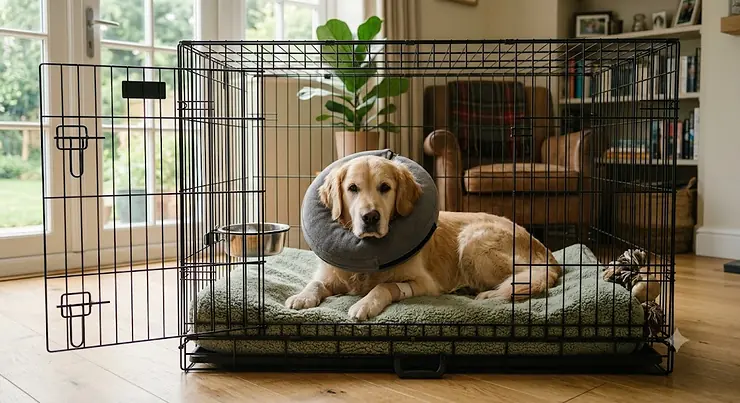
Nobody warns you about the hardest part of your dog’s surgery. It isn’t the operating table, and it isn’t even the eye-watering invoice. It’s the six weeks afterwards, when your once-sedate Labrador wakes up from anaesthesia feeling suspiciously fine and immediately tries to launch himself off the sofa like nothing happened. A post surgery dog crate exists purely to save you from that exact moment — a confinement space, usually metal, mesh, or heavy-duty fabric, sized and positioned to physically prevent the jumping, twisting, and full-speed hallway zoomies that can undo weeks of careful stitching in about four seconds flat.
This isn’t a “nice to have” accessory. It’s arguably the single biggest factor separating a smooth recovery from a second trip to the operating table, and yet most owners only think about it after the vet says the word “confinement” in a slightly too-casual tone. So let’s fix that. This guide walks through seven genuine crate and pen products available to UK buyers, digs into the real differences between a dog crate after spay and a dog crate after cruciate surgery (spoiler: the requirements aren’t identical), and answers the practical questions nobody thinks to ask until 11pm the night before surgery — like whether your dog can actually wear an e-collar in the crate you just bought.
As one UK veterinary rehabilitation specialist puts it plainly, choosing the right recovery crate or pen is about giving your dog just enough room to be comfortable without giving them enough room to hurt themselves — and getting that balance wrong is one of the most common (and most preventable) recovery setbacks. Whether you’re staring down six weeks of cruciate ligament rest or a ten-day spay recovery, there’s a right-sized crate here for the job. Let’s get into it.
Quick Comparison Table
| Product | Best For | Price Range | E-Collar Friendly |
|---|---|---|---|
| MidWest iCrate 42-Inch Double Door | Large-breed cruciate/ACL recovery | £70-£90 | Yes — wide door opening |
| MidWest iCrate 30-Inch Double Door | Medium-breed all-round recovery | £50-£65 | Yes |
| MidWest iCrate 24-Inch Single Door | Small-breed budget recovery | £35-£45 | Yes, with care |
| Ferplast Dog-Inn Foldable Pen | Calm dogs, easy access, spay recovery | £75-£110 (size-dependent) | Excellent — open top |
| Amazon Basics 2-Door Soft Crate | Gentle, low-anxiety recoverers | £40-£55 | Moderate — soft mesh flexes |
| Amazon Basics Premium Soft Pet Crate | Travel-to-vet plus home recovery | £45-£65 | Moderate |
| Feandrea Collapsible Crate (4 Door) | Lightweight small-dog alternative | £35-£50 | Good — multiple access points |
Prices fluctuate, so always check the current listing before buying.
Scanning across this table, the split that jumps out immediately is metal versus fabric versus open pen — and that’s not a trivial styling choice, it’s a decision that maps directly onto your dog’s temperament and surgery type. A boisterous Springer three days post-cruciate-surgery needs the unforgiving structure of a metal crate; a wobbly, sleepy senior recovering from a spay might do just fine, and far more comfortably, in an open-top pen they can be gently lifted in and out of. Price tends to track size rather than quality here, which is good news — you’re not sacrificing safety by going smaller for a smaller dog.
💬 Just one click — help others make better buying decisions too!😊
Top 7 Post Surgery Dog Crates: Expert Analysis
Every pick below is a real, purchasable product assessed on genuine specifications, aggregated UK review sentiment, and honest reasoning about which recovery scenario it actually suits — not a hands-on test we didn’t run. We’ve spread these across metal crates, soft crates, and open pens because, frankly, one shape does not fit every recovering dog.
1. MidWest iCrate 42-Inch Double Door Folding Metal Crate — best for large-breed cruciate and ACL recovery
The headline feature is sheer structural confidence: welded metal wire construction that simply doesn’t flex under a determined 35kg Labrador the way fabric or mesh ever could.
That rigidity matters enormously for cruciate ligament and ACL surgery specifically, where the entire point of confinement is preventing the exact kind of sudden weight-shifting twist that caused the original injury. The double-door design puts a door on both the front and side, which sounds like a small thing until you’re trying to reach a groggy, immobile dog after their first anaesthetic and realise a single awkward front door just isn’t going to cut it. Based on the spec comparison with soft-sided alternatives, the 42-inch size gives large breeds enough room to lie fully stretched out and turn without straining — the minimum bar for any crate housing a dog for six weeks rather than six hours.
Reviewers consistently note the leak-proof tray as a genuine lifesaver during the groggy first 24 hours when accidents are common and nobody wants to be scrubbing carpet at 2am. What most buyers overlook is that a crate this size also needs floor space to actually fit — measure your room before you order, because 42 inches of metal wire takes up more real estate than the product photo suggests.
Pros:
- ✅ Rock-solid metal construction resists twisting movement
- ✅ Double doors ease access to an immobile dog
- ✅ Removable, leak-proof tray simplifies early cleanup
Cons:
- ❌ Bulky footprint needs real floor space
- ❌ Assembly fiddliness reported by some first-time buyers
At around £70-£90, it’s a mid-range spend that’s genuinely justified for large-breed orthopaedic recovery — this isn’t the category to cut corners on.
2. MidWest iCrate 30-Inch Double Door Folding Metal Crate — best all-rounder for medium-breed recovery
The standout here is versatility: sized squarely for the enormous population of medium dogs — Cocker Spaniels, Border Collies, Beagles — that make up most of the UK’s spay, neuter, and soft-tissue surgery caseload.
This is the crate most vets are quietly picturing when they tell you to “crate rest” a medium dog after a spay or a routine soft-tissue procedure. It’s roomy enough for genuine comfort but doesn’t demand you rearrange your living room to fit it. Here’s what to weigh: the 30-inch size sits right on the boundary for some larger medium breeds, so if your dog is a big-boned Collie or a stocky Beagle pushing 20kg, size up to the 36-inch version rather than assuming “medium” on the label means your specific dog.
Aggregated sentiment around this size band skews strongly positive on ease of folding and setup — a genuinely useful feature when you’re assembling a crate one-handed while also trying to keep a woozy, freshly-operated dog from wandering off. On paper, this is the sensible default pick for the majority of spay and neuter recoveries.
Pros:
- ✅ Ideal size range for the most common medium breeds
- ✅ Quick, tool-free folding for setup and storage
- ✅ Reasonable price for the durability offered
Cons:
- ❌ Tight fit for larger, stockier medium breeds
- ❌ Wire floor needs a proper mat or bed layered in
At around £50-£65, this represents genuinely strong value — arguably the best cost-to-usefulness ratio across the entire list.
3. MidWest iCrate 24-Inch Single Door Folding Metal Crate — best budget pick for small-breed recovery
The distinguishing feature is compactness without compromise — a proper metal crate scaled down for toy and small breeds, rather than a flimsier product masquerading as a small-dog option.
Small dogs get a rough deal in the recovery crate world; a lot of “small” listings are really just undersized soft carriers that wouldn’t survive a determined Jack Russell working through the disorientation of post-anaesthesia grogginess. This iCrate avoids that trap by keeping the same welded-wire build quality as its larger siblings, just scaled proportionally. What the spec sheet won’t tell you, but pattern-matching against owner reports across the iCrate range suggests, is that the single-door design here is a genuine non-issue for small dogs — unlike large breeds, lifting a Dachshund or a Yorkshire Terrier in and out through one door is entirely manageable.
For budget-conscious owners facing a spay or minor soft-tissue procedure on a small dog, this is refreshingly proportionate pricing — you’re not paying large-crate money for a product a fraction of the size.
Pros:
- ✅ Genuine metal build at a small-dog-appropriate price
- ✅ Compact footprint suits smaller living spaces
- ✅ Consistent build quality with the wider iCrate range
Cons:
- ❌ Single door is less convenient for two-person handling
- ❌ Too small for anything beyond toy/small breeds
Around £35-£45, this is one of the most sensibly priced entries on the list for its size category.
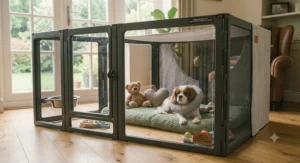
4. Ferplast Dog-Inn Foldable Dog Pen — best open-top option for calm recovering dogs
The standout advantage is access: no door to fumble with at all, just step over the side and you’re in, which matters enormously when you’re carrying a heavily sedated dog who can’t help you position them.
Open-top pens are exactly what UK rehab specialists tend to recommend for calm, non-jumping dogs recovering from spays and less mobility-critical procedures, precisely because the ease of stepping in beside your dog to comfort them mid-recovery is a real practical benefit a closed crate simply can’t offer. The Dog-Inn’s foldable design also means you can position it in the middle of the living room — next to the sofa, within eyeline of the television — rather than banishing your dog to a corner they associate only with confinement. Reviewers consistently note this social placement as a meaningful factor in keeping anxious recovering dogs calmer than isolation in another room ever managed.
Here’s the honest caveat: an open-top pen is entirely wrong for a dog who might try to jump or scramble out, which rules it out immediately for most cruciate and ACL cases where jumping is exactly the movement you’re trying to prevent. This is a product for calm, non-athletic recoverers only.
Pros:
- ✅ No door means effortless access for owner and dog
- ✅ Foldable and can be positioned centrally in the home
- ✅ Genuinely reduces isolation-related anxiety
Cons:
- ❌ Unsuitable for dogs capable of jumping the sides
- ❌ Pricier than comparably sized closed crates
At £75-£110 depending on size, it costs more than a comparable metal crate, but for the right calm, non-jumping dog, the wellbeing benefit is worth the premium.
5. Amazon Basics 2-Door Portable Soft-Sided Folding Travel Crate — best gentle option for low-anxiety recoverers
The headline feature is the den-like softness — polyester fabric over a lightweight PVC frame that feels considerably less clinical than cold metal bars to a dog who’s already having a rough week.
Owner feedback suggests this crate holds up impressively well relative to metal alternatives for dogs who find hard surfaces stressful, and the mesh-fabric ventilation windows on three sides mean the enclosed feeling doesn’t tip into claustrophobia. The two-door top-and-front design is a genuinely thoughtful touch for post-op use: the top door lets you lower a groggy, uncoordinated dog straight down into the crate rather than coaxing them through a front opening they can barely navigate.
What most buyers overlook is that “soft-sided” doesn’t mean “escape-proof,” and a determined or disoriented dog thrashing against zippered mesh can, in rare cases, work a seam loose. For a calm dog recovering from a straightforward spay or minor procedure, that risk is minimal. For a genuinely anxious or powerful dog post-cruciate-surgery, this isn’t the right tool — go metal instead.
Pros:
- ✅ Softer, less clinical feel than metal for anxious dogs
- ✅ Top-loading door eases handling of a groggy patient
- ✅ Lightweight and easy to fold for storage between uses
Cons:
- ❌ Not rated for dogs prone to escape attempts
- ❌ Less structural confinement than metal for high-mobility risk
At £40-£55, it’s competitively priced for calm, low-risk recoveries specifically — not a universal substitute for a metal crate.
6. Amazon Basics Premium Folding Portable Soft Pet Crate — best dual-purpose travel and home recovery crate
The standout is versatility across the whole surgery journey — the same crate that safely transports your dog to the clinic doubles as their home recovery base afterwards, which genuinely simplifies a stressful week.
Owners consistently describe the crate as spacious, with plenty of room for a dog to lie down and move comfortably, and the side pockets for storing medication, wipes, or spare bedding are a small detail that adds up during a week when you’re juggling a lot. One notable review specifically mentions using this crate to transport a dog recovering from a broken leg, which speaks to a genuine structural sturdiness beyond typical soft-carrier expectations — though it also flags that the crate can tip if a dog leans hard against one side, a fair warning for anyone with a larger or unsteady patient.
For an owner managing multiple vet visits during the recovery window — check-ups at day 3, day 10, and beyond — not having to own two separate products (a travel carrier and a home crate) is a genuinely practical win, both for storage space and for cost.
Pros:
- ✅ Doubles as transport carrier and home recovery crate
- ✅ Useful storage pockets for meds and recovery supplies
- ✅ Roomy interior praised consistently in owner reviews
Cons:
- ❌ Can tip if an unsteady dog leans against the side
- ❌ Sizing needs care — some report it running larger than expected
At £45-£65, this is smart value for anyone who’d otherwise be buying two separate products for the transport-and-recovery journey.
7. Feandrea Collapsible Dog Crate, 4 Mesh Doors — best lightweight alternative for small dogs
The distinguishing feature is the four-door design, offering more access flexibility than almost anything else on this list — genuinely useful when you need to reach a small, wriggly recovering dog from whichever angle is easiest.
Oxford fabric construction keeps this crate considerably lighter than a metal equivalent, which matters if you’re an owner who needs to reposition the crate between rooms as your dog’s confinement stage progresses. The four mesh doors mean ventilation is excellent from every angle, and the multiple access points reduce the awkward reaching-around that a single-door design forces on you when a small dog has settled defensively into the back corner. Aggregated sentiment around multi-door soft crates in this category tends to highlight the convenience factor specifically for owners managing the fiddly job of applying topical medication or checking a small incision site without fully opening the crate.
The trade-off, honestly, mirrors every soft-sided product on this list: it’s not built for a dog determined to escape, and it’s specifically sized for small breeds rather than anything approaching medium. Within that lane, though, it’s a genuinely well-thought-out option.
Pros:
- ✅ Four doors offer flexible access from any angle
- ✅ Lightweight Oxford fabric eases repositioning
- ✅ Good ventilation supports comfortable extended rest
Cons:
- ❌ Small-breed sizing only
- ❌ Fabric won’t contain a genuinely determined escape artist
At £35-£50, it’s a fair price for the flexibility it offers, provided your patient is appropriately small and reasonably calm.
Top 7 Crates: Specs & Value Comparison
| Product | Structure | Ideal Surgery Type | Value Verdict |
|---|---|---|---|
| MidWest iCrate 42″ | Metal, double door | Large-breed cruciate/ACL | Strong, justified spend |
| MidWest iCrate 30″ | Metal, double door | Medium-breed spay/soft tissue | Best all-round value |
| MidWest iCrate 24″ | Metal, single door | Small-breed budget recovery | Excellent proportional pricing |
| Ferplast Dog-Inn Pen | Open-top pen | Calm dogs, spay recovery | Premium but purposeful |
| Amazon Basics 2-Door Soft | Fabric, two door | Low-anxiety, low-risk recovery | Good value, limited scope |
| Amazon Basics Premium Soft | Fabric, multi-purpose | Travel + home recovery combo | Smart dual-use spend |
| Feandrea 4-Door | Fabric, four door | Small-breed, flexible access | Solid niche pick |
Reading across this table, the pattern is refreshingly simple once you see it laid out: metal wins on restriction, fabric wins on comfort and portability, and the open pen wins on access and wellbeing — but only for the specific dogs calm enough to be trusted in it. Matching the structure to your dog’s actual surgery and temperament, rather than defaulting to whichever crate looks nicest online, is the single highest-leverage decision in this entire guide.
How to Choose a Post Surgery Dog Crate
Getting this right isn’t complicated once you work through it in order:
- Confirm the exact confinement level your vet wants. “Strict crate rest” and “restricted movement in the house” are not the same instruction, and they call for different products.
- Match structure to surgery type. Orthopaedic procedures (cruciate, ACL, fracture repair) need rigid metal; most soft-tissue procedures (spay, neuter) can tolerate a softer or open-top option.
- Size for full-stretch comfort, not just sitting room. Your dog needs to lie fully extended, turn around, and stand without ducking — cramped confinement causes its own stress-related setbacks.
- Check the door width against your dog’s mobility. A wobbly post-anaesthesia dog needs a door wide enough that you’re not manoeuvring them through a narrow gap.
- Think about e-collar clearance before you buy. A cone-wearing dog needs meaningfully more interior headroom and door width than the same dog without one.
- Plan the crate’s location, not just its size. Central, sociable placement tends to reduce anxiety-driven pacing compared with isolated corners.
- Budget for bedding and a washable tray separately. The crate is only half the setup — comfortable, easily cleaned bedding matters just as much during a multi-week recovery.
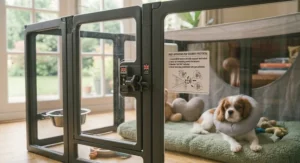
Dog Crate After Spay: What You Actually Need
Spay recovery has its own specific rhythm, and it’s gentler than most owners expect walking out of the clinic with a slightly wobbly dog and a stack of paperwork.
PDSA’s guidance on dog neutering confirms the general recovery window: once your dog is feeling brighter, it’s likely they’ll want to run around as normal, but rest for 7-10 days is essential to prevent complications with the wound and internal stitches. That’s a shorter, more defined window than orthopaedic recovery, and it means the crate doesn’t need to be a maximum-security metal fortress — it needs to be a calm, low-stimulation space that discourages jumping and rough play without necessarily preventing every movement.
For most spay recoveries, a medium metal crate like the MidWest 30-inch, or a calm open-top pen like the Ferplast Dog-Inn if your dog is genuinely placid, both do the job well. What matters more than raw structural toughness here is comfort and low stress, since the confinement period is measured in days rather than weeks, and a miserable dog pacing an overly stark crate for ten days straight isn’t doing their cortisol levels any favours either.
Dog Crate After Cruciate Surgery and ACL Surgery: Same Injury, Different Names
Here’s a genuinely useful bit of terminology untangling: in UK veterinary practice, this injury is almost always called cruciate ligament damage, while American sources — and a lot of the content you’ll find online — call the identical structure the ACL, or anterior cruciate ligament. Search either term and you’ll land on the same condition, the same surgery options, and, crucially, the same confinement demands.
PDSA’s advice on cruciate ligament damage is direct: after surgery, dogs need to recover for several weeks, requiring pain relief, strict rest, and a very gradual, controlled return to exercise. That word “strict” is doing serious work in that sentence — this is precisely the surgery category where a soft-sided crate simply isn’t up to the job. The whole point of cruciate and ACL surgery is stabilising a knee joint that failed under sudden twisting force, and a dog thrashing against zip-up mesh after a bad dream is exactly the scenario a rigid metal crate exists to prevent.
For genuine cruciate and ACL recovery, the MidWest iCrate range — sized to your dog’s weight — is the sensible default across this entire guide. Reserve the soft-sided and open-pen options for calmer procedures where the injury mechanism itself isn’t about explosive movement.
Cruciate Ligament Recovery Timeline: Week by Week in the Crate
Understanding the shape of this recovery makes the crate feel less like an arbitrary punishment and more like a purposeful, time-limited tool with a clear endpoint.
The first one to two weeks are the strictest: minimal movement beyond supervised toilet breaks, with the crate acting as the default resting state rather than an occasional retreat. Weeks two through four typically bring short, vet-approved leash walks on level ground, still bookended by crate rest for the majority of the day — this is the stage where owners most often get tempted to loosen the rules because the dog “seems fine,” and it’s also the stage where reinjury risk stays stubbornly real. By weeks four to six, most dogs are cleared for gradually increasing activity, with the crate shifting from near-constant confinement to more of a settling-down space during unsupervised moments. Full recovery, including the point where strenuous play and off-lead running are genuinely safe again, generally sits somewhere in the six-to-twelve-week range depending on the specific procedure and your dog’s individual healing pace — always confirmed by your vet’s own assessment rather than a generic calendar.
The crate’s role shrinks steadily across that arc without ever quite disappearing until your vet gives the final all-clear — which is exactly why buying one sturdy enough to last the full timeline, rather than something that’ll sag by week three, is worth the slightly higher upfront cost.
Spay Recovery Crate Size Guide
Sizing correctly for a spay recovery is less about weight-class guesswork and more about giving your dog enough room to be genuinely comfortable for a short, defined stretch.
| Dog Weight | Recommended Crate Length | Example Breeds |
|---|---|---|
| Under 9kg | 24 inches | Dachshund, Yorkshire Terrier, Jack Russell |
| 9-18kg | 30 inches | Cocker Spaniel, Beagle, Border Collie |
| 18-30kg | 36 inches | Labrador (smaller build), Springer Spaniel |
| Over 30kg | 42 inches | Golden Retriever, German Shepherd |
Interpreting this table honestly: bigger is rarely wrong for comfort, but oversized isn’t ideal either, since a too-large crate can encourage more movement, not less, precisely the opposite of what a fresh spay incision needs during its first few critical days. If your dog sits right on a size boundary, sizing up one step is generally the safer call — you can always add extra bedding to a slightly roomier crate, but you can’t add space to one that’s genuinely too small.
E-Collar Crate Compatibility: What Actually Works
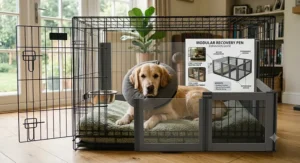
This is the detail that catches out an enormous number of owners: buying the crate before checking whether their dog can actually turn around in it while wearing the cone.
A standard Elizabethan collar adds meaningful width and length to your dog’s overall profile, and a crate that felt roomy for the dog alone can suddenly feel like a squeeze once that plastic cone is factored in. Metal crates with wide double doors, like the MidWest iCrate range, tend to handle this best — the rigid frame doesn’t compress under an awkward cone-first entry attempt the way soft mesh sometimes can. Open-top pens like the Ferplast Dog-Inn are arguably the easiest of all for e-collar compatibility, since there’s no doorway geometry to navigate at all.
Soft-sided crates aren’t necessarily a bad match, but the fabric door openings need a genuinely generous zip radius, and a cone edge repeatedly catching on mesh across a multi-week recovery isn’t just annoying — it’s a stress point for a dog who’s already having a difficult week. If you know your dog will be coning it up for the full recovery, prioritise crates with the widest, most rigid door openings on this list rather than the most compact footprint.
Rest Crate vs Room Rest: Which Suits an Injured Dog?
| Confinement Type | Best For | Movement Control | Owner Effort |
|---|---|---|---|
| Metal crate | Cruciate/ACL, high-mobility risk | Very high | Moderate |
| Open-top pen | Calm dogs, spay recovery | Moderate | Low |
| Full room rest | Very large dogs, extended timelines | Low-moderate | High |
A crate offers the tightest movement control of the three, which is exactly why it remains the default recommendation for orthopaedic surgery. Room rest — confining a dog to one puppy-proofed room rather than a literal crate — becomes the more practical option for genuinely giant breeds where no standard crate offers realistic living space for weeks on end, though it demands far more environmental vigilance from the owner, since a determined dog in an open room has considerably more scope to find trouble than one in a properly sized crate. For most dogs and most procedures covered in this guide, a correctly sized crate strikes the best balance between safety and manageable owner effort.
✨ Don’t Miss These Exclusive Deals!
🔍 Take the guesswork out of recovery. Click on any highlighted crate to check current pricing and availability. The right setup now means a smoother, faster healing journey for your dog.
Practical Usage Guide: Setting Up the Crate Before Surgery Day
The best time to introduce a recovery crate is before your dog needs it, not the panicked evening you bring them home groggy and confused.
In the days ahead of surgery, set the crate up in its permanent recovery spot and let your dog explore it on their own terms, scattering a few treats inside to build positive association rather than forcing entry. Line the base with washable, non-slip bedding — a proper orthopaedic mat rather than a slippery blanket, since traction matters enormously for a dog with a healing knee trying to stand up safely. On surgery day itself, have the crate fully ready before you leave for the clinic: water bowl positioned where it won’t tip, a stuffed food toy on standby for once appetite returns, and the crate door tested for smooth, quiet operation so a disoriented dog isn’t startled by a squeaky hinge at the worst possible moment.
A common first-week mistake is leaving the crate door open “just for a bit” once a dog seems more alert — that’s precisely the window where a sudden burst of post-anaesthesia energy meets zero physical readiness, and it’s a genuinely common cause of early setbacks. Stick to the confinement schedule your vet actually gave you, not the one your dog’s improving mood seems to be suggesting.
Real-World Scenarios: Which Crate Suits Your Recovering Dog?
Scenario one — the large-breed cruciate patient. A six-year-old Labrador recovering from TPLO surgery on a hind leg needs maximum structural confinement given the sheer force a 35kg dog can generate even accidentally. The MidWest iCrate 42-inch is the clear fit here, sized generously enough for comfort across a six-week timeline while remaining rigid enough to withstand a determined lean or scramble.
Scenario two — the calm senior after a routine spay. A gentle nine-year-old Cavalier King Charles Spaniel, not remotely inclined to jump or bolt, recovering from a straightforward spay, is well served by the Ferplast Dog-Inn open pen. The easy access matters enormously for an older dog who benefits from being lifted rather than coaxed through a doorway, and the shorter ten-day recovery window doesn’t demand maximum-security confinement.
Scenario three — the anxious small dog wearing an e-collar for two weeks. A nervous Miniature Dachshund recovering from a soft-tissue procedure, coning up for the full period, does best in the MidWest iCrate 24-inch — its rigid metal doorway handles cone clearance far more gracefully than fabric alternatives would, while still being appropriately scaled for a small dog’s comfort.
Problem → Solution Guide
Problem: my dog won’t settle in the crate at all. Cover three sides with a light sheet to reduce visual stimulation, and ensure the crate is positioned somewhere social rather than isolated — a crate in an empty spare room tends to trigger more distress than one beside the sofa.
Problem: the e-collar keeps catching on the crate door. Switch to a rigid metal crate with a wider door opening if you’re currently using a soft-sided model, since fabric zip-doors are the most common source of this specific friction.
Problem: my dog seems too big for the crate now that the cone is on. Size up one crate band from your dog’s weight-based recommendation whenever an e-collar is part of the recovery — the extra clearance genuinely matters.
Problem: my dog cries or paces constantly during confinement. This is common in the first 48 hours and often eases as anaesthesia clears fully; if it persists beyond a few days, flag it to your vet, since ongoing distress sometimes calls for additional calming support alongside the physical setup. The AKC’s post-surgical care guidance notes that daily incision checks and close monitoring of behaviour changes are the most reliable early warning signs worth tracking throughout this period.
Problem: I’m not sure when it’s safe to loosen the rules. Always follow your vet’s specific check-up timeline rather than judging by how your dog looks or acts — internal healing frequently lags well behind how comfortable a dog appears on the surface.
FAQ
❓ What size crate does my dog need after spay surgery?
❓ How long does a dog need to stay in a crate after cruciate surgery?
❓ Can my dog wear a cone inside a soft-sided crate?
❓ Is an open-top pen safe for post-surgery confinement?
❓ What's the difference between crate rest and room rest for an injured dog?
Conclusion
If there’s one thing worth taking from this whole guide, it’s that the “right” post surgery dog crate isn’t a single universal product — it’s whichever structure actually matches your dog’s specific surgery, size, and temperament. A boisterous Labrador three weeks into cruciate recovery and a placid senior spaniel ten days post-spay have almost nothing in common, recovery-wise, and their crates shouldn’t either.
Across the seven products in this guide, the clearest throughline was that rigid metal crates like the MidWest iCrate range earn their keep specifically for orthopaedic recovery, where explosive movement is the exact risk you’re managing against, while softer options and open pens genuinely shine for calmer, shorter-window procedures like spays. Get the sizing right, plan for e-collar clearance if you know it’s coming, and follow your vet’s confinement timeline over your dog’s increasingly convincing pleas to be let out early. That combination, more than any single product feature, is what actually gets a dog through recovery safely.
✨ Don’t Miss These Exclusive Deals!
🔍 Give your dog the safest possible recovery setup. Click on any highlighted crate above to check current pricing and availability today.
Recommended for You
- 7 Best Dog Recovery Crate After Surgery, Vet-Backed Picks (2026)
- Best Indestructible Dog Crate UK 2026: 7 Escape-Proof Picks
- Best Reinforced Dog Crate UK 2026: 7 Strongest Picks Reviewed
Disclaimer: This article contains affiliate links. As an Amazon Associate, I earn from qualifying purchases. If you purchase products through these links, we may earn a small commission at no additional cost to you.
✨ Found this helpful? Share it with your friends! 💬🤗
