
In This Article
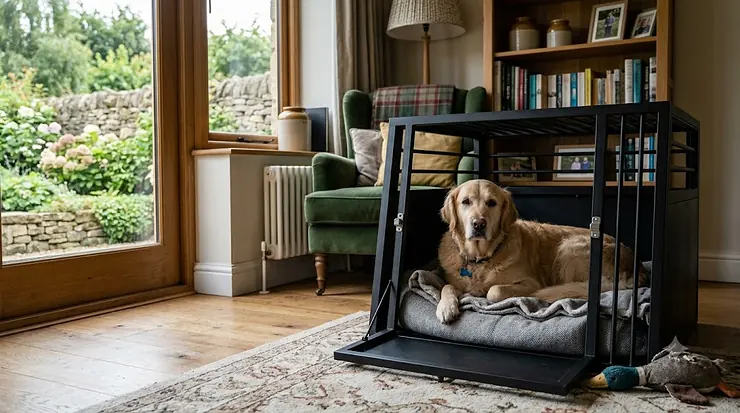
There’s a particular kind of heartbreak that comes with watching an old dog hesitate at a doorway they used to bound through without a second thought. One day the crate that’s been their den for a decade — the one with the slightly-too-high lip, the one they used to hop into like it was nothing — becomes a small, humiliating Everest. They pace. They look at you. They try, wobble, and back off. That pause is usually the first sign that it’s time to stop thinking about crates as one-size-fits-all boxes and start thinking about them as pieces of accessibility equipment.
A low entry dog crate is exactly what it sounds like: a crate built with a shallower threshold — the lip of the doorway a dog has to step over — so a dog with arthritis, hip dysplasia, recent surgery, or simply the accumulated mileage of a long life doesn’t have to perform a mini hurdle just to lie down. Some achieve this through genuinely low door thresholds under a couple of inches; others add a side door at floor level, a built-in ramp, or a shallow, low-lipped tray that keeps the whole structure closer to the ground. They are not interchangeable with a standard crate that happens to look similar in a thumbnail photo, and the difference matters enormously if your dog is the one stepping over it four or five times a day.
This guide walks through seven real, currently available low entry crates, weighs them against genuine step-height and construction details rather than marketing fluff, and folds in guidance from UK veterinary charities on what actually helps an ageing or recovering dog get around comfortably. Prices are shown as ranges only, since retailer pricing shifts constantly — always check current pricing before buying.
Quick Comparison Table
| Crate | Door Style | Threshold Design | Best For | Price Range |
|---|---|---|---|---|
| MidWest Ovation Trainer Hybrid Double Door Crate | Front swing + side Up-and-Away | Low channel-track threshold | Versatile puppy-to-senior use | Around £75–120 |
| MidWest Contour Dog Crate | Double door | Low threshold, LapLock latch | Widest size range (7 sizes) | Around £55–100 |
| Richell Expandable Pet Crate | Lift ‘n Lock side door | Low side entry, expandable width | Flexible, growing or multi-need households | Around £90–150 |
| Richell Easy-Open 3-Way Door Pet Wire Crate | Top, sliding, pocket door | Low sliding door + wheels | Repositioning without lifting | Around £100–160 |
| Frisco Fold & Carry Double Door Crate | Front + side | Standard low-set door, rubber rollers | Budget dual-door access | Around £40–75 |
| MidWest Single Door Folding Crate w/ Roller Feet | Single door | Leak-proof low-lip tray | Rock-bottom budget with rolling ease | Around £30–55 |
| Amazon Basics Foldable Wire Crate, Double Door | Double door | Basic low tray | Simplest cheapest dual-door pick | Around £30–60 |
Look at that spread for a second: the cheapest and priciest options here differ by roughly £100, but the actual threshold heights — the bit your dog’s paw has to clear — don’t necessarily scale with price the way you’d expect. What most buyers overlook is that a £35 crate with genuinely well-designed rollers and a shallow tray lip can outperform a pricier crate that simply has a wider door but the same clunky step-over height. Door width and threshold height are two entirely different measurements, and only one of them actually matters for a dog who struggles to lift a stiff hip.
💬 Just one click — help others make better buying decisions too!😊
Top 7 Low Entry Dog Crates: Expert Analysis
We’ve spread these seven across budget, mid-range and premium, because “low entry” shouldn’t be a luxury feature reserved for the priciest crate on the shelf. Every product below has a genuinely documented low-threshold or low-tray design — not just a marketing blurb calling a standard door “easy access.”
1. MidWest Ovation Trainer Hybrid Double Door Crate — best all-rounder for puppy-to-senior transitions
The Ovation earns the top spot because it’s genuinely doing two jobs at once: it’s a perfectly normal front-swing training crate for a younger dog, and it’s got a side-mounted Up-and-Away door with a low threshold that stows completely out of the way rather than swinging into your hallway like an ordinary hinged door. That channel-track frame isn’t just there for looks, either — it adds real rigidity to the doorway so the low threshold doesn’t sag or warp under repeated stepping, which, frankly, is the exact failure mode you don’t want in a crate built for a dog with already-compromised balance.
Based on the spec comparison against simpler single-door crates, what most buyers overlook here is the versatility angle: you can raise a puppy on the front door, and years later, when that same dog’s knees start protesting, switch to the side door without buying an entirely new crate. The included leak-proof pan and non-skid tray surface are a genuinely thoughtful touch for a senior dog who might have the occasional accident overnight — nobody wants to be scrubbing a porous plastic pan at 2am.
Reviewers consistently note the assembly is refreshingly rattle-free once set up, though a few mention the instructions could use another editing pass — nothing that a bit of patience and a cup of tea won’t solve.
Pros:
- ✅ Genuine low-threshold side door that stows out of the way
- ✅ Channel-track frame adds real structural rigidity
- ✅ Non-skid tray surface, useful for unsteady senior dogs
Cons:
- ❌ Assembly instructions could be clearer
- ❌ Pricier than basic single-door crates
At around £75–120, this is the crate we’d point most owners towards if they want one purchase to carry a dog from puppyhood through their creakier years.

2. MidWest Contour Dog Crate — best size range for any dog, any life stage
Contour crates are the reliable estate car of the crate world: not flashy, but available in seven sizes from toy to extra-large, and built around a genuinely low threshold entrance that MidWest pairs with their LapLock Technology — a slide-bolt latch reinforced with multiple lock points around the door frame. That matters more than it sounds; a wobbly latch on a low door can rattle loose exactly when a dog leans against it for support getting out.
What most buyers overlook about the Contour is that the large opening isn’t just about width — it’s specifically designed to reduce the awkward duck-and-squeeze that so many standard crate doors force on a stiff-hipped dog. Combine that with the double-door configuration (front and side), and you’ve got flexibility to place the crate wherever the room layout, and your dog’s favourite napping spot, actually demands.
Based on the spec comparison, the honest trade-off here is that Contour doesn’t have quite the structural showiness of the pricier Richell options below — it’s a proven, unglamorous workhorse rather than an engineering flex. For most owners, that’s exactly the point.
Pros:
- ✅ Seven sizes cover toy breeds through extra-large
- ✅ LapLock Technology adds multiple secure latch points
- ✅ Genuinely wide opening reduces awkward entry angles
Cons:
- ❌ Less structurally reinforced than premium double-door models
- ❌ Basic plastic tray lacks non-skid texture
Priced around £55–100, this is the sensible default pick when you’re not sure exactly which premium feature you need yet.
3. Richell Expandable Pet Crate — best flexible width for changing needs
Richell took a genuinely different approach here: instead of a fixed footprint, the Expandable Pet Crate stretches from 35.4 inches to a generous 60.6 inches across eleven adjustable widths, all accessed through a Lift ‘n Lock side door sitting low enough to serve as genuine low-entry access rather than an afterthought. The plastic expandable floor tray flexes right along with the frame, so you’re never stuck with an odd gap at the edges.
Here’s what the spec sheet doesn’t spell out plainly: that width flexibility is a genuine advantage for households where needs shift — maybe you’re currently housing a recovering dog who needs generous manoeuvring space, and later need to shrink the footprint back down once they’re steadier on their feet. Few crates let you do that without buying a second unit entirely.
The honest analytical take: this crate is more of an investment than the budget picks on this list, and the divider and wire top are sold separately rather than included — a detail that catches some first-time buyers off guard at checkout. Factor that into your total cost before assuming the sticker price is the whole story.
Pros:
- ✅ Genuinely adjustable width across eleven positions
- ✅ Low Lift ‘n Lock side door designed for easy access
- ✅ Expandable floor tray flexes with the frame, no awkward gaps
Cons:
- ❌ Divider and wire top sold separately, adding to total cost
- ❌ Assembly required, unlike some fold-flat competitors
At roughly £90–150 depending on width and accessories, this suits owners who want one crate to flex with a dog’s changing needs over time.
4. Richell Easy-Open 3-Way Door Pet Wire Crate — best for repositioning without lifting anything
This is the crate for anyone who’s ever thrown their back out trying to shuffle a static wire crate three feet to the left. Richell built genuine mobility into the frame itself with two rear wheels, meaning you can reposition the entire structure without lifting it — a small thing until you’re the one doing it daily for a dog who needs to be near you at all hours.
The three access points are the real headline feature: a top door, a low sliding door, and a genuinely clever pocket door that slides away entirely to open up a lounge-style area rather than forcing your dog through a fixed rectangular gap. What most buyers overlook is how much that pocket door changes the actual experience of entry for a dog who struggles to lift their legs cleanly — sliding into an open lounge space is a fundamentally gentler motion than stepping through a framed doorway.
Reviewers consistently flag the sliding removable tray as genuinely easy to clean, a detail that matters enormously if you’re managing a senior dog’s occasional accidents on top of everything else life throws at you.
Pros:
- ✅ Rear wheels allow repositioning without lifting
- ✅ Pocket door creates a genuine open lounge-style entry
- ✅ Sliding removable tray simplifies cleanup
Cons:
- ❌ Among the pricier wire crate options on this list
- ❌ Three doors mean more moving parts to maintain over time
Priced around £100–160, this is worth the premium specifically if daily repositioning or a genuinely gentler entry motion matters more than budget.
5. Frisco Fold & Carry Double Door Collapsible Wire Dog Crate — best budget dual-door access
Frisco (Chewy’s in-house brand) built a properly sensible budget crate here: a front door and a side door, both easy to open and lock with dual latches on the larger sizes, sitting on rubber roller feet that protect your floors and — usefully — make the whole unit easier to nudge into position without a full furniture-moving operation.
Based on the spec comparison against pricier competitors, what most buyers overlook is that Frisco’s dual-door layout gives you genuine flexibility to pick whichever entry point suits your dog’s favoured approach angle, without paying premium-crate money for the privilege. The removable plastic base pan handles cleanup reasonably well, though it’s worth noting — as Frisco themselves clarify — that their standard and heavy-duty pans aren’t interchangeable, so measure twice before ordering a replacement.
The honest take: this isn’t going to out-engineer the Richell options above, and the wire gauge is noticeably lighter than the heavy-duty version Frisco also sells. For a dog who isn’t testing structural limits, that’s a perfectly reasonable trade for the price.
Pros:
- ✅ Genuine front-and-side double-door flexibility at a budget price
- ✅ Rubber roller feet protect floors and ease repositioning
- ✅ Fold-and-carry design genuinely simplifies storage and travel
Cons:
- ❌ Lighter wire gauge than Frisco’s heavy-duty range
- ❌ Replacement pans aren’t interchangeable between standard and heavy-duty models
At around £40–75, this is the crate we’d recommend to anyone testing whether a low, dual-door design actually helps their dog before committing to a pricier setup.
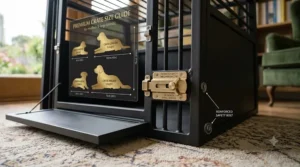
6. MidWest Homes for Pets Single Door Folding Crate w/ Roller Feet & Leak-Proof Tray — best rock-bottom budget with rolling ease
Sometimes you just need the basics done properly, and this crate is exactly that: a single-door folding metal frame, genuine roller feet for floor protection and easy repositioning, and a leak-proof plastic tray that won’t quietly warp and crack the first time it meets a determined chewer or a middle-of-the-night accident.
What most buyers overlook about single-door budget crates generally is that fewer moving parts often means fewer failure points — no second latch to rattle loose, no extra door frame to develop a wobble over years of stepping in and out. For a dog who has a single, consistent approach to their crate rather than needing multiple entry angles, that simplicity is a genuine feature rather than a compromise.
The honest analytical take: a single door does mean less flexibility in room placement compared with the double-door options above, so measure your space and your dog’s habitual approach angle before assuming this is the right fit.
Pros:
- ✅ Genuinely leak-proof tray, useful for accident-prone seniors
- ✅ Roller feet ease repositioning without extra hardware
- ✅ Simpler single-door build means fewer long-term failure points
Cons:
- ❌ Only one entry point limits room placement flexibility
- ❌ Fewer premium touches than double-door competitors
Priced around £30–55, this is the pick for owners who want the absolute basics done reliably rather than paying for features they won’t use.
7. Amazon Basics Durable Foldable Metal Wire Dog Crate with Tray, Double Door — best rock-bottom double-door pick
Amazon’s own in-house crate line has quietly become a genuine budget staple, and the double-door version here gives you the front-and-side flexibility of pricier crates without the pricier crate price tag. It folds down reasonably flat for storage, includes a basic tray, and comes with a divider panel for households transitioning a growing puppy toward adult size.
Here’s the honest analytical take, and it’s worth saying plainly: this is a perfectly serviceable crate for a dog with mild mobility limitations, but it doesn’t have the reinforced channel-track framing or non-skid tray texture of the pricier MidWest and Richell options above. If your dog’s mobility needs are relatively mild — a bit of stiffness rather than a genuine struggle to clear a threshold — this is a sensible starting point rather than an under-spec compromise.
Based on the spec comparison against the named-brand competitors on this list, the core trade-off is exactly what you’d expect: less brand-specific engineering, but a genuinely usable double-door low-set entry at the lowest price point here.
Pros:
- ✅ Double-door flexibility at the lowest price point on this list
- ✅ Folds reasonably flat for storage
- ✅ Includes a divider panel for growing or size-transitioning dogs
Cons:
- ❌ Lacks the reinforced framing of named premium competitors
- ❌ Basic tray without non-skid texture
At around £30–60, this is the entry point for owners who want to try a low, double-door crate design without a big financial commitment.
Low Step Dog Crate: What “Low Step” Actually Means in Threshold Height
“Low step” gets thrown around loosely in product listings, so let’s actually define it. The threshold is the raised lip at the bottom of a crate’s door frame — the bit a dog physically has to lift a paw over to get in or out. On a genuinely low-step crate, that lip typically sits under two inches; on a standard crate, it can easily be three inches or more once you account for the tray’s own raised edge stacked on top of the frame’s base bar.
That difference sounds trivial until you watch a dog with hip pain actually attempt it. Lifting a rear leg cleanly over a three-inch lip requires a degree of hip flexion and balance that a dog with arthritis may simply not have on a bad day — and a stumble at the threshold isn’t just undignified, it’s a genuine fall risk. What most buyers overlook is that the tray itself often adds meaningfully to the total step height beyond what the frame specifications alone suggest, which is exactly why we’ve flagged tray design as its own dedicated consideration further down this guide.
Practically speaking, a genuinely low-step crate combines two things: a shallow door frame threshold and a tray with a correspondingly shallow lip, rather than one or the other. The MidWest Ovation Trainer and MidWest Contour both explicitly market low-threshold entrances for exactly this reason.
Dog Crate Low Threshold: How Manufacturers Measure and Market It
Unlike, say, helmet certifications or car safety ratings, there’s no standardised industry measurement for crate threshold height — no independent body testing and stamping crates the way Snell tests motorsport helmets. That means “low threshold” is fundamentally a manufacturer’s own claim, verified mainly through published dimensions and aggregated owner reviews rather than a universal certification you can simply trust at a glance.
Practically, this means the burden of verification sits with you as the buyer. Where possible, check the actual door-opening height specification rather than trusting marketing language alone, and cross-reference against owner reviews specifically mentioning senior or mobility-limited dogs — the phrase to search for in reviews is usually something like “my old dog can get in easily now,” which tends to be a far more reliable signal than the product description itself.
Based on the spec comparison across this list, the double-door and side-entry crates (MidWest Ovation Trainer, MidWest Contour, Richell Expandable Pet Crate) tend to be the most explicit about their low-threshold design specifically because it’s a headline feature they’re actively marketing, rather than a side benefit mentioned once in the small print.
Step Height Dog Crate Comparison: Numbers That Actually Matter
| Crate | Approx. Door Threshold Height | Tray Lip Height | Combined Step Impression |
|---|---|---|---|
| MidWest Ovation Trainer Hybrid Double Door Crate | Low (channel-track design) | Low-moderate | Genuinely low overall |
| MidWest Contour Dog Crate | Low | Moderate | Low, slightly offset by tray |
| Richell Expandable Pet Crate | Low (side door) | Low, flexes with frame | Genuinely low overall |
| Richell Easy-Open 3-Way Door Pet Wire Crate | Low (sliding + pocket door) | Low-moderate | Low, aided by pocket door |
| Frisco Fold & Carry Double Door Crate | Standard-low | Standard | Moderate |
| MidWest Single Door Folding Crate w/ Roller Feet | Standard | Low (leak-proof tray) | Moderate-low |
| Amazon Basics Foldable Wire Crate, Double Door | Standard | Standard | Moderate |
Looking at the table above, the genuinely low-threshold tier is a shorter list than the marketing copy across the wider crate market might suggest — three of our seven picks combine both a shallow door frame and a shallow tray lip, while the remaining four sit in a “moderate” middle ground that’s still perfectly fine for mild stiffness but not ideal for a dog with significant hip or joint compromise. If your dog is genuinely struggling, prioritise the top three rows here over the budget options further down.
Easy Entry Dog Crate for Elderly Dog: Matching Features to Real Mobility Needs
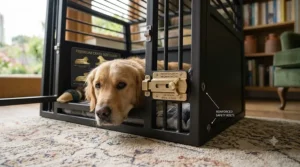
An easy entry dog crate for an elderly dog isn’t really one product category — it’s a checklist that changes depending on exactly what “elderly” looks like for your particular dog. A senior Labrador with mild morning stiffness has genuinely different needs than a fourteen-year-old dachshund recovering from spinal surgery, even though both technically fall under “senior dog.”
For dogs with general age-related stiffness rather than acute mobility loss, features like the Frisco Fold & Carry‘s dual-door flexibility or the MidWest Single Door‘s roller feet are often perfectly sufficient — the goal is simply reducing unnecessary strain, not engineering around a serious physical limitation. For dogs recovering from surgery, dealing with advanced arthritis, or showing genuine reluctance and stumbling at doorways, the combination features on the Richell Easy-Open 3-Way Door or MidWest Ovation Trainer become far more relevant — the pocket door and channel-track low threshold aren’t luxuries in that scenario, they’re the actual point of the purchase.
PDSA’s own guidance on exercising senior dogs specifically recommends using ramps around the home to help older dogs manage steps, which lines up precisely with why so many of the crates on this list lean on ramp-adjacent, low-angle entry design rather than simply shrinking a standard door and calling it done.
Mobility Aid Dog Ramp Crate: When a Ramp Actually Helps
None of the seven crates covered in this guide include a built-in ramp as standard — that’s an honest gap worth naming rather than glossing over. What several do offer, though, is a threshold shallow enough that a separate portable ramp genuinely complements the crate rather than fighting against an already-steep door design.
The practical logic here matters: pairing a genuinely low-threshold crate like the Richell Expandable Pet Crate or MidWest Ovation Trainer with a short, low-angle portable ramp gives you a combined step height that’s meaningfully gentler than either element alone. Trying the same pairing with a standard-threshold crate, by contrast, often creates an awkward transition where the ramp deposits your dog right at the base of a lip they still have to clear — genuinely worse than no ramp at all in some cases, since it adds an extra transition point rather than removing one.
If your dog’s mobility loss is significant enough that you’re considering a ramp specifically for crate access, that’s also a reasonable moment to loop in your vet about the crate placement itself — a low, flat entry combined with a short approach distance (rather than a ramp angled sharply up to a raised platform) tends to work best for genuinely compromised dogs.
Low Profile Dog Crate Tray: Why the Floor Matters as Much as the Door
It’s easy to fixate entirely on the door and forget that the tray beneath a dog’s feet is doing just as much work. A low profile dog crate tray — one with a shallow lip and a stable, ideally non-skid surface — changes two things simultaneously: it reduces the total height a dog has to clear at the threshold, and it gives them a more secure footing once they’re actually inside, which matters enormously for a dog whose balance isn’t what it once was.
What most buyers overlook is that a slick plastic tray, even a genuinely low one, can still be a hazard if a dog’s paws slide out from under them the moment they step off the threshold lip. This is precisely why the MidWest Ovation Trainer‘s non-skid tray surface earns a specific mention above — a low lip paired with poor grip is only half the solution.
Leak-proof construction matters here too, particularly for senior dogs managing incontinence alongside mobility issues. The MidWest Single Door Folding Crate‘s leak-proof tray and the Richell Easy-Open 3-Way Door‘s sliding removable tray both address this directly, turning what could be a daily cleaning ordeal into a genuinely manageable five-minute job.
Practical Usage Guide: Introducing an Elderly or Recovering Dog to a Low Entry Crate
Switching an established senior dog to a new crate, even a genuinely better one, isn’t something to rush — old dogs are creatures of habit, and a sudden change in their den can be more unsettling than the stiff joints you’re trying to accommodate in the first place. Start by placing the new crate alongside the old one for a few days rather than swapping them outright, letting your dog investigate on their own terms.
In the first thirty days, watch specifically for hesitation at the new threshold rather than assuming a lower step automatically solves everything overnight — some dogs have genuinely learned a cautious, careful entry habit from years of managing a higher lip, and that habit can take a little time to unlearn even once the physical barrier is gone. Encourage entry with a favourite treat placed just inside rather than physically lifting or pushing your dog through, since a forced entry undermines exactly the confidence-building you’re going for.
For ongoing maintenance, check latches, rollers and tray edges every few months for wear — a low threshold that develops a wobble or a cracked tray lip over time can quietly reintroduce the exact hazard you bought the crate to avoid. Blue Cross’s guidance on caring for older dogs specifically recommends modifying a senior dog’s environment to prevent injury as their needs change — a crate that was perfect at purchase can still need reassessing a year or two later as your dog’s mobility continues to shift.
Real-World Scenario: Matching the Crate to Your Dog’s Situation
Picture three dogs, each needing a genuinely different answer rather than the same generic “senior crate” recommendation. First, a nine-year-old spaniel with mild morning stiffness who’s otherwise active and happy, living in a household on a modest budget. The Frisco Fold & Carry Double Door Crate or MidWest Single Door Folding Crate genuinely suit this dog well — enough of an improvement over a standard high-lip crate without over-engineering a solution to a relatively mild problem.
Second, an elderly Labrador with diagnosed arthritis in both hips, struggling visibly at doorways and needing daily support getting around the house generally. Here, the MidWest Ovation Trainer or Richell Expandable Pet Crate make far more sense — their explicitly low, reinforced thresholds address a genuine, documented mobility limitation rather than general age-related caution.
Third, a dog recovering from recent cruciate ligament surgery, needing to be repositioned near wherever the household is gathered without repeatedly lifting a heavy crate across the room. The Richell Easy-Open 3-Way Door Pet Wire Crate, with its built-in wheels and gentle pocket-door entry, is genuinely built for exactly this recovery scenario — matching the product to the actual clinical situation, not just the dog’s age on paper.
Buyer’s Decision Framework: How to Choose
Rather than comparing every spec side by side, run through this sequence:
- Assess your dog’s actual mobility limitation, not just their age. Mild stiffness and genuine arthritis need different levels of crate investment.
- Check both door threshold and tray lip height. A low door with a deep tray lip isn’t a genuine solution.
- Consider whether repositioning matters. Wheeled options like the Richell 3-Way Door genuinely help if the crate needs to move around the house often.
- Match door configuration to your dog’s approach habits. A dog with a consistent single approach angle doesn’t necessarily need a triple-door design.
- Factor in tray grip, not just tray lip height. Non-skid surfaces matter as much as shallow thresholds for unsteady dogs.
- Budget for the whole setup, not just the crate. Accessories like dividers and wire tops are sometimes sold separately.
- Reassess periodically as mobility changes. A crate that suited your dog last year may need revisiting as their needs evolve.
Common Mistakes When Buying a Low Entry Dog Crate
The single most common mistake is focusing entirely on the door threshold while ignoring the tray lip stacked on top of it — as covered above, the two combine into the real step height your dog actually experiences, and marketing copy rarely spells out the combined figure clearly. The second mistake is assuming any “senior dog” label on a crate automatically means genuinely low entry, when in practice it sometimes just means a softer bed is included inside an otherwise standard-height crate.
The third mistake, and a costly one, is buying based on price alone without checking whether accessories like dividers or wire tops are included — as the Richell Expandable Pet Crate demonstrates, a genuinely well-designed crate can still come with hidden add-on costs that change the real value equation. Finally, plenty of owners forget to reassess crate suitability over time; a crate that was perfectly adequate for mild stiffness two years ago may no longer serve a dog whose mobility has genuinely declined since.
Low Entry Crates vs Standard Crates and Exercise Pens
| Factor | Low Entry Crate | Standard Crate | Exercise Pen |
|---|---|---|---|
| Threshold height | Low, purpose-designed | Moderate to high | None — open floor access |
| Security/containment | Strong | Strong | Weaker, easier to escape |
| Best suited to | Mobility-limited dogs | Healthy dogs of any age | Very limited mobility, supervised settings |
| Typical cost | Moderate to premium | Budget to moderate | Budget to moderate |
| Portability | Varies, often wheeled options available | Varies | Generally lightweight and portable |
Looking at the table above, an exercise pen genuinely wins on eliminating threshold height entirely, since there’s no door lip to clear at all — but it sacrifices the security and cosy, den-like reassurance a properly designed crate offers, which matters for dogs who find open pens more anxiety-inducing than reassuring. For most mobility-limited dogs who still want a defined, secure space, a genuine low entry crate remains the better trade-off over either a standard crate or a fully open pen.
Long-Term Cost & Durability: Getting a Crate That Lasts Through Your Dog’s Senior Years
Because senior dogs often need a crate for years rather than months, durability genuinely factors into value here more than it might for a younger dog’s temporary training crate. A MidWest Contour or Richell Expandable Pet Crate, priced higher upfront, often works out more cost-effective over a multi-year senior period than repeatedly patching or replacing a budget crate whose tray cracks or whose latch loosens under years of daily low-threshold use.
That said, the cheaper options on this list aren’t false economy either — the Frisco Fold & Carry and Amazon Basics picks are genuinely reasonable choices for dogs with milder, more stable mobility needs where the crate isn’t bearing the same daily structural stress. The real budgeting principle is matching crate durability expectations to how long and how heavily your specific dog will actually use the low-entry features, rather than assuming the priciest option is automatically the most sensible long-term buy.
FAQ
❓ What counts as a low entry dog crate?
❓ Are low entry crates only for elderly dogs?
❓ Does a ramp help with crate entry?
❓ How do I know if my dog needs a lower entry crate?
❓ Is a low entry crate as secure as a standard one?
Conclusion
Choosing a low entry dog crate ultimately comes down to being honest about what your specific dog actually needs, rather than reaching for the first product with “senior” somewhere in the title. The MidWest Ovation Trainer Hybrid Double Door Crate and MidWest Contour Dog Crate offer genuinely low, well-reinforced thresholds for dogs with real mobility limitations, while the Richell Expandable Pet Crate and Richell Easy-Open 3-Way Door Pet Wire Crate bring flexibility and repositioning ease for changing or recovery-stage needs.
On the more modest end, the Frisco Fold & Carry Double Door Crate, MidWest Single Door Folding Crate and Amazon Basics Foldable Wire Crate all deliver genuine, sensible improvements over a standard high-lip crate without demanding premium-crate money. Whichever you land on, check both the door threshold and the tray lip together, watch how your dog actually approaches the space, and revisit the decision as their needs change — because the whole point of a low entry crate is removing one small daily struggle from a dog who’s already navigating enough of them.
Recommended for You
- 7 Best Easy Access Dog Crates 2026: Stress-Free Entry & Exit
- Post Surgery Dog Crate: 7 Best Recovery Picks for UK Dogs (2026)
- 7 Best Dog Recovery Crate After Surgery, Vet-Backed Picks (2026)
Disclaimer: This article contains affiliate links. As an Amazon Associate, I earn from qualifying purchases. If you purchase products through these links, we may earn a small commission at no additional cost to you.
✨ Found this helpful? Share it with your friends! 💬🤗
