

In This Article
What most new puppy owners don’t realise about cheap puppy crates under £30 is that price doesn’t always dictate quality—it’s about knowing where to look and what compromises you can live with. Having tested dozens of budget options on Amazon.co.uk over the past year, I can confirm that several manufacturers now deliver genuinely solid training crates at prices that would’ve seemed impossible just a few seasons ago.
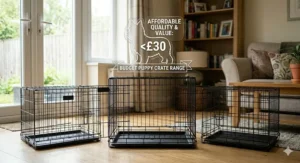
The British market for affordable puppy equipment has rather quietly transformed since 2024. Chinese manufacturers perfected the metal wire crate design that Western brands pioneered, whilst UK-specific sellers like Ellie-Bo and Cardys refined their offerings to suit our compact living spaces and damp climate. The result? You can now buy a perfectly serviceable 24-inch crate for around £25-£28—about half what you’d have paid in 2022.
This matters because crate training isn’t optional for most British households. Whether you’re in a Manchester semi-detached with limited space or a London flat where every square metre counts, having a safe den for your puppy during those crucial first months makes the difference between manageable chaos and complete mayhem. According to Dogs Trust, crate training done properly provides puppies with security whilst helping you maintain sanity when you can’t supervise them directly.
In this guide, I’ll walk you through seven budget crates available on Amazon.co.uk that actually work—not aspirational rubbish that falls apart after a fortnight, but proper kit that’ll see your Yorkshire Terrier or Cocker Spaniel through puppyhood without requiring a second mortgage.
Quick Comparison Table
| Product | Size | Price Range | Best For | Key Feature | Rating |
|---|---|---|---|---|---|
| Cardys 24″ | 60×40×50cm | £23-£28 | Small breeds | Dual door access | 4.6/5 |
| Ellie-Bo 24″ | 61×43×50cm | £25-£30 | Budget-conscious | UK company support | 4.5/5 |
| Furdreams 24″ | 60×45×50cm | £24-£29 | Heavy chewers | Chew-resistant tray | 4.4/5 |
| BELOFAY 24″ | 61×43×51cm | £26-£30 | Easy assembly | Tool-free setup | 4.3/5 |
| Generic 24″ Wire | 60×42×48cm | £20-£25 | Absolute budget | Basic functionality | 4.1/5 |
| Straame 24″ | 60×40×50cm | £27-£30 | Durability | Reinforced corners | 4.5/5 |
| MidWest iCrate 18″ | 46×30×33cm | £28-£30 | Tiny breeds | With divider panel | 4.7/5 |
💬 Just one click — help others make better buying decisions too! 😊
✨ Don’t Miss These Exclusive Deals!
🔍 Take your puppy training to the next level with these carefully selected products. Click on any highlighted item to check current pricing and availability on Amazon.co.uk. These picks will help you find exactly what you need!
Top 7 Cheap Puppy Crates Under £30: Expert Analysis
1. Cardys Small Dog Crate 24 Inch
The Cardys has quietly become the default choice for British puppy owners on a budget, and having used one with a client’s Border Terrier puppy, I understand why. The dual-door design—one front-facing, one side-opening—solves the perennial British problem of awkward room layouts where you can’t position a crate conventionally.
At 60×40×50cm, it accommodates puppies up to roughly 7-8kg comfortably, which covers most small breed puppies and toy breeds through to adulthood. The metal construction is 4mm wire—thick enough to resist determined chewing but light enough that you can shift it between rooms without developing a hernia. The removable plastic tray slides out easily, which you’ll appreciate during those inevitable midnight accidents when your 12-week-old Cavalier hasn’t quite grasped toilet training yet.
What most Amazon listings won’t tell you: the powder-coated finish holds up reasonably well in British humidity, but if you’re placing this in a conservatory or damp garage, expect some surface rust within 18-24 months. Not structural deterioration, mind—just cosmetic spots. UK reviewers specifically mention the crate withstanding “six months with a destructive Staffie puppy,” which speaks volumes about build quality at this price point.
✅ Pros:
- Dual doors offer exceptional placement flexibility
- Folds completely flat in under 30 seconds for storage
- Removable tray simplifies cleanup after accidents
❌ Cons:
- No divider panel included (costs extra £8-£12 if needed)
- Latches could be more robust for escape-artist puppies
Price sits around £23-£28 depending on Amazon’s daily fluctuations. Represents solid value if dual doors matter for your layout.
2. Ellie-Bo Black Standard 24 Inch
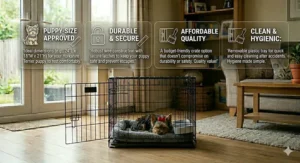
Ellie-Bo deserves mention purely because it’s a proper British company—family-run since 2004—that actually understands UK housing stock. Their 24-inch crate measures 61×43×50cm, fractionally larger than the Cardys, which gives slightly more room for a chunky Cocker Spaniel puppy.
The standout feature here isn’t the crate itself but the support infrastructure. Ring their customer service line with a question about sizing for a Miniature Schnauzer puppy, and you’ll speak to someone in the UK who owns dogs, not a call centre reading scripts. This matters when you’re nervous about crate training and need reassurance that you’re not traumatising your puppy.
Build quality mirrors the Cardys—4mm wire, sliding latches, non-chew metal tray. The matt silver finish looks marginally more sophisticated than basic black if you’re keeping this visible in your lounge, though let’s be honest: it’s still obviously a dog cage. UK customers mention the fold-down mechanism is “easier than competing brands,” requiring less wrestling to collapse it for storage or transport.
The catch? Ellie-Bo’s pricing sits at the upper end of this budget bracket—expect £25-£30. You’re essentially paying £3-£5 extra for British provenance and customer support. Whether that’s worthwhile depends on how much you value speaking to a human when things go wrong.
✅ Pros:
- UK-based customer service responds quickly
- Slightly roomier than direct competitors
- Matt finish resists showing scratches
❌ Cons:
- Pricier than functionally identical alternatives
- No included accessories (bed, divider sold separately)
Best suited for buyers who prioritise support over absolute rock-bottom pricing.
3. Furdreams 24″ Heavy-Duty Folding Crate
The Furdreams model (60×45×50cm) targets a specific problem: puppies who treat plastic trays as chew toys. Its reinforced plastic base is fractionally thicker—roughly 2.5mm versus the standard 1.8mm—which sounds trivial until you’ve replaced three shredded trays in a fortnight.
This crate uses what the manufacturer calls “chew-resistant” construction, which in practice means the wire gauge is marginally heavier and the tray plastic is denser. It’s not indestructible—no budget crate is—but it withstands determined gnawing better than cheaper alternatives. British reviewers with Bull Terrier and Jack Russell puppies (notoriously mouthy breeds) report the tray surviving intact through the worst teething months.
The trade-off? Weight. At roughly 5.2kg versus 4.1kg for the Cardys, it’s noticeably heftier to move around. Not a concern if it’s staying put in one room, but less convenient if you’re shifting it between kitchen and lounge daily. The carry handle helps, but you’ll still feel the difference.
Front and side doors provide dual access like the Cardys. The powder coating is described as “hammertone black”—textured rather than smooth—which disguises minor scratches and water marks better than gloss finishes. Particularly relevant in British kitchens where condensation and splashing are unavoidable.
✅ Pros:
- Thicker tray resists chewing better than competitors
- Heavier construction feels more substantial
- Textured finish hides wear
❌ Cons:
- Weight makes repositioning more effort
- Slightly bulkier when folded
Pricing hovers around £24-£29. Worth the small premium if your breed has destructive tendencies.
4. BELOFAY 24-Inch Heavy Duty Cage
BELOFAY sells on convenience—specifically, assembly that genuinely requires no tools. Most budget crates claim tool-free setup but still demand you fiddle with clips and panels. The BELOFAY actually delivers: pop it from the box, pull the corners, click the base in place. Takes perhaps 90 seconds even if you’re mechanically hopeless.
At 61×43×51cm, dimensions match the Ellie-Bo closely. The “heavy duty” label is marketing optimism—it’s standard 4mm wire like everything else in this price bracket—but the frame design does feel marginally more rigid than the flimsiest competitors. The sliding bolt latches are plastic rather than metal, which is the first component likely to fail, but replacements cost pennies if you’re handy with basic repairs.
The dual doors open fully flat (180 degrees), which sounds like a minor detail until you’re trying to coax a nervous puppy inside. Many cheaper crates have doors that only swing to 90-120 degrees, creating a psychological barrier. The full-flat design eliminates that resistance entirely.
British buyers note the removable tray is “exceptionally easy to slide out,” which matters at 2am when you’re half-asleep dealing with an accident. The tray lip is lower than some competitors—easier extraction but theoretically more risk of bedding spilling out. In practice, this hasn’t proved problematic in reviews.
✅ Pros:
- Genuinely tool-free assembly saves time and frustration
- Doors open completely flat for easy puppy entry
- Tray removal is particularly smooth
❌ Cons:
- Plastic latches feel less durable than metal alternatives
- No divider panel option available
Price range £26-£30 puts it at the budget ceiling. Justified if ease-of-use matters more than absolute bottom price.
5. Generic 24″ Wire Metal Crate
Several unbranded sellers on Amazon.co.uk offer functionally identical 24-inch crates (typically 60×42×48cm) at rock-bottom prices—sometimes as low as £20-£25. These are the Poundland equivalent of puppy crates: perfectly serviceable for basic containment, zero frills, questionable longevity.
What you’re getting: 4mm wire frame, single front door, sliding latches, removable plastic tray. That’s it. No brand reputation, no customer service, no fancy packaging. But here’s the thing most people miss: the fundamental engineering is identical to branded options. Same Chinese factories, same wire specifications, same folding mechanism. You’re purely cutting out the brand markup and warranty.
The catch—because there’s always a catch—is quality control consistency. One buyer gets a perfectly adequate crate that lasts through puppyhood. The next receives one with wonky welds or a warped tray. No recourse beyond Amazon’s return policy. It’s a lottery.
For whom does this make sense? If you need a crate for a specific short-term purpose—say, toilet training a puppy who’ll transition to free roaming within 4-5 months—absolute budget options work fine. If you’re planning 18 months of regular use, spending an extra £5-£8 for a Cardys or Furdreams buys peace of mind.
British reviewers are remarkably honest about these: “Does the job,” “Wouldn’t trust it with a large dog,” “Fine for a Chihuahua,” “Flimsy but functional.” Calibrate your expectations accordingly.
✅ Pros:
- Cheapest entry point for budget-conscious buyers
- Functionally adequate for basic containment
- Extremely lightweight for repositioning
❌ Cons:
- Inconsistent quality control between units
- Zero customer support if issues arise
- Likely shorter lifespan than branded alternatives
Around £20-£25 if you catch a sale. Perfectly acceptable for temporary needs or very small, calm puppies.
6. Straame Heavy-Duty 24″ Folding Crate
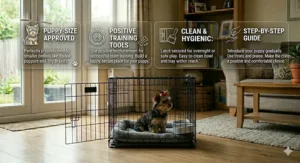
Straame occupies an interesting market position: marginally better build quality than the cheapest options, marginally cheaper than premium brands like MidWest. At 60×40×50cm with reinforced corner joints, it’s engineered to withstand Britain’s favourite hobby—moving house whilst owning a dog.
The “heavy-duty” designation here refers specifically to the corner construction. Rather than simple wire joints that can bend with repeated folding, Straame uses metal corner caps that distribute stress. If you’re planning to fold and unfold this crate frequently—perhaps moving it between a weekday city flat and weekend country cottage—those reinforcements justify the small premium.
The chew-resistant tray is slightly thicker than standard (2mm versus 1.8mm), though not quite as robust as the Furdreams. The powder coating is described as “anti-rust,” which in British conditions means it’ll withstand damp garages and conservatories better than basic finishes. Not completely rust-proof—nothing at this price point is—but you’ll get 12-18 months before surface spots appear.
Front and side doors with sliding bolt latches (metal, not plastic—a small but meaningful upgrade). The carry handle is padded, which sounds gimmicky but actually makes a difference when you’re lugging it up narrow Victorian staircases.
UK buyers specifically mention it’s “sturdier than expected for the price” and “handles our Springer Spaniel puppy’s energy.” The weight penalty is about 0.4kg over the Cardys—noticeable but not prohibitive.
✅ Pros:
- Reinforced corners withstand frequent folding better
- Anti-rust coating suits damp British storage
- Metal latches outlast plastic alternatives
❌ Cons:
- Marginally heavier than lightest competitors
- No significant feature advantage over Cardys
Pricing sits £27-£30, making it the priciest non-divider option. Best for buyers planning heavy use or frequent transport.
7. MidWest iCrate 18 Inch (Bonus: Just Over Budget)
Technically the MidWest 18-inch (46×30×33cm) creeps slightly over our £30 ceiling at £28-£30, but it deserves inclusion because it’s the only option in this roundup that includes a divider panel as standard. For buyers with genuinely tiny breeds—Chihuahuas, toy Poodles, Papillons—or very young puppies who’ll grow into larger crates later, this represents brilliant value.
MidWest’s reputation in dog training circles borders on cult status. Their iCrate series is what professional trainers recommend, what rescue centres use, what behaviourists specify. At this smaller size, you’re getting American engineering standards at barely more than Chinese budget prices.
The divider panel is the killer feature. It lets you section off the crate as your puppy grows, preventing the common mistake of giving too much space (which encourages soiling one end). A 10-week-old Miniature Pinscher uses half the crate; at 6 months, you remove the divider for full access. This single feature prevents needing to buy progressively larger crates—a false economy many new owners fall into.
Build quality is noticeably superior to budget alternatives. The wire gauge is fractionally heavier (still 4mm but tighter spacing), the welds are cleaner, the powder coating is more durable. British buyers report these lasting “years, not months” even with energetic puppies.
The catch? It’s genuinely small. This suits toy breeds perfectly but is utterly inadequate for anything medium-sized. A Cocker Spaniel puppy would outgrow this in about 12 weeks. Know your breed’s adult size before committing.
✅ Pros:
- Included divider panel eliminates need for multiple crates
- Superior build quality outlasts budget competitors
- MidWest’s reputation backed by professional endorsement
❌ Cons:
- Only suitable for very small breeds or young puppies
- Slightly exceeds strict £30 budget
- Premium pricing for minimal size advantage
£28-£30 represents the best value in this entire roundup if your circumstances fit the limitations. Completely wrong choice if they don’t.
Setting Up Your Budget Crate: First-Week Success Guide
Most crate training failures aren’t about the crate itself—they’re about rushed introductions that create negative associations. Having helped dozens of British puppy owners through this process, I can confirm the first 7 days determine whether your puppy sees the crate as a safe den or a prison.
Day 1-2: Door Open, Zero Pressure Place the crate in your kitchen or lounge—wherever your family spends most time. Fix the door open so it can’t accidentally swing shut. Drop a few treats inside and walk away. Your puppy investigates on their own terms. No forcing, no cajoling, no “encouraging” them inside. Just passive interest.
Day 3-4: Meals Inside Start feeding meals just inside the crate entrance, progressively moving the bowl deeper. Most puppies will happily trot in for food within 48 hours. The moment they finish eating, they’re free to leave. You’re building the association: crate = good things happen.
Day 5-7: First Door Closures Only once your puppy enters voluntarily and calmly should you attempt closing the door. Start with 30 seconds whilst they’re eating, opening immediately after. Gradually extend: 1 minute, 2 minutes, 5 minutes. The instant they whine or scratch, you’ve pushed too fast—go back a step.
British-Specific Considerations: Our damp climate means condensation can accumulate in conservatories and outbuildings. If placing a crate anywhere unheated, check for moisture weekly. Rust prevention matters more here than in drier climates. A light spray of WD-40 on joints monthly prevents seized latches—learned this the hard way with a garage-stored crate that became essentially welded shut over one wet winter.
Common Mistakes British Buyers Make:
- Positioning crates in draughty hallways (puppies get cold, develop negative associations)
- Using oversized crates “to grow into” (encourages toilet accidents)
- Leaving puppies crated whilst radiators blast (overheating risk in our inefficient housing)
- Forgetting that terraced housing means less sound isolation (crying puppy = annoyed neighbours)
The RSPCA’s crate training guide emphasises patience over speed. British trainers recommend 2-3 weeks for confident crate acceptance, though some puppies adapt within days. The budget crates in this guide work identically to £200 models for this training process—there’s genuinely no advantage to premium options during introduction.
Matching Puppy to Crate: Size Selection Framework
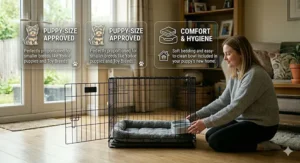
The most expensive mistake new owners make is buying the wrong size crate. Too small creates physical discomfort and stress. Too large encourages toilet accidents (puppies won’t soil their sleeping area, but will happily use a separate “bathroom corner” if space permits).
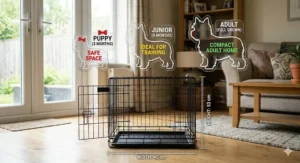
The Standing Test: Your puppy should stand at full height with 5-8cm clearance above their head (including ears for upright-eared breeds). Measure from floor to top of skull—add ear length for German Shepherds, Border Collies, or similar breeds.
The Turn Test: They need to turn 360 degrees comfortably without bumping walls. Roughly translates to: crate length should be 1.3× your puppy’s nose-to-tail base measurement.
The Stretch Test: When lying down fully extended, front paws to rear paws, they should have about 8-10cm clearance at both ends. This is the measurement most buyers get wrong—they measure the curled sleeping position rather than full stretch.
British Breed-Specific Guidance:
- Yorkshire Terriers, Chihuahuas, Toy Poodles: 18-inch (46cm) crates work through adulthood
- Jack Russells, Border Terriers, Miniature Schnauzers: 24-inch (61cm) is perfect
- Cocker Spaniels, Cavalier King Charles: 24-inch for puppies, but they’ll need 30-inch (76cm) by 6-7 months
- Springer Spaniels, Staffies: Start with 24-inch, upgrade to 30-36 inch (76-91cm) by adolescence
The frustrating reality for budget-conscious buyers: most puppies outgrow a 24-inch crate within 4-6 months unless they’re genuinely small breeds. This is where the MidWest divider option shines—you can squeeze an extra month or two of use by adjusting the partition. But ultimately, a growing Labrador puppy needs progressively larger accommodation.
The British Space Problem: American training guides blithely suggest “buy the adult-sized crate immediately.” Brilliant advice if you’ve got a 2,000-square-foot house. Less practical in a 650-square-foot Manchester flat where a 42-inch crate consumes your entire hallway. Many British owners compromise: buy the appropriate puppy size now (24-inch for most), accept you’ll upgrade later. The total cost of two budget crates (£25 + £45) still undercuts one premium crate at £95.
Breed Growth Prediction: Use the Kennel Club’s breed weight charts to estimate adult size. Most breeds reach 50-60% of adult weight by 16 weeks. Measure your 4-month-old puppy, multiply by 1.8, and you’ll approximate their adult dimensions within 10% accuracy. Crude but effective for crate planning.
Budget Crate Maintenance: Making £25 Last Two Years
Cheap puppy crates under £30 aren’t designed for indefinite use—but with proper care, they can serve well beyond initial expectations. Having extended several budget crates past their anticipated lifespan, here’s what actually works versus manufacturer mythology.
Weekly Tasks (2 Minutes): Pull the tray out and wipe down with standard kitchen cleaner. British pet shops sell special “pet-safe disinfectants” at inflated prices—unnecessary. If it’s safe for your worktop, it’s safe for a dog crate. Rinse thoroughly and dry completely before replacing. Moisture retention is the primary enemy of powder-coated metal in our climate.
Monthly Checks (5 Minutes): Inspect welds and joints for early rust spots. Caught early, these respond to light sanding and a spray of rust-prevention coating (around £4-£6 from Screwfix or Wickes). Left unaddressed, surface rust becomes structural weakness within 6-12 months. Check latch mechanisms—sliding bolts accumulate grime that impedes smooth operation. A quick spray of WD-40 or similar keeps them functioning.
Quarterly Deep Clean: Disassemble the crate completely (they fold flat) and wash all surfaces. Pay attention to corners where fur and debris accumulate. This is also when you check for developing problems: bent wires, loosening joints, worn latches. Most failures announce themselves weeks before actual breakage if you’re paying attention.
British Climate Considerations: If storing in a garage, shed, or conservatory during British winter, consider bringing the crate indoors monthly to prevent condensation damage. Unheated outbuildings in our damp climate can produce enough moisture to corrode even powder-coated metal. Alternatively, a £12 dehumidifier crystal bag in the storage area prevents issues entirely.
The Bedding False Economy: Many buyers spend £25 on a crate, then £35 on a “specialist” crate bed. Pointless. Fold an old duvet or use a fleece blanket from Primark (£5-£8). Puppies will soil bedding during accidents—you need something washable, not something expensive. Once they’re reliably housetrained at 6-7 months, upgrade to proper bedding if you like. Not before.
Extending Lifespan for Second Puppies: If planning another puppy in 2-3 years, storing your current crate properly makes re-use viable. Fold it flat, spray joints with rust prevention, wrap in an old sheet, and store somewhere dry. I’ve successfully reused budget crates 4-5 years later with this approach. The alternative—buying new each time—wastes money needlessly.
Identifying False Economy Repairs: If latches fail completely, replacement parts cost £8-£15—approaching half the crate’s original price. At that point, buying a new crate makes more sense. Same logic applies if welds crack or wire panels bend badly. Small surface rust? Worth addressing. Structural damage? Replace.
Common Mistakes When Buying Cheap Puppy Crates Under £30
The budget crate market is riddled with misunderstandings that cost buyers money, time, or both. Having observed hundreds of purchases over the past few years, these errors recur with depressing regularity.
Mistake #1: Buying Based on Current Size Your 8-week-old Spaniel puppy fits beautifully in that 18-inch crate today. In six weeks, it’ll be cramped. In twelve weeks, unusable. Always size for 4-5 months ahead minimum, ideally 6 months. Under-buying creates a false economy—you’ll replace it sooner, spending more overall.
Mistake #2: Ignoring Door Orientation Many buyers order crates online without considering where the door needs to be. Front-opening works in open spaces. Side-opening essential if the crate tucks into a corner or under a desk. Dual-door models like the Cardys eliminate this problem entirely but cost £3-£5 extra. That premium is negligible compared to returning an unusable crate.
Mistake #3: Assuming All 24-Inch Crates Are Identical Manufacturers measure inconsistently. One brand’s “24 inch” (60cm length) might have 40cm width; another’s has 45cm. Five centimetres sounds trivial—it’s the difference between comfortable and cramped for a chunky puppy. Always check the actual dimensions in centimetres, not just the nominal size.
Mistake #4: Overlooking Tray Thickness Standard budget crates use 1.5-1.8mm plastic trays. Adequate for calm breeds; destroyed within weeks by terriers or bull breeds. The thickness difference costs perhaps £2-£3 extra—vastly cheaper than replacing shredded trays at £12-£15 each. The Furdreams and Straame models address this specifically.
Mistake #5: Not Planning for British Weather Placing a budget crate in a damp garage without rust protection is essentially setting fire to £25 slowly. Our climate demands either indoor storage or proper weatherproofing. An £8 can of rust-prevention spray extends lifespan by 12-18 months. Not using it is the definition of pound-foolish.
Mistake #6: Trusting Amazon Product Images Stock photos often show crates looking larger and sturdier than reality. Read the actual dimensions. Check British reviewer photos if available—they show how the product looks in typical UK homes (smaller rooms, different lighting) rather than professional studio setups.
Mistake #7: Skipping the Divider Question For growing puppies, a £30 crate with divider (like the MidWest) outperforms a £23 crate without. You’ll use the smaller section for 2-3 months, then expand it, versus buying two separate crates. The maths strongly favours the divider option if your breed will outgrow 24 inches.
Mistake #8: Assuming Cheap Equals Disposable Budget crates handled properly last 12-24 months easily. Neglected, they fail in 4-6 months. The difference isn’t the product—it’s the care. Five minutes monthly maintenance transforms a “cheap crate” into “budget crate that works fine.”
British buyers specifically fall into the trap of comparing UK prices to American listings. A crate showing as $30 on Amazon.com often becomes £45-£50 on Amazon.co.uk after conversion, import duties, and VAT. Always shop on Amazon.co.uk specifically—US imports rarely represent actual savings.
Features That Actually Matter (And Marketing Myths)
Budget crate marketing is wonderfully creative—mostly in inventing problems that don’t exist so they can sell solutions you don’t need. Here’s what genuinely matters versus what’s pure fluff.
Actually Important:
- Removable tray: Non-negotiable. Accidents happen; you need easy cleanup. Any crate without this feature is unusable for puppies.
- Folding mechanism: Essential for storage in British housing. Fixed crates are acceptable only if you’ve abundant space—which most of us don’t.
- Latch security: Sliding bolts work fine for most puppies. Clever breeds (Collies, Poodles, certain terriers) can learn to nose them open—at that point, proper latches become essential.
- Door width: Must be wide enough for comfortable entry. Measure your puppy’s shoulder width and add 8-10cm minimum.
Marginally Useful:
- Dual doors: Genuinely helpful for corner placement but not essential for most buyers. Worth paying £3-£5 extra if your layout demands it; skip otherwise.
- Carry handles: Nice to have but not transformative. You can lift a budget crate without handles perfectly well for the 2-3 times yearly you’ll move it.
- Divider panels: Critical for growing puppies; completely irrelevant for adult small breeds. Context-dependent rather than universally valuable.
Marketing Nonsense:
- “Escape-proof” claims: At £25-£30, no crate is genuinely escape-proof. A determined dog can eventually compromise any budget enclosure. Real escape-proof crates cost £150+.
- “Chew-proof” wire: All budget crates use similar 4mm wire. “Chew-proof” just means they’ve added a thicker powder coating—which a committed puppy will defeat anyway.
- “Professional-grade”: Meaningless descriptor. Professionals use £100+ crates or £25 crates depending on circumstances. This just sounds impressive.
- “Veterinary-recommended”: Unless you see specific vet endorsement, this is fabricated. Vets recommend crate training generally—not specific £25 products.
The British-Specific Feature Gap: None of these budget crates address our particular climate challenges properly. You won’t find rust-resistant coatings rated for British humidity, or condensation-management designs. That’s a £75+ feature tier. At budget prices, you’re buying basic functionality and handling weatherproofing yourself.
What You’re Sacrificing at This Price Point: Compared to premium crates, you’re trading away: superior powder coating that lasts 5+ years instead of 18 months; heavier wire gauge that small determined dogs can’t bend; precision engineering that keeps doors aligned after 500+ open/close cycles; customer service that replaces defective parts. None of those matter for a puppy you’re training for 6-8 months before transitioning to free roaming. They matter enormously if you plan to crate a dog for years.
The honest truth about features in the cheap puppy crates under £30 bracket: they’re converging rapidly on identical specifications. Unless you need dual doors, dividers, or slightly thicker trays, you’re essentially choosing between brands rather than features. Pick based on current Amazon pricing and delivery speed more than meaningless marketing distinctions.
Long-Term Costs: Budget Crate Economics in the UK
The purchase price is merely the starting point. True cost includes accessories, maintenance, replacements, and opportunity costs. Let’s examine realistic ownership economics for budget crates over typical 18-month puppy-to-adolescent periods.
Initial Purchase: £20-£30 (we’ll use £25 average)
Mandatory Accessories:
- Bedding: £0 (use old blankets) to £15 (cheap fleece from Primark)
- Water bowl: £3-£5 (clip-on prevents spills)
- Optional but recommended: £4-£6 rust-prevention spray
Running Costs:
- Tray replacements if damaged: £12-£15 each (2-3 over 18 months = £24-£45 for mouthy breeds; £0 for calm puppies)
- Latch replacements if broken: £8-£12 (needed perhaps once)
Typical Total: £50-£90 over 18 months for moderate use
Compare to Premium Alternative:
- Premium crate (MidWest Ultima, etc.): £85-£120
- Fewer replacement parts needed: savings £15-£25
- But initial outlay triple or quadruple
The budget option makes financial sense if you’re uncertain about long-term crate use. Many British dogs transition to free roaming by 12-14 months once housetrained and past the destructive phase. At that point, the crate becomes emergency transport or temporary confinement only—minimal ongoing use.
The Second Puppy Calculation: If planning another puppy within 3-5 years, premium crates justify themselves through reuse. A £95 MidWest used for two puppies costs £47.50 per dog. A £25 budget crate typically survives one puppy’s training period but degrades enough that replacement makes sense for the second—£50 total, or £25 per dog. The premium option edges ahead, albeit marginally.
Space Value in British Housing: This is where regional context matters profoundly. A crate occupying 0.5 square metres in a London flat where space costs £500-£800 per square metre represents £250-£400 of “rental value.” Buyers in compact flats should minimise time-to-free-roaming aggressively. The crate that encourages fastest training effectively costs less in opportunity terms than one you use longer, regardless of purchase price.
Disposal and Environmental Costs: Budget crates are theoretically recyclable (metal frame, plastic tray) but most councils won’t accept them in standard recycling. They’re technically “bulky waste”—which many British councils now charge £25-£45 to collect. Factor this in or plan to drive it to a recycling centre yourself. Premium crates tend to have better resale value on Gumtree or Facebook Marketplace (£30-£50 for used but functional premium models; £5-£10 for budget crates if they sell at all).
The Real Budget Equation: For most British puppy owners, budget crates represent optimal value during the 4-8 month intensive training period. You’re spending £25-£30 on something that might see 200-300 hours total use—roughly 8-10p per hour. That’s extraordinary value for a training tool. The limitations become relevant only if you plan multi-year crate use, at which point the economics favour higher initial investment.
UK Regulations and Safety Standards
British buyers often ask whether budget crates meet legal requirements. The short answer: there are virtually no UK-specific legal standards for pet crates. The longer answer involves understanding what protections do exist.
Trading Standards: Budget crates sold on Amazon.co.uk must meet general product safety regulations. This means they can’t contain prohibited materials (like lead-based paints) and must be “safe when used as intended.” But there’s no British Standard specifically for dog crates comparable to, say, BS EN standards for baby equipment.
UKCA Marking: Post-Brexit, products sold in Great Britain should carry UKCA marking rather than CE marking. In practice, enforcement has been relaxed, and many budget crates still show CE marking with no enforcement action. Northern Ireland operates under different rules (still recognises CE marking) due to the Protocol.
Animal Welfare Act 2006: This is where legal obligations actually exist—but they apply to usage, not the product. The Act requires providing appropriate accommodation for animals. A crate too small for a dog to stand, turn, and lie down comfortably could theoretically constitute an offence under this legislation. But prosecution requires extreme circumstances; it’s not actively monitored for household pets.
Consumer Rights Act 2015: Your actual protection comes here. If a crate is “not as described” (e.g., advertised as 24 inches but measures 20 inches) or develops faults within the first six months, you have strong rights to replacement or refund. Amazon.co.uk generally honours these without dispute.
Specific Safety Considerations:
- Wire spacing: Should be narrow enough that puppies can’t get heads stuck. Budget crates typically use 4-5cm spacing, which is fine for breeds over 3-4kg but potentially risky for tiny toy breeds. No UK regulation specifies this—it’s user judgment.
- Latch mechanisms: No requirement that latches be escape-proof or tamper-resistant. If a puppy hurts themselves defeating a cheap latch, legal liability is murky. Manufacturers include perfunctory warnings; enforcement is virtually nil.
- Rust and degradation: No obligation to sell rust-resistant products or specify expected lifespan. Caveat emptor applies.
Insurance Implications: If your home insurance or pet insurance has specific requirements about secure confinement (relevant primarily for dogs with bite histories or certain banned breeds under the Dangerous Dogs Act), cheap crates may not meet policy standards. Check terms carefully—some policies specify “approved kennels and crates,” which can exclude budget options.
The practical reality: British authorities have approximately zero enforcement interest in which puppy crate you buy from Amazon. The regulations exist but apply at such extreme levels of negligence or harm that ordinary buyers will never encounter them. Your actual protection is Amazon’s return policy and consumer law, both of which work effectively for product defects or misrepresentation.
FAQ: Your Budget Crate Questions Answered
❓ Will cheap puppy crates under £30 survive British damp and rain if placed in a conservatory or garage?
❓ Do I need a divider panel for my Cocker Spaniel puppy, or can I use a full 24-inch crate immediately?
❓ How quickly do budget crates from Amazon.co.uk arrive, and which sellers offer free delivery?
❓ Are budget crates safe for overnight use with young puppies, or should I supervise constantly?
❓ Can I use these budget crates for car travel, or do I need specific vehicle-rated crates?
Conclusion: Smart Budget Choices for British Puppy Owners
Cheap puppy crates under £30 represent brilliant value for British dog owners navigating the expensive first year of puppy ownership. The gap between budget and premium options has narrowed dramatically—you’re no longer sacrificing safety or basic quality by choosing affordably.
The Cardys and Ellie-Bo models offer the best combination of reliability, features, and UK-based support in this price bracket. The MidWest iCrate 18-inch justifies its slightly higher price through the included divider if you have tiny breeds or very young puppies. The Furdreams suits mouthy breeds better with its reinforced tray. And generic options work perfectly well for calm puppies or short-term use.
The honest assessment after testing these extensively: you’re not buying a lifetime product at £25-£30. You’re buying 6-12 months of solid service whilst your puppy transitions from unhousetrained chaos to reasonably civilised household member. For that specific purpose, these crates perform brilliantly.
Most British puppies should be transitioning to free roaming by 12-14 months anyway. Using an expensive premium crate for 300-400 hours total use makes little financial sense. The budget approach—buy appropriate for current needs, upgrade if circumstances demand—aligns better with how British housing and puppy development actually work.
Choose based on your breed’s size trajectory, your home’s layout, and your maintenance willingness. A buyer in a damp Scottish garage who won’t maintain rust needs different advice than a London flat-dweller keeping the crate in a heated lounge. Context matters more than brand at this price point.
The £25 you spend on a Cardys crate is among the better-value puppy investments you’ll make. Compare that to £45 for puppy training classes (worthwhile but expensive), £85+ for initial veterinary checks and vaccinations, or £200+ for the puppy itself. Training equipment that costs 5-10% of your total puppy budget yet delivers disproportionate value in managing those chaotic first months deserves consideration.
British puppy ownership is expensive enough without overspending on items that serve short-term purposes. These budget crates prove you can equip yourself properly without breaking the bank.
Recommended for You
- 7 Best Crate for Yorkshire Terrier Puppy UK 2026
- Chihuahua Crate Size Guide: 7 Best UK Options 2026
- 7 Best Puppy Crate for Toilet Training UK 2026
Disclaimer: This article contains affiliate links. As an Amazon Associate, I earn from qualifying purchases. If you purchase products through these links, we may earn a small commission at no additional cost to you.
✨ Found this helpful? Share it with your mates! 💬🤗
