
In This Article
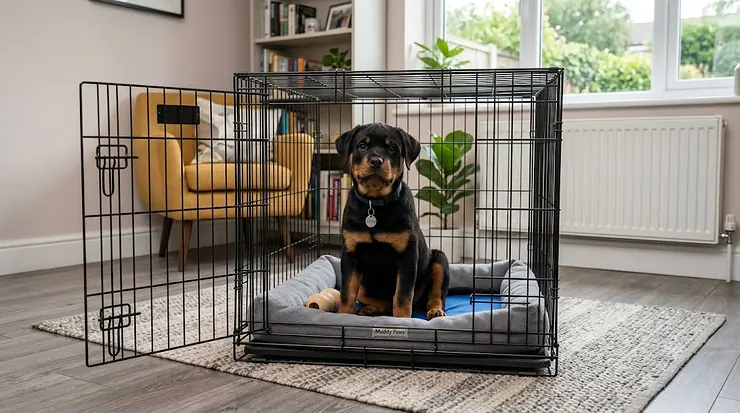
Picture this: you’ve just brought home an adorable 8-week-old Rottweiler puppy who resembles a small bear cub. Fast forward six months, and that cuddly bundle has transformed into a 40-kilogram force of nature with the strength to knock over furniture and the stubbornness to test every boundary you’ve set. What most new Rottie owners overlook is that the crate you choose today will shape your relationship with this intelligent, powerful breed for years to come.
Understanding proper crate training isn’t just good practice — it’s essential to meeting your dog’s welfare needs under the Animal Welfare Act 2006. The UK government’s animal welfare strategy emphasises that dogs must have a suitable environment, including a safe, comfortable place to rest.
Rottweiler puppy crate training isn’t about confinement — it’s about creating a personal sanctuary where your growing giant feels genuinely safe. Unlike smaller breeds, Rottweilers require careful planning from day one because an adult male can reach 61 kilograms, and retrofitting your training approach when they’re already adolescent is considerably harder than starting right. The British climate adds another layer to consider: damp winters mean more indoor time, making a well-trained crate relationship absolutely essential for maintaining your sanity and your home’s structural integrity.
What sets Rottweilers apart from other large breeds is their remarkable intelligence combined with a deeply ingrained guarding instinct. They’re not simply big dogs who need big crates — they’re working dogs bred for centuries to make independent decisions, which means crate training requires a different approach than you’d use for, say, a Labrador. Get it right, and you’ll have a confident, well-adjusted companion who views their crate as a peaceful retreat rather than a punishment. Get it wrong, and you might face separation anxiety, destructive behaviour, or a dog who associates confinement with distress.
Quick Comparison: Top Rottweiler Puppy Crates at a Glance
| Crate Model | Size | Divider Included | Price Range (GBP) | Best For | Amazon UK Available |
|---|---|---|---|---|---|
| MidWest iCrate 48″ | 122 x 76 x 84 cm | ✅ Yes | £60-£85 | Budget-conscious families | ✅ Prime eligible |
| Feandrea Heavy-Duty XXL | 122 x 74.5 x 80.5 cm | ❌ No | £110-£145 | Anxious or strong chewers | ✅ Prime eligible |
| Cardys XXL Double Door | 122 cm | ✅ Yes | £55-£75 | First-time Rottie owners | ✅ Free delivery |
| Amazon Basics 48″ | 122 x 76 cm | ✅ Yes | £50-£70 | Value seekers | ✅ Prime eligible |
| PawHut Heavy Duty | 120 x 77 x 83 cm | ❌ No | £80-£105 | Moderate anxiety cases | ✅ Free delivery |
| Yaheetech 48″ Double | 122 x 76 x 81 cm | ✅ Yes | £65-£90 | Growing puppies | ✅ Prime eligible |
| SONGMICS Collapsible 48″ | 122 x 76 x 81 cm | ✅ Yes | £70-£95 | Frequent travellers | ✅ Prime eligible |
The table reveals something crucial that many first-time Rottweiler owners miss: the presence of a divider isn’t just a nice feature — it’s absolutely essential for the 6-18 month growth period when your puppy balloons from 5 kilograms to potentially 50 kilograms. Those crates without dividers might look sturdier, but they’ll force you into either buying multiple crates or dealing with housetraining setbacks because your 4-month-old puppy discovers they can toilet in one corner and sleep in another. The MidWest iCrate and Amazon Basics models dominate UK sales for good reason: they offer proper divider panels at price points that won’t make you wince when you’re already spending hundreds on puppy vaccinations and insurance.
💬 Just one click — help others make better buying decisions too! 😊
Top 7 Rottweiler Puppy Crates: Expert Analysis for UK Homes
1. MidWest iCrate 48-Inch Double Door — The UK Standard-Bearer
The MidWest iCrate 48-Inch occupies a special position in British dog training circles, and with good reason. This American-designed crate has become ubiquitous in UK homes precisely because it strikes that delicate balance between affordability and genuine functionality. The 122 x 76 x 84 cm dimensions provide ample space for an adult male Rottweiler weighing up to 50 kilograms, whilst the included divider panel means you won’t need to purchase a separate puppy crate for those crucial first six months.
What distinguishes this model in real-world British use is the double-door configuration. In our characteristically compact homes — particularly the Victorian terraces and post-war semis that dominate much of England — being able to access the crate from either the front or side transforms what would otherwise be furniture-rearranging exercises every time you need to clean or interact with your puppy. The fold-flat design might not sound revolutionary until you’re trying to fit it through a narrow hallway or store it during a house move, something American-market crates designed for larger homes don’t always accommodate.
UK customers consistently note the divider panel’s robustness in their reviews, mentioning it stays firmly in place even when tested by curious Rottie puppies. The slide-bolt latches have proven reliable through the breed’s notoriously strong nose-and-paw manipulation attempts, though a handful of particularly clever escape artists have required additional carabiner clips from the hardware shop. The removable plastic tray slides out smoothly for cleaning — rather important during those inevitable housetraining accidents that even the most diligent owner can’t always prevent.
Pros:
✅ Included divider grows with your puppy from 8 weeks to adulthood
✅ Double-door design suits British narrow hallways and compact rooms
✅ Folds completely flat for storage or transport in the car
Cons:
❌ Wire gauge might bend under sustained aggressive chewing (rare but possible)
❌ Some very determined puppies can shake it enough to create annoying rattling noises
Priced in the £60-£85 range depending on current Amazon.co.uk offers, this represents solid value for money. Prime members benefit from next-day delivery, which matters when you’re bringing a new puppy home and haven’t sorted the crate situation yet.
2. Feandrea Heavy-Duty XXL Dog Crate — Built for Anxious or Powerful Rotties
The Feandrea Heavy-Duty XXL takes a different philosophical approach to Rottweiler containment. Measuring 122 x 74.5 x 80.5 cm, it sacrifices the divider panel and portability in favour of sheer structural integrity. This isn’t a crate for the average Rottie puppy — it’s engineered for dogs who’ve already demonstrated anxiety-driven destructive behaviours or possess the physical power and determination to compromise standard wire crates.
The reinforced metal wire uses a noticeably thicker gauge than budget models, with spacing narrowed to just 3.7 cm between bars. What this means in practice is that even an adolescent Rottweiler in full teenage rebellion mode will struggle to bend or manipulate the structure. The five L-shaped locking mechanisms represent proper over-engineering: the large door and top lid are both removable if needed, which UK trainers particularly appreciate when working with rescue Rotties who’ve developed crate aversions.
Here’s what the specs sheet won’t tell you: this crate weighs 21.4 kilograms when assembled. That’s not a feature, that’s a commitment. You’re not casually moving this between rooms or folding it away when guests visit. But for families dealing with separation anxiety or a Rottweiler who’s already destroyed a lighter crate, that immovability becomes a virtue. The pull-out tray features stoppers to prevent your strong-nosed dog from dislodging it during enthusiastic digging sessions.
Pros:
✅ Exceptional structural strength handles powerful adult Rottweilers without flexing
✅ Removable door and roof transform it into an open resting area as trust builds
✅ Five locking points provide genuine escape-proof security
Cons:
❌ No divider panel means you’ll need a separate crate for the puppy stage
❌ Heavy weight (21.4 kg) makes repositioning a two-person job
UK pricing typically falls in the £110-£145 bracket, reflecting the heavy-duty construction. Available through Amazon.co.uk with Prime delivery, though the weight means standard couriers rather than Royal Mail delivery.
3. Cardys XXL Double Door Metal Dog Crate — The First-Timer’s Friend
The Cardys XXL Double Door occupies that sweet spot where UK-based small businesses meet Amazon marketplace availability. At 122 cm length, it provides adequate adult Rottweiler space whilst including the crucial divider panel that Feandrea’s heavy-duty model omits. What makes Cardys particularly appealing for first-time Rottweiler owners is the brand’s UK-centric approach: measurements use centimetres rather than confusing inch-to-metric conversions, and the folding mechanism has been designed around British homes rather than adapted from American specifications.
The dual-access doors open both frontally and from the side, with sliding bolt locks that strike a practical middle ground between the basic clips on budget crates and the elaborate five-point systems on premium models. The removable plastic tray features slightly raised edges — a small detail, but one that prevents puppy accidents from immediately seeping onto your carpet, buying you precious minutes to notice and clean up. British buyers consistently mention the straightforward assembly process in reviews, noting it genuinely requires no tools and takes under 10 minutes even for those mechanically challenged among us.
The metal finish uses a black electro-coat that resists the rust issues cheaper powder-coated crates sometimes develop in our damp climate. After six months of British winter use — which essentially means daily exposure to wet paws, the occasional indoor puddle, and general moisture in the air — the frame should show minimal corrosion. The divider panel adjusts smoothly as your puppy grows, though it lacks the extra-secure clips found on MidWest models.
Pros:
✅ UK-designed measurements and assembly suit British home layouts
✅ Divider panel included for puppy-to-adult growth
✅ Competitive pricing without sacrificing essential build quality
Cons:
❌ Wire gauge sits between budget and heavy-duty, may not suit extreme chewers
❌ Lacks the brand recognition and established track record of MidWest
Priced around £55-£75 on Amazon.co.uk, the Cardys represents excellent entry-level value. Free delivery typically applies on orders over £25, and small business badge indicates you’re supporting a UK-based operation rather than a multinational conglomerate.
4. Amazon Basics 48-Inch Wire Crate — When Budget Meets Reliability
The Amazon Basics 48-Inch proves that own-brand doesn’t automatically mean inferior. Amazon’s surprising competence in the pet product category stems from their data-driven approach: they’ve analysed thousands of customer reviews across competitor products to identify exactly what works and what frustrates buyers. The result is a 122 x 76 cm crate that includes all the features Rottweiler owners actually use whilst stripping away the marketing fluff nobody needs.
The included divider panel uses the same basic design as the MidWest iCrate, which isn’t coincidental — Amazon essentially reverse-engineered the market leader’s successful elements. What you sacrifice is brand heritage and the marginal build quality improvements that come with MidWest’s century of manufacturing experience. What you gain is typically £10-£20 lower pricing and Amazon’s frankly unbeatable returns policy if something does go wrong. The double-door configuration provides front and side access, crucial for British homes where the crate often ends up in a corner rather than the middle of a room.
The folding mechanism works smoothly enough, though the metal clips don’t have quite the precision feel of premium models — think functional rather than refined. The removable tray is slightly thinner plastic than MidWest’s version, which in practical terms means it might crack if you’re rough during cleaning, but performs perfectly fine with normal handling. British buyers appreciate the pre-assembled nature: it arrives already clipped together, requiring only unfolding and securing the corner locks.
Pros:
✅ Lowest price point among reliable crates with divider panels
✅ Amazon’s customer service handles issues quickly without fuss
✅ Dimensions identical to MidWest, so accessories are interchangeable
Cons:
❌ Slightly lighter wire gauge may not withstand aggressive chewing as well
❌ Generic branding means less community knowledge sharing about model-specific quirks
Typically priced £50-£70 on Amazon.co.uk, often the cheapest option during Prime Day or Black Friday sales. Prime delivery means next-day arrival, which matters when you’re in a puppy emergency and need a crate immediately.
5. PawHut Heavy Duty Metal Dog Crate — The Moderate Anxiety Solution
PawHut’s Heavy Duty crate at 120 x 77 x 83 cm positions itself between standard wire crates and the ultra-reinforced models costing £200+. This Chinese-manufactured brand has gained traction in the UK market by addressing a genuine gap: dogs who need more security than basic crates provide but don’t quite justify the investment in Impact-grade aluminium cages. The thicker tubular frame uses 16-gauge steel rather than the 18-20 gauge found in budget models, which translates to noticeably less flex when your adolescent Rottweiler tests the boundaries.
What UK owners particularly value is the lockable wheel system. In British homes where the kitchen often serves as the crate location during the day and the bedroom at night (particularly during puppy housetraining), being able to roll the crate between rooms without dismantling it proves genuinely useful. The wheels lock securely enough that even a determined Rottweiler can’t inadvertently create a mobile cage situation, though very large dogs might manage to shift it slightly during vigorous activity.
The double-door design includes both a front access point and a smaller feeding door, the latter proving unexpectedly handy when you want to deliver treats or refresh water without fully opening the crate. The removable tray sits on a raised grid rather than directly on the frame, creating better airflow and preventing your puppy from lying in dampness if accidents occur. The lack of a divider panel represents the primary limitation — this crate works brilliantly for adult Rottweilers or adolescents from about 6 months onwards, but you’ll need a separate smaller crate for the early puppy stage.
Pros:
✅ Lockable wheels enable easy repositioning in British multi-room homes
✅ Reinforced frame handles moderate anxiety without heavy-duty pricing
✅ Smaller feeding door reduces escape opportunities during meal times
Cons:
❌ No divider panel limits use during crucial early puppy months
❌ Wheels add weight and bulk, making flat storage impossible
Priced in the £80-£105 range on Amazon.co.uk, this sits comfortably in the mid-tier category. Free delivery typically applies, though the weight means standard parcel courier rather than Royal Mail delivery.
6. Yaheetech 48-Inch Double Door — The Smart Growth Investment
The Yaheetech 48-Inch at 122 x 76 x 81 cm represents the increasingly competitive Chinese manufacturing sector’s maturation. What once might have been dismissed as cheap import quality has evolved into genuinely competent products that undercut established brands whilst delivering comparable performance. The included divider panel uses a slightly different clip system than MidWest’s design, featuring smaller, more numerous attachment points that some users find more secure once properly adjusted.
The double-door configuration mirrors the standard layout, but Yaheetech adds thoughtful touches that reveal genuine user-experience consideration. The slide-bolt latches include rubber caps that prevent the metallic clanging sound when they snap shut — a small detail, but one that stops the jarring noise at 3 a.m. when you’re settling your puppy after a toilet break. The corner clips feature rounded edges rather than the sharper points found on some competitors, reducing the risk of snagged clothing or scratched hands during assembly.
British buyers mention the rust-resistant coating holds up well through our damp climate, though a few reports suggest occasional surface rust appearing after 12-18 months of heavy outdoor use (think garden placement during summer, not recommended but some owners do it). The removable tray features slightly higher edges than budget models, containing spills more effectively. The divider adjusts smoothly as your Rottweiler puppy grows, with clear markings indicating appropriate spacing for different age ranges.
Pros:
✅ Divider panel with multiple attachment points grows precisely with your puppy
✅ Rubber-capped latches eliminate annoying metallic clanging
✅ Competitive pricing undercuts established brands without quality sacrifice
Cons:
❌ Lesser-known brand means fewer online community resources and tips
❌ Some reports of minor surface rust after extended outdoor exposure
Typically priced £65-£90 on Amazon.co.uk with regular discount vouchers bringing it closer to £60. Prime delivery available, with the brand’s UK warehouse enabling next-day service in most postcodes.
7. SONGMICS Collapsible 48-Inch — The Travel-Ready Option
The SONGMICS Collapsible 48-Inch measuring 122 x 76 x 81 cm targets a specific subset of Rottweiler owners: those who travel frequently or split time between multiple properties. The enhanced folding mechanism uses a different principle than standard crates, employing a panel-based design rather than the typical wire-frame construction. This enables genuinely tool-free setup in under 60 seconds and equally rapid breakdown — crucial when you’re loading the car for a weekend in the Lake District or transporting your dog to training classes.
The divider panel integrates into the same tool-free system, sliding into position and locking via simple clips rather than requiring manual attachment at multiple points. British owners who regularly visit family or travel to dog-friendly holiday rentals consistently praise this feature, noting it transforms what used to be a 15-minute wrestling match into a swift, frustration-free process. The carrying handles on top aren’t mere decoration — they’re properly reinforced to support the crate’s weight when folded, though naturally you wouldn’t want to carry it long distances.
The trade-off for this convenience is slightly reduced structural rigidity compared to traditional welded-corner crates. A calm, well-adjusted adult Rottweiler will find it perfectly adequate, but dogs with serious anxiety issues or destructive tendencies might find ways to compromise the panel-based construction. The removable tray uses the same system as the divider, sliding out without fuss for cleaning. The black finish resists showing scratches better than lighter colours, maintaining presentable appearance even after regular setup-breakdown cycles.
Pros:
✅ Genuine 60-second tool-free assembly suits frequent travellers
✅ Integrated divider system eliminates fiddly clip attachments
✅ Carrying handles enable easier car loading than fixed crates
Cons:
❌ Panel-based design less robust than welded construction for anxious dogs
❌ Slightly higher price reflects the convenience engineering
Priced around £70-£95 on Amazon.co.uk, this represents fair value for the convenience factor. Prime delivery standard, with the brand’s presence in multiple EU warehouses enabling quick restocking even during high-demand periods.
Setting Up Your Rottweiler’s First Night: A Realistic Timeline
The first 24 hours with your Rottweiler puppy will either establish a foundation of calm acceptance or create associations that take weeks to undo. What most training guides don’t acknowledge is that the “perfect” gradual introduction they describe requires luxuries many working families simply don’t have: uninterrupted time, a puppy who arrived at a convenient hour, and a household that can tolerate whining without neighbours complaining through thin terraced house walls.
4:00 PM – Collection and Transport Your breeder hands over your 8-week-old puppy, and the crate training actually begins right here in the car park. Place the crate in your car’s boot (estate cars) or back seat (saloons) with the puppy inside rather than holding them on someone’s lap for the journey home. Yes, they’ll likely whine. Yes, it feels harsh. But this 30-60 minute car journey represents their first lesson that the crate means safety during movement, not abandonment. Line the crate with an old towel you’re prepared to bin if travel sickness occurs, which happens in roughly 40% of first journeys.
5:30 PM – Arrival and Initial Exploration Bring the crate inside and position it in the chosen location before opening the door. Rottweiler puppies are brilliant at learning spatial relationships, and moving the crate later creates confusion about where their “den” actually exists. Open the crate door and walk away. Don’t coax, don’t reach in, don’t create pressure. Your puppy will emerge when ready, having learned that exits aren’t contingent on your involvement. This first exit might take 30 seconds or 30 minutes — patience here pays dividends later.
6:00 PM – Dinner Service Creates Positive Association Feed your puppy’s first meal inside the crate with the door open. Place the bowl at the very back, requiring them to fully enter to eat. Most Rottie puppies are sufficiently food-motivated that they’ll march straight in without hesitation. Don’t close the door during this first meal — you’re building the association that wonderful things (food) happen in the crate, not creating a trap. The divider panel should already be positioned to create a space just large enough for standing, turning, and lying down, typically 60-75 cm for an 8-week-old puppy.
7:00 PM – First Door-Close Experiment After dinner, wait until your puppy voluntarily enters the crate to investigate their new space. The moment they’re fully inside, quietly close the door for exactly 30 seconds, then open it before any whining begins. Success in crate training hinges on this seemingly tiny detail: you open the door whilst they’re still calm, not after they’ve discovered that whining produces results. Those 30 seconds feel ridiculously short, and you’ll be tempted to extend them. Don’t. Repeat this process 3-4 times over the next hour, maintaining the 30-second duration.
9:00 PM – The Crucial Toilet Break Take your puppy outside for a toilet break, using whatever spot you’ve designated as their bathroom area. Rottweiler puppies at 8 weeks need to eliminate every 1-2 hours when awake, so this isn’t optional. The moment they finish (and they will, given enough patient waiting), immediately return inside and place them in the crate with the door closed. This sequence — toilet, crate, sleep — forms the foundation of housetraining. Don’t allow play or extended cuddles between toilet and crate, as this teaches them to hold their bladder to prolong fun time outside.
10:00 PM – Bedtime Reality Check This is where theory meets British reality. Your puppy will likely whine, possibly escalating to full crying. The traditional advice says “ignore it completely until they settle,” which works brilliantly if you live in a detached house in the countryside. For those of us in terraced houses with shared walls or flats with downstairs neighbours, pure ignore-it-completely approaches risk noise complaints and eviction threats. The compromise: wait until they’ve been quiet for at least 10 seconds before responding, teaching them that silence, not noise, produces your attention.
2:00 AM – Night Toilet Break Set an alarm. Yes, really. An 8-week-old Rottweiler puppy cannot physically hold their bladder for 8 hours, and expecting them to creates the housetraining setbacks you’re trying to avoid. When the alarm sounds, immediately take puppy outside, allow them to toilet, then straight back to the crate. No play, no prolonged cuddles, minimal interaction. This is business, not bonding time. The whole process should take under 5 minutes.
6:00 AM – Morning Success If you’ve managed the night toilet break correctly, your puppy should wake relatively dry. The instant you hear them stirring (they’ll likely whine to signal wakefulness), take them outside. Don’t delay for a cup of tea or to get properly dressed — throw on whatever’s nearest and go. Successfully toileting outside upon waking creates the strongest association of the entire day.
What this timeline reveals is that the first night isn’t about achieving perfect silence or complete acceptance — it’s about preventing the formation of problematic associations whilst acknowledging practical limitations. British homes, British work schedules, and British social housing realities don’t always accommodate textbook approaches, and that’s perfectly acceptable. Consistency matters far more than perfection.
The Divider Panel Dilemma: Why Most Owners Get This Wrong
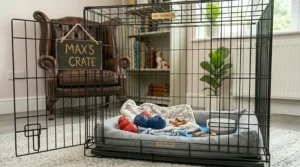
The divider panel inclusion or absence represents the single specification that separates successful puppy crate training from frustrating setbacks, yet it’s the feature that receives the least attention in buying decisions. The reasoning behind dividers isn’t immediately obvious: why deliberately make a large crate smaller when you’ve already paid for the larger size? The answer lies in canine instinct that predates domestication by millennia.
The Den Instinct Reality Wild canids — wolves, foxes, coyotes — create dens sized precisely to their body dimensions. Too large, and the den fails to provide the secure, enclosed feeling that signals safety. Too small, and it becomes uncomfortable. Domestic dogs retain this instinct, which means your 5-kilogram Rottweiler puppy placed in a 122 cm crate designed for 50-kilogram adults will feel genuinely anxious rather than grateful for the extra space. According to RSPCA guidance on crate training, dogs benefit from having a den-like space where they feel secure, but the crate must be appropriately sized for the dog’s current dimensions. The psychological impact manifests as increased whining, reluctance to settle, and the behaviour every owner dreads: toileting in one end whilst sleeping in the other.
The Housetraining Mathematics Understanding why the two-zone toilet situation occurs requires knowing a bit about puppy bladder control. An 8-week-old Rottweiler can hold their bladder for approximately 2-3 hours maximum when awake, and perhaps 4-5 hours overnight. However, this assumes they’re motivated to hold it. The motivation comes from dogs’ natural aversion to soiling their sleeping area — they’ll genuinely try to avoid toileting where they sleep. But if the crate is large enough that toileting in the far corner leaves their sleeping area clean, that natural aversion disappears. The divider eliminates this option by ensuring the entire crate constitutes their sleeping area.
The Growth Calculation Here’s where dividers prove their financial worth. A Rottweiler puppy grows at a frankly alarming rate: roughly 1.5-2 kilograms per week during peak growth periods between 8-16 weeks. Without a divider, you face two equally unappealing options. Option one: purchase a puppy-sized crate (76-90 cm) for the first 4-6 months, then buy the adult-sized crate (122 cm) once they’ve outgrown it. Total cost: £110-£150 for two crates. Option two: buy the adult crate immediately and accept the housetraining complications of too much space. The divider panel eliminates this dilemma, allowing a single £60-£85 crate to serve from puppyhood through adulthood.
The Adjustment Schedule The divider isn’t a set-it-and-forget-it installation. It requires regular adjustment as your puppy grows, typically every 2-3 weeks during rapid growth phases. The correct positioning allows your puppy to stand up fully (head not touching the top), turn around completely, and lie down with legs extended. Any larger, and you’ve recreated the two-zone problem. Any smaller, and you’re causing unnecessary discomfort. This sounds fiddly, but most modern dividers use simple clip systems requiring perhaps 60 seconds to adjust.
What many first-time owners don’t realise until they’ve made the mistake is that crates without dividers aren’t universally cheaper than those with them. The Feandrea Heavy-Duty model costs £110-£145 without a divider, whilst the MidWest iCrate costs £60-£85 with one included. The extra cost reflects enhanced structural integrity rather than the absence of the divider. This means buying a heavy-duty crate for a young puppy often necessitates purchasing a separate smaller crate anyway, doubling your investment whilst providing no actual benefit until the puppy reaches 6-9 months old.
The divider panel’s value extends beyond puppyhood in one specific scenario: multi-dog households. If you later add a second, smaller dog to your family, the divider allows the large Rottweiler crate to accommodate both a 50-kilogram Rottie and a 15-kilogram Cocker Spaniel simultaneously (though only for temporary situations like travel, not as permanent housing). Without the divider, the smaller dog would feel overwhelmed by the excessive space.
Crate Size Mathematics: The 4-Inch Rule Explained for UK Rotties
Every crate manufacturer publishes sizing guidelines, yet the most commonly cited “rule” — add 4 inches (10 cm) to length and height measurements — originated in American markets using imperial measurements and doesn’t translate directly to metric without creating confusion. More importantly, it oversimplifies the genuine complexity of sizing for giant breed puppies who’ll triple their dimensions within six months.
The Rottweiler Growth Reality Male Rottweilers typically reach 61-68 cm at the shoulder when fully grown, whilst females measure 56-63 cm. However, these figures represent breed standards, and plenty of well-fed British Rotties exceed them by several centimetres. What matters for crate sizing isn’t shoulder height but rather total height when standing naturally, measured from floor to the top of the skull. For adult males, this often reaches 75-80 cm; for females, 70-75 cm. Add the recommended 10 cm clearance, and you need a crate with internal height of at least 85 cm for males, 80 cm for females.
The Length Conundrum Length measurement creates more confusion than height because it depends on how your Rottweiler naturally lies down. Some dogs sleep curled in a tight ball, fitting comfortably in spaces barely longer than their standing height. Others sprawl with legs fully extended, requiring nearly double the space. Rottweilers, being working dogs bred for endurance, tend toward the sprawling category — they need to truly relax their muscular frames after exercise. The measurement protocol: have your adult-sized Rottweiler (or a friend’s adult Rottie if you only have a puppy) lie down naturally, then measure from nose tip to tail base. Add 10-15 cm, and that’s your minimum length requirement.
The Width Oversight Most sizing guides ignore width entirely, assuming the “turn around comfortably” criterion covers it adequately. But width proves particularly relevant for broad-chested breeds like Rottweilers. An adult male might measure 40-45 cm across the chest when sitting upright. The crate needs to be wider than this for them to turn around without scraping their sides against the walls. The 122 cm length crates typically offer 74-77 cm width, providing adequate space for even large males. Anything narrower than 70 cm will feel restrictive to a full-grown Rottie.
The Puppy Prediction Problem Here’s the challenge that trips up first-time Rottweiler owners: you’re buying the crate when your puppy is 8-12 weeks old, but you’re sizing it for an adult dog who won’t reach full size until 18-24 months. Without seeing the parents, predicting adult size involves educated guesswork. Male puppies with large, heavy-boned parents will likely need the full 122 cm length and 85+ cm height. Female puppies from moderate-sized lineage might be perfectly comfortable in 106 cm length crates. The financially prudent approach? Go larger if there’s any doubt — the divider panel eliminates the excess space problem during puppyhood.
The 48-Inch UK Translation The persistent use of “48-inch” crate designation in UK markets despite our metric system creates endless confusion. 48 inches converts to exactly 121.92 cm, which manufacturers round to 122 cm in metric markets. This is the standard “extra-large” size that suits adult Rottweilers. The 42-inch (106.68 cm) size marketed for “large breeds” proves too small for most adult male Rotties but might work for smaller females. The 54-inch (137 cm) size exists but is generally excessive unless you’re housing a genuinely giant breed like Great Danes or Irish Wolfhounds.
The Real-World British Factor All these measurements assume unlimited space in your home, which British property realities rarely provide. A 122 cm crate occupies 0.92 square metres of floor space — in a small kitchen or bedroom, that’s significant. The temptation to buy a smaller crate to save space is understandable but misguided. An uncomfortable Rottweiler will resist using the crate, undermining the entire training process. Better to rearrange furniture or accept the space sacrifice than compromise on adequate dimensions.
The often-overlooked measurement is access door size. Most 122 cm crates feature doors around 70-75 cm tall and 45-50 cm wide. A fully-grown Rottweiler at 60+ kilograms won’t appreciate having to duck and contort to enter. Check the door dimensions specifically if your adult Rottie shows reluctance to enter despite otherwise accepting the crate — sometimes the issue isn’t the internal space but rather the awkward entry process.
Why Your Neighbour’s Crate Training Advice Probably Won’t Work
The single most damaging myth in Rottweiler puppy training circles is that one universal approach works for all dogs. Your neighbour successfully crated their Labrador puppy using the “cry-it-out” method, so surely the same technique will work for your Rottie, right? Wrong, for reasons rooted in fundamental breed differences that casual dog owners often don’t appreciate.
The Guarding Breed Difference Rottweilers were selectively bred for centuries to make independent decisions whilst guarding property and livestock. Unlike retrievers, bred to work in close partnership with humans and eagerly seek approval, Rottweilers maintain a certain emotional independence. When you close the crate door and walk away, a Labrador puppy thinks “my human will return because they always do.” A Rottweiler puppy thinks “I need to alert my human to this inappropriate confinement.” This isn’t stubbornness — it’s genetic programming.
The practical implication: Rottweilers require more gradual crate introduction than many other breeds, with shorter initial confinement periods and more frequent reassurance. The training timeline that works for a Golden Retriever (full night sleep in the crate by night 3-4) might take 2-3 weeks for a Rottie puppy. Owners who don’t understand this breed-specific difference often conclude their puppy is “bad at crating” when actually the timeline expectations were unrealistic from the start.
The Size-Strength Reality An 8-week-old Labrador puppy weighs perhaps 3-4 kilograms. An 8-week-old Rottweiler puppy weighs 5-7 kilograms. By 6 months, that Rottie reaches 25-35 kilograms whilst the Labrador sits at 15-20 kilograms. This dramatic size difference means a Rottweiler can physically stress a standard wire crate in ways smaller breeds simply cannot. The budget £40 crate that successfully housed your neighbour’s Cocker Spaniel might start showing bent bars and stress fractures within weeks when containing a boisterous Rottweiler adolescent.
The Intelligence Factor Rottweilers consistently rank in the top 10 canine intelligence rankings, which sounds wholly positive until you’re dealing with a clever puppy who’s worked out that specific whining patterns produce specific human responses. A less intelligent breed might cry randomly in the crate, eventually giving up when it doesn’t work. A Rottweiler puppy systematically tests different whine types, volumes, and patterns, then exploits the one that gets results. They’ll learn that the high-pitched desperate whine at 3 a.m. makes you check on them, whilst the lower grumbling doesn’t. Once learned, this behaviour proves remarkably difficult to extinguish.
The British Home Context Your neighbour in a detached house with a soundproofed nursery can employ pure ignore-the-whining approaches that simply aren’t viable in a terraced house with shared walls or a flat with downstairs neighbours. The training methods that work in spacious American suburban homes don’t translate directly to British urban housing density. A Rottweiler puppy’s 3 a.m. crying session that your neighbour successfully ignored in their rural cottage would result in noise complaints and housing association letters in a Manchester city centre flat.
The Exercise Equation Here’s a mistake first-time Rottweiler owners repeatedly make, often on advice from friends with less energetic breeds: believing that a tired puppy will sleep peacefully in their crate. This works for many breeds, but Rottweilers require carefully calibrated exercise. Too little, and they’re indeed too energetic to settle. Too much, particularly during growth phases when their joints are developing, and you risk orthopedic problems that plague the breed later in life. The sweet spot — enough exercise to promote calmness without causing developmental issues — is narrower than most casual dog owners realise.
The Food Motivation Variance “Just put treats in the crate and they’ll love it!” works brilliantly for Labrador puppies, whose food motivation borders on obsessive. Rottweilers show more variable food drive — some are treat-motivated, others aren’t particularly bothered. If your puppy falls into the latter category, the standard treat-based introduction methods prove far less effective. You’ll need to identify what your specific puppy values most (toys, physical affection, play) and use that as the motivator instead.
The underlying issue is that generic dog training advice assumes all breeds respond identically to training methods, which hasn’t been true since the moment humans began selectively breeding dogs for different purposes 15,000 years ago. Rottweiler-specific training acknowledges their unique combination of independence, intelligence, size, and protective instincts — qualities that made them excellent working dogs but that require adjusted approaches during puppyhood.
Managing Separation Anxiety Before It Starts
The traditional advice to prevent separation anxiety in puppies focuses on gradual desensitisation: leave for 5 minutes, then 10 minutes, then 15 minutes, slowly building tolerance. This approach works reasonably well for many breeds, but Rottweilers — with their strong bonding tendencies and guardian instincts — require more nuanced handling from the very first days. The critical window is 8-16 weeks, before problematic patterns solidify into genuine anxiety disorders that require professional intervention.
The Over-Attachment Pattern Rottweiler puppies bond intensely with their primary caregiver, which sounds lovely until you realise this can morph into unhealthy dependence. The early signs appear innocent: your puppy follows you from room to room, settles immediately when you’re present, shows clear preference for your company. The problem emerges when this normal attachment prevents them from developing confidence in your absence. If you’re always available during those crucial early weeks — working from home, taking extended leave — the puppy never learns that your departure isn’t a crisis.
The prevention strategy feels counterintuitive: from day one, create deliberate periods of separation even when you’re home. Place the puppy in their crate in one room whilst you work in another. Initially for just 5-10 minutes, gradually extending to 30-60 minutes. The puppy learns that your absence from immediate view doesn’t signal abandonment. British work-from-home trends since 2020 have inadvertently created a cohort of pandemic puppies who struggle enormously with separation because their owners were constantly present during the critical developmental window.
The Crate-Negative-Event Association Here’s a pattern that creates lasting problems: you leave for work at 8 a.m., crating your puppy before departure. Your puppy, distressed by your absence, cries for 20-30 minutes before exhausting themselves. Over weeks, they begin associating the crate specifically with your departure and the resulting distress. The solution requires breaking this association by using the crate for positive experiences that don’t involve leaving. Feed meals in the crate. Provide high-value chew toys only in the crate. Close the crate door whilst you’re cooking dinner in the same room. The puppy needs to experience the crate as a generally positive space that sometimes, but not always, coincides with your departure.
The Graduated Departure Protocol The standard “leave for progressively longer periods” advice oversimplifies what actually works for Rottweilers. The protocol needs to account for different types of departures. Stage one: leaving the room whilst remaining in the house. Stage two: leaving the house but remaining nearby (sitting in your car, standing in the garden). Stage three: actual departures of increasing duration. Each stage requires success at the previous level before progressing. A puppy who’s fine when you’re in the next room might still panic when you actually leave the property, because they can somehow sense the difference (possibly through routine cues like putting on a coat or picking up keys).
The Routine Rigidity Trap Establishing predictable routines helps puppies feel secure, but excessive routine rigidity creates separation anxiety triggers. If you always put on your shoes, pick up your bag, give a specific goodbye phrase, then leave, your puppy learns to recognise this exact sequence as the anxiety-inducing departure signal. They’ll begin showing distress the moment you reach for your shoes, before you’ve even approached the crate. The solution: deliberately scramble the routine. Sometimes put on shoes but don’t leave. Pick up your bag, walk to the door, then return and sit down. Say your “goodbye” phrase at random times when you’re not leaving. This desensitises the puppy to the individual trigger elements.
The British Weather Factor Our climate creates a specific separation anxiety challenge that sunnier countries don’t face. Long, dark winter months mean puppies spend more time indoors, creating fewer natural separation opportunities. The summer approaches that work brilliantly — popping the puppy in their crate whilst you garden for an hour — aren’t viable when it’s dark by 4 p.m. and sleeting sideways. British Rottweiler owners need winter-specific strategies: crating the puppy whilst you’re in the garage, whilst you’re collecting deliveries from the front door, whilst you’re having a video call in another room. Any activity that creates physical separation without actual absence.
The Rescue Rottweiler Consideration If you’ve adopted an adolescent or adult Rottweiler rather than purchasing a puppy, separation anxiety often arrives pre-installed. Previous abandonment experiences or multiple home changes create genuinely traumatic associations. The graduated introduction timeline that works for puppies proves insufficient for rescue dogs. Professional behaviorist intervention becomes necessary rather than optional. The crate, ironically, can actually help rebuild confidence if introduced as a safe space rather than forced confinement, but this requires expert guidance to execute correctly.
The uncomfortable truth about separation anxiety prevention is that it requires deliberately creating mild stress during the critical development period — allowing your puppy to experience your absence and discover they can cope. British cultural tendencies toward indulgence with pets (“I can’t bear to hear them cry”) often sabotage this process. The short-term discomfort of a crying puppy prevents the long-term suffering of a dog who cannot tolerate any separation from their owner.
Common Mistakes That Extend Training from Weeks to Months
Walk into any British veterinary waiting room and you’ll find Rottweiler owners exchanging crate training horror stories: puppies who still aren’t reliably sleeping through the night at 6 months old, adolescent dogs who destroy crates in separation panic, adult Rotties who never fully accepted confinement. In nearly every case, the extended timeline traces back to one of five preventable mistakes made during the crucial first weeks.
Mistake #1: The Too-Large-Too-Soon Crate We’ve covered this conceptually, but the real-world version deserves specific attention. You buy the adult-sized 122 cm crate but forget to install the divider panel properly, or you adjust it too generously, leaving your 8-week-old puppy with 90 cm of space instead of the appropriate 60 cm. The first week goes reasonably well, then suddenly housetraining collapses. The puppy who was making steady progress starts having accidents in the crate. Frustrated, you assume they’re being stubborn or regressing, when actually they’ve simply discovered the two-zone toilet option. Fixing this requires backtracking to the correct smaller space, essentially restarting the training process.
Mistake #2: The Inconsistent Night Handler In two-person households, both adults need to execute identical protocols during night toilet breaks. What actually happens: one person takes puppy out at 2 a.m., allows a quick wee, returns them immediately to the crate. The other person also allows 5 minutes of kitchen play before returning to the crate. The puppy quickly learns that whining sometimes produces extended fun time outside the crate, so they whine more frequently testing whether tonight is a fun-time night. This inconsistency can extend night waking by months.
Mistake #3: The Rescue Intervention This mistake flows from understandable compassion that nevertheless undermines training. Your puppy cries in the crate at night. You hold out for 20 minutes, then crack and take them out for comfort cuddles. The message received: crying for 20 minutes produces freedom. The next night, they cry for 25 minutes, testing whether the threshold has changed. You intervene again at 20 minutes, confirming that this duration works. Within a week, you’ve trained your puppy that sustained crying yields results, which is precisely the opposite of the intended lesson.
The correct protocol: if you must intervene (and in British housing situations with thin walls, sometimes you truly must), wait for at least 10 seconds of silence before opening the crate. The puppy learns that quiet behaviour, not crying, produces your attention. This tiny adjustment transforms the dynamic from reward-for-crying to reward-for-silence.
Mistake #4: The Weekend-Warrior Training You work full-time Monday through Friday, so you plan to implement serious crate training during the weekend when you have more time and patience. The puppy spends weekdays in a different arrangement — perhaps sleeping in a different room, perhaps not crated at all. Come the weekend, you expect them to suddenly adapt to the crate training schedule. This works about as well as you’d expect. Rottweilers require consistency across all days, not weekend-only training sessions. If your work schedule prevents proper weekday training, you need to either adjust your schedule or reconsider getting a puppy until your circumstances change.
Mistake #5: The Crate-Equals-Punishment Association Your 12-week-old puppy has an accident on the carpet, or chews your favourite shoes, and your immediate response is to put them in the crate. You’re not intending it as punishment — you’re simply removing them from the problematic situation. But the puppy, lacking sophisticated understanding of your intentions, learns that the crate is where they go when you’re displeased. Over weeks, the crate accumulates negative associations. They begin showing reluctance to enter even when you’re offering treats or meals. The solution requires completely separating discipline from crate use, which means you need alternative management strategies for addressing unwanted behaviours.
Mistake #6: The Exercise-Timing Error You’ve correctly identified that a tired Rottweiler puppy is a calmer puppy, so you implement a vigorous play session immediately before bedtime crate time. The puppy, now thoroughly wound up with elevated heart rate and energy levels, is completely unsuitable for calm settling. The correct timing: exercise should conclude at least 60-90 minutes before crate time, allowing physiological arousal to naturally decrease. The hour before crating should involve calm activities — gentle training, quiet cuddles, perhaps some food-puzzle toys that engage the mind without revving up the body.
Mistake #7: The Temperature Oversight British homes in winter can vary wildly in temperature between rooms. The kitchen where the crate lives might drop to 12-14°C overnight with the heating off. Your Rottweiler puppy, separated from litter-mate warmth for the first time, feels genuinely cold in addition to lonely. They cry, and you interpret it as typical separation protest, addressing it with training techniques when actually they need a heated pad or extra bedding. The UK’s Code of Practice for Dog Welfare specifically states that dogs need protection from cold and damp conditions — living in a cold place can lead to suffering. Similarly, summer heatwaves turn wire crates into ovens if positioned in direct sun or poorly ventilated areas. Temperature comfort might not be a training issue, but it directly impacts training success.
The pattern across these mistakes: they stem from
viewing crate training as a mechanical process — do X, get result Y — rather than a relationship-building exercise that requires constant attention to the puppy’s individual responses and adjustment based on their specific needs. The timeline from puppy to reliable crated dog takes 4-12 weeks when executed well, 4-12 months when these preventable mistakes accumulate.
Frequently Asked Questions
❓ What size crate for a fully grown Rottweiler in the UK?
❓ Can I use the same crate for Rottweiler puppy and adult?
❓ How long can Rottweiler puppies stay in crates during the day in the UK?
❓ Are heavy-duty crates necessary for Rottweiler puppies or just adults?
❓ Do Rottweilers shipped from EU breeders to UK need different crate specifications?
Conclusion: Your 12-Week Action Plan
Rottweiler puppy crate training isn’t a weekend project or a task you can outsource to YouTube tutorials watched at midnight when your crying puppy has destroyed your resolve. It’s a deliberate, sustained process that transforms an 8-week-old puppy who’s never spent a moment alone into a confident adult dog who views their crate as a peaceful sanctuary. The difference between the owners who succeed in 4-6 weeks and those still struggling at 6 months comes down to consistent execution of proven principles, adjusted for British housing realities and this specific breed’s unique psychological needs.
Your success depends on three non-negotiable foundations. First, the physical crate itself must provide adequate space for your adult Rottweiler whilst offering divider flexibility for puppyhood — the MidWest iCrate and similar models achieve this in the £60-£85 range available through Amazon.co.uk Prime delivery. Second, your training timeline needs to account for Rottweiler-specific traits: their intelligence, independence, and strong guardian instincts require more gradual introduction protocols than breeds like Labradors or Spaniels. Third, British home contexts — terraced houses with thin walls, work schedules that conflict with ideal puppy routines, damp climate affecting indoor time — require pragmatic adjustments to generic American-oriented advice.
The most important thing to understand is that setbacks don’t signal failure. Your puppy will have accidents despite your best efforts. They’ll cry at 3 a.m. when you’ve just fallen back asleep after the 2 a.m. toilet break. They’ll refuse to enter the crate on day 8 despite happily using it on days 1-7. These moments test your consistency more than your puppy’s capacity. The owners whose Rottweilers become reliably crate-trained aren’t those whose puppies never struggled — they’re the owners who maintained consistent responses through the struggles.
Looking 12 weeks ahead, you should have a Rottweiler puppy who settles quietly in their crate for 6-8 hours overnight, tolerates 3-4 hours during the day, and views the crate as their chosen resting spot even when the door stands open. This outcome isn’t guaranteed, but it’s reliably achievable with the right equipment, realistic expectations, and sustained effort. Your investment of time during these crucial weeks prevents years of management headaches with an anxious, destructively bored adult Rottweiler.
Recommended for You
- 7 Best Heavy Duty Crate for Boxer Dogs UK 2026
- German Shepherd Crate Size Guide: 7 Expert UK Picks (2026)
- Best Golden Retriever Crate 42 Inch UK: 7 Expert Picks 2026
Disclaimer: This article contains affiliate links. As an Amazon Associate, I earn from qualifying purchases. If you purchase products through these links, we may earn a small commission at no additional cost to you.
✨ Found this helpful? Share it with your mates! 💬🤗
