
In This Article
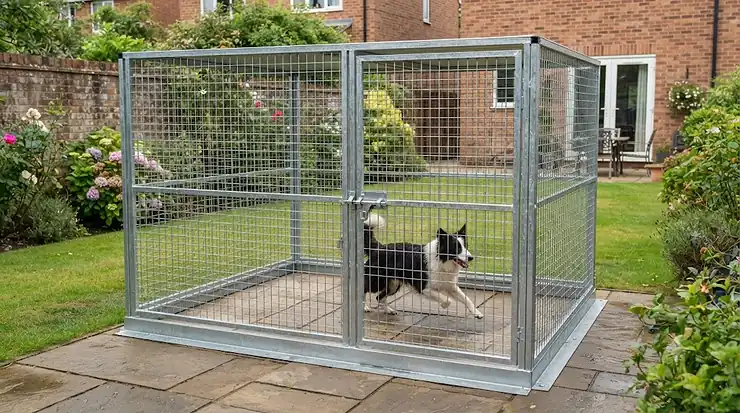
Every dog owner with a true escape artist knows the exact moment the penny drops: you glance out the kitchen window, and the garden is empty. Not a rustle, not a bark, just an unsettling, dog-shaped absence. If you’re reading this, you’ve probably already tried the obvious fixes — a taller panel here, a bungee cord there — and watched your dog treat each one as a puzzle to be solved within the hour. Finding a genuinely secure dog run for escape artists isn’t about buying the flashiest kennel on the shelf; it’s about matching the right structure, barrier and lock to the specific way your dog breaks out, because Houdini hounds rarely repeat the same trick twice.
Some dogs are climbers, scaling chain link like it’s a ladder built just for them. Others are diggers, quietly excavating a tunnel over several patient nights while you assume the garden is fine. A smaller number are simply escape opportunists, waiting for one unlatched gate to slip through. This guide walks through seven real, currently available UK products — proper dog runs, dig-proof barrier fixes and lock upgrades — with honest analysis of what actually holds up against a determined dog, rather than what the marketing copy promises. We’ll also unpack the behaviour behind the escaping, because the sturdiest run in the world only buys you time if you never address why your dog wants out in the first place.
Quick Comparison Table
| Product | Type | Best For | Price Range |
|---|---|---|---|
| Dellonda DG281 | Chain link dog run | Budget all-rounder | £100-£200 |
| PawHut Outdoor Dog Kennel | Covered dog run | Weather protection + security | £150-£300 |
| vidaXL Dog House with Extended Run | House + run combo | Full-time outdoor containment | £250-£450 |
| COZY PET Dog Run Panels | Modular panel system | Custom-sized enclosures | £200-£500+ |
| Suregreen Galvanised Weld Mesh Roll | Dig-proof barrier | Diggers and tunnellers | £20-£50 |
| Master Lock Excell Padlock | Lock mechanism | Upgrading weak latches | Under £15 |
| vidaXL Dog Cage | Compact lockable run | Small gardens, smaller dogs | £80-£180 |
The pattern here is worth sitting with for a second: only three of these seven are complete standalone runs. The other four are targeted fixes — a dig barrier, a padlock, a compact cage — because a genuinely secure dog run for escape artists is very rarely a single purchase. It’s usually a base structure plus one or two specific reinforcements aimed at exactly how your dog tries to get out, and that combination approach shows up again and again in the analysis below.
💬 Just one click — help others make better buying decisions too! 😊
Top 7 Secure Dog Run Products: Expert Analysis
1. Dellonda DG281 — the budget chain-link classic
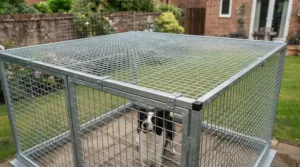
Dellonda DG281 is the sort of dog run that shows up in a lot of UK gardens for a simple reason: galvanised steel chain link fencing paired with a weatherproof roof cover and a lockable latch, all at a genuinely accessible price point. The chain link construction is welded into a rigid frame rather than simply stretched between posts, which matters enormously for escape artists, since loose chain link is exactly the kind of structure a determined dog can distort and squeeze through over time. Based on the spec comparison with pricier modular systems, what you’re sacrificing at this price is customisation — it comes in fixed panel sizes rather than being built around your specific garden shape or dog’s jump height. Reviewers consistently flag that the lockable latch on the door is a genuine step up from the simple bolt-slide closures found on cheaper kennels, though a recurring theme in aggregated feedback is that determined chewers can work at the chain link joints over many months, so this suits opportunistic escapers more than committed destroyers.
Pros:
- ✅ Genuinely affordable entry point for a full run
- ✅ Welded chain link resists distortion better than loose mesh
- ✅ Lockable latch beats basic bolt closures
Cons:
- ❌ Fixed panel sizes limit custom garden fit
- ❌ Chain link joints can weaken under sustained chewing
Sitting in the £100-£200 range depending on size, this is a solid budget starting point for moderate escape attempts rather than the most extreme cases.
2. PawHut Outdoor Dog Kennel — weatherproof security for covered containment
PawHut Outdoor Dog Kennel pairs a UV-resistant, water-resistant roof with a fully lockable door, and that roofed structure does more for security than it might first appear — a covered run removes the option of a dog using the top rail as a springboard onto an overhanging branch or fence, which is a surprisingly common climbing route for agile breeds. What most buyers overlook about this model is that the roof also changes the psychology of the space: a shaded, weather-protected run tends to reduce the restless pacing that often precedes an escape attempt, since the dog isn’t simply trying to get out of direct sun or rain. Aggregated reviewer sentiment consistently praises the sturdiness of the frame under normal use, though a common complaint is that the door hinges need periodic tightening, since a slightly loose hinge can create just enough of a gap for a persistent nose-pusher to exploit. On paper, this makes it a strong pick for owners dealing with a dog whose escape attempts are partly weather- or boredom-driven rather than purely structural testing.
Pros:
- ✅ Weatherproof roof reduces climbing launch points
- ✅ Fully lockable door as standard
- ✅ Shaded structure can reduce escape-driving restlessness
Cons:
- ❌ Hinges require periodic tightening to stay gap-free
- ❌ Heavier and more involved to assemble than basic kennels
Typically priced between £150 and £300 depending on dimensions, it’s a fair mid-range jump for owners who want covered, all-weather containment as standard.
3. vidaXL Dog House with Extended Run — the full-time containment combo
For dogs who genuinely live outdoors for large parts of the day, vidaXL Dog House with Extended Run combines an insulated-feel sleeping house with a substantial galvanised steel run in one connected structure, meaning there’s no gap between shelter and enclosure for a dog to exploit during a handover moment. The protective roof over the run section, not just the house, is a meaningful upgrade over basic runs, since it closes off the most common climbing exit — using the top of a doorway or low roofline as a stepping stone over the fence line. Here’s what the spec sheet won’t tell you, but reviewers note repeatedly: the sheer footprint of this combo unit means it needs a genuinely flat, prepared base to sit securely, and any unevenness in the ground can create small gaps at the base that a digger will find within days. Reviewer sentiment across UK buyers tends to highlight the secure, hinged door as one of the strongest features, consistently describing it as noticeably harder to nudge open than basic slide-bolt kennels.
Pros:
- ✅ Combined house and run removes handover gaps
- ✅ Full roof coverage closes off common climbing routes
- ✅ Secure hinged door outperforms basic bolt latches
Cons:
- ❌ Requires a flat, well-prepared base to install properly
- ❌ Larger footprint needs more garden space than standalone runs
Generally priced from £250 up to £450 depending on size, this sits at the premium end but earns it for dogs needing genuine full-time outdoor security.
4. COZY PET Dog Run Panels — build it around your escape artist, not the other way round
COZY PET Dog Run Panels take a completely different approach: rather than one fixed shape, you’re buying heavy-duty galvanised steel panels designed to be configured into whatever layout and size actually suits your garden and your dog’s specific escape history. Based on the spec comparison with fixed-shape runs, this modular format is the single biggest advantage for genuine escape artists, because you can build taller sections specifically where your dog has previously tried to climb, or extend the footprint into an awkward garden corner a boxed kennel simply wouldn’t fit. What most buyers overlook is that panel systems like this were originally designed for breeders and kennels managing multiple dogs, so the steel gauge and welding standard tends to run noticeably heavier duty than typical consumer dog runs — a genuine advantage when a dog is testing the structure daily rather than occasionally. Aggregated reviewer feedback consistently notes the assembly takes real time and planning compared with a boxed kit, but that the resulting structure feels considerably more rigid once bolted together.
Pros:
- ✅ Fully customisable size and shape to fit any garden
- ✅ Breeder-grade steel gauge outperforms typical consumer runs
- ✅ Individual panels can be reinforced exactly where needed
Cons:
- ❌ Significantly more assembly time and planning required
- ❌ Higher total cost once enough panels are purchased
Expect to spend £200-£500 or more depending on the final configuration, making this the go-to premium option for genuinely determined, repeat escape artists.
5. Suregreen Galvanised Weld Mesh Roll — the dig-proof fix nobody thinks to buy first
Most owners chasing a secure dog run for escape artists focus entirely on height and forget the ground itself, which is exactly where Suregreen Galvanised Weld Mesh Roll earns its place on this list. This isn’t a standalone run — it’s the raw material for building an L-footer, the wire barrier laid flat against the base of an existing fence or run and bent at ninety degrees into the enclosure, so a digging dog hits a horizontal wire wall well before reaching open ground beyond the fence line. Based on the spec comparison with pre-made “no-dig” panel kits, buying a mesh roll and cutting it to length works out considerably cheaper per metre for larger runs, though it demands more DIY effort than a boxed dig-barrier product. What the marketing rarely spells out clearly is that this barrier doesn’t need to be buried to function — laid flat and weighted down with soil, gravel or paving slabs, it still physically blocks the tunnel before it can form, which is exactly the kind of practical detail experienced diggers’ owners learn the hard way.
Pros:
- ✅ Considerably cheaper per metre than boxed dig-barrier kits
- ✅ Works without deep burial when properly weighted down
- ✅ Adaptable to any fence type, chain link or timber
Cons:
- ❌ Requires manual cutting and fitting effort
- ❌ Sharp cut edges need careful handling and covering
Priced roughly £20-£50 depending on roll length, this is arguably the single best-value addition on this entire list for a confirmed digger.
6. Master Lock Excell Laminated Steel Padlock — the £10 upgrade that outperforms most factory latches
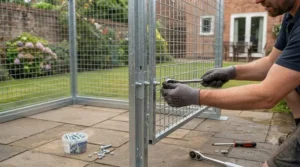
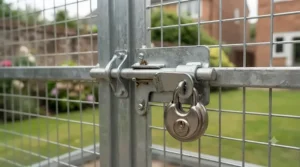
It’s an unglamorous entry, but Master Lock Excell Laminated Steel Padlock deserves a spot here because lock mechanisms are consistently the weakest link in an otherwise solid dog run — a heavy-duty chain link kennel with a flimsy factory slide-bolt is only as secure as that bolt. The laminated steel construction resists prying far better than the thin folded-metal latches bundled with budget runs, and critically, a padlock removes the option of a nose-savvy dog simply nudging a slide-bolt open, which is a genuinely common escape method that owners often don’t believe until they see it on camera. What most buyers overlook about lock mechanisms generally is that a shrouded shackle design — where the padlock’s loop is partially enclosed by the lock body — resists both weather corrosion and deliberate tampering noticeably better than an exposed-shackle equivalent, making it the smarter upgrade pick over a generic budget padlock. Reviewer sentiment consistently praises the smooth key action even after outdoor exposure, a detail that matters more than it sounds once a lock has spent a winter in a British garden.
Pros:
- ✅ Far sturdier than bundled factory slide-bolts
- ✅ Shrouded shackle resists weather and tampering
- ✅ Genuinely inexpensive relative to the security gain
Cons:
- ❌ Requires drilling or hasp fitting on some gate types
- ❌ An extra key to keep track of and not lose
At under £15 in most cases, this is realistically the cheapest, highest-impact upgrade on the entire list.
7. vidaXL Dog Cage — the compact lockable option for smaller gardens
Not every escape artist is a large breed, and not every garden has room for a sprawling run, which is where vidaXL Dog Cage fits in — a galvanised steel, fully lockable crate-style enclosure sized more modestly than the full runs earlier on this list, designed for playing, exercise and short-term secure containment. The mesh design keeps ventilation strong while still presenting a tight enough gap spacing that smaller, more flexible dogs — the breeds most likely to squeeze through gaps a larger dog physically couldn’t — can’t simply push their way out. Reviewers consistently note this suits smaller courtyards, patios or balconies where a full-size run genuinely wouldn’t fit, though aggregated feedback also flags that the compact footprint isn’t intended for a dog spending extended hours outdoors unsupervised, more for secure short bursts of outdoor time. On paper, this makes it a sensible complementary purchase alongside a larger run, or a standalone option for compact urban gardens with a smaller escape-prone breed.
Pros:
- ✅ Genuinely lockable despite the compact footprint
- ✅ Mesh spacing suited to smaller, flexible breeds
- ✅ Fits gardens, patios and courtyards larger runs can’t
Cons:
- ❌ Not intended for extended unsupervised outdoor hours
- ❌ Too small for medium or large dog breeds
Generally priced between £80 and £180 depending on dimensions, it’s a smart budget-to-mid option for smaller escape artists in tighter spaces.
Real-World Scenarios: Which Fix Actually Suits Your Escape Artist?
Picture three very different gardens. First, there’s the terraced house with a young terrier who’s already dug three tunnels this spring — here, no amount of fencing height matters until the ground itself is addressed, so a Suregreen Galvanised Weld Mesh Roll L-footer around the base of the existing fence, paired with a Master Lock Excell on the gate, solves the actual problem for a fraction of the cost of a full replacement run. Second, there’s the rural cottage with a large, agile lurcher who treats any fence under six feet as a minor inconvenience — here, the roofed, fully enclosed structure of a vidaXL Dog House with Extended Run removes the climbing option entirely, since there’s simply no open top to launch from. Third, there’s the small urban courtyard with an escape-prone but genuinely small breed, like a determined Jack Russell — a compact vidaXL Dog Cage with tight mesh spacing solves the squeeze-through problem without needing anywhere near the footprint of a full run. None of these owners need every product on this list — they need the one or two that actually target their dog’s specific escape method.
Problem → Solution: Common Escape Methods, Solved
Dog climbing straight up chain link like a ladder? Add an inward-leaning “lean-in” extension at the top of the run, angled into the enclosure, since a vertical extension alone still gives a determined climber something to grip. Dog digging under the fence line within days of installation? An L-footer barrier using something like Suregreen Galvanised Weld Mesh Roll stops the tunnel before it starts, without needing to concrete the entire perimeter. Dog nudging the gate open with their nose or paw? Swap the factory latch for a proper padlock such as Master Lock Excell, since slide-bolts are far more vulnerable to persistent nudging than most owners assume. Dog squeezing through a surprisingly small gap? Check mesh or bar spacing against your dog’s head width specifically, not just their overall body size, since a dog that can get its head through a gap will usually follow through with the rest of its body. Multiple dogs testing weak points as a team, taking turns? Treat this as a behavioural escalation, not just a structural one, and consider breaking up boredom-driven joint escape attempts with more supervised outdoor time and enrichment, as recommended in Dogs Trust’s guidance on dogs escaping and running away.
What Is a Secure Dog Run for Escape Artists?
A secure dog run for escape artists is an outdoor enclosure specifically reinforced against the particular escape methods a determined dog uses — climbing, digging, squeezing or manipulating weak latches — rather than a standard kennel run relying on height and basic fencing alone. It typically combines a rigid structural boundary with targeted reinforcements like dig-proof ground barriers and upgraded lock mechanisms.
How to Choose Escape-Proof Fencing Options
- Identify your dog’s specific escape method first. Climbers, diggers and squeezers each need a completely different structural fix, so watch (or review footage of) an actual escape attempt before buying anything.
- Measure jump height honestly, including launch points. Raised ground, garden furniture or bins near the fence line effectively lower the real barrier height, regardless of the fence’s stated dimensions.
- Check the ground, not just the fence. A six-foot fence with no ground barrier is meaningless against a committed digger, which is why dig-proof add-ons matter as much as the fence itself.
- Prioritise lock mechanisms over overall structure size. A modest run with a genuinely secure lock consistently outperforms an impressive structure held shut with a flimsy factory bolt.
- Consider a roofed or fully enclosed design for serious climbers. Removing the open top eliminates the climbing option entirely rather than simply raising the challenge.
- Match mesh or bar spacing to your specific breed. Smaller, more flexible dogs need tighter gap spacing than the general product description might assume.
- Plan for behavioural reinforcement alongside the structure. Physical containment buys time and safety, but addressing why your dog wants to escape reduces how hard they test the barrier in the first place.
Chain Link Dog Run vs Other Fencing Types
| Comparison Point | Chain Link Dog Run | Solid Panel / Timber Run | Modular Steel Panels |
|---|---|---|---|
| Climb resistance | Moderate — gives foot purchase | Strong, no gripping points | Strong, especially welded types |
| Dig resistance (alone) | Weak without ground barrier | Weak without ground barrier | Weak without ground barrier |
| Visibility for the dog | High, reduces anxiety | Low, can increase boredom | High |
| Customisation | Limited, mostly fixed sizes | Moderate | Excellent |
| Best For | Budget setups like Dellonda DG281 | Anxious dogs needing reduced stimulation | Determined escape artists needing COZY PET Dog Run Panels-style flexibility |
Reading across this table, the honest takeaway is that a chain link dog run genuinely earns its popularity on cost and visibility, letting your dog see and hear the wider garden rather than feeling boxed in, but it offers real climbers more grip than a smooth panel surface would. Solid panel runs solve the climbing-grip problem but can increase frustration-driven digging in dogs who dislike the reduced visibility, while modular steel panel systems sit at the top for pure escape-resistance simply because they can be reinforced exactly where a specific dog has already proven weak points exist. None of these fencing types solve digging on their own — that requires a dedicated ground barrier regardless of which fence type sits above it.
Dig-Proof Barriers: Stopping Diggers at the Root
Digging is consistently one of the most underestimated escape routes, largely because it’s invisible until the tunnel is already finished. The classic fix is an L-footer — wire mesh laid flat against the base of the fence and bent inward at roughly ninety degrees, so a dog attempting to dig along the fence line hits a horizontal barrier well before reaching open ground on the other side. According to Blue Cross advice on creating a pet-friendly garden, placing wire barriers roughly twelve inches below ground level is a commonly recommended depth for digging pets, though a barrier laid flat and weighted rather than buried can work nearly as well with considerably less effort. For genuinely committed diggers, a poured concrete footer along the base of the fence is the most bombproof option available, though it’s a significant undertaking best suited to a determined, repeat-offender dog rather than a first response. The unglamorous truth is that most digging-related escapes are entirely preventable with a barrier costing a fraction of a full fence replacement — it’s simply the step most owners skip until after the first escape.
Lock Mechanisms: Which Gate Locks Actually Hold
The single most overlooked weak point in an otherwise secure dog run is almost always the lock, not the fence. A slide-bolt latch, the default fitted to most budget kennels, relies entirely on gravity and a small lip to stay shut — precisely the kind of mechanism a nose-pushing or paw-pawing dog can defeat through simple repetition. Upgrading to a genuine padlock, such as Master Lock Excell Laminated Steel Padlock, removes that vulnerability entirely, since a shrouded, keyed mechanism can’t be nudged open by persistence alone. Spring-loaded carabiner-style clips sit in a useful middle ground — quicker for a human to operate one-handed than a padlock, and still far more secure than a basic slide-bolt, though a genuinely determined dog with dexterous paws can occasionally work a poorly seated clip loose over time. The most secure setups tend to layer two mechanisms together — a spring clip for quick daily access and a padlock for anything longer than a supervised session — rather than relying on a single point of failure.
Understanding Dog Containment Behaviour: Why Dogs Escape
Escape behaviour is rarely random, and understanding the underlying motivation matters just as much as the physical barrier itself. According to Dogs Trust’s guidance on dogs escaping and running away, it’s important to work out which specific situations trigger the urge to escape and exactly how a dog is getting away, since the same fix rarely works for every underlying cause. Boredom and under-stimulation are common drivers, particularly in working or high-drive breeds left without enough physical or mental outlet, while anxiety-driven escaping — a dog trying to reach or avoid something specific, or panicking during fireworks or storms — often overrides even a well-built physical barrier, since a frightened dog will attempt far more extreme measures than a bored one. Hormonally driven escape attempts, particularly around a female dog’s seasonal cycle, tend to spike sharply and unpredictably, which is why supervised outdoor access during those periods matters more than usual. As an owner, it’s also worth understanding your legal responsibility here: under UK law, as outlined in GOV.UK guidance on controlling your dog in public, owners carry direct responsibility for keeping their dog under control, which makes proactive containment a welfare issue and a legal one, not just a matter of convenience.
Common Mistakes When Buying a Secure Dog Run
The most common mistake, according to aggregated reviewer feedback across every product category on this list, is buying based on height alone while completely ignoring ground-level digging risk — a mistake that only becomes obvious after the first successful tunnel. A close second is sticking with the factory-fitted latch on an otherwise solid structure, effectively undermining an expensive run with a cheap point of failure that a determined dog finds within days. Owners also frequently underestimate mesh or bar spacing relative to their specific dog’s head size, assuming overall body size is the only relevant measurement when a narrow gap a head can pass through is often enough. Another recurring oversight is treating the physical structure as the entire solution, without addressing the boredom, anxiety or hormonal triggers actually driving the escape attempts in the first place — a stronger fence alone rarely resolves a behaviourally motivated escape artist long-term. Finally, many owners buy a single, fixed-size run without first identifying their dog’s specific escape method, ending up with an expensive structure that’s genuinely strong in the wrong place.
Long-Term Cost & Maintenance
Full runs like PawHut Outdoor Dog Kennel or vidaXL Dog House with Extended Run represent the larger upfront spend on this list, but they’re realistically a one-off purchase that, with basic maintenance — checking hinges, re-tensioning mesh, touching up any rust spots on galvanised steel — can last for years rather than needing regular replacement. Modular systems like COZY PET Dog Run Panels cost more initially but hold real long-term value precisely because individual panels can be reinforced or replaced rather than needing a whole new structure when your dog’s escape tactics evolve. The smaller, targeted fixes — Suregreen Galvanised Weld Mesh Roll and Master Lock Excell Laminated Steel Padlock — are genuinely the best value per pound spent on this entire list, since they’re inexpensive additions that directly close the two most common failure points, digging and weak locks, on top of whatever structure you already own. The real long-term cost trap is buying the wrong first structure and then having to double-spend on a full replacement once a workaround fails, which is exactly why matching the fix to the specific escape method matters more than chasing the biggest, most expensive option available.
Frequently Asked Questions
❓ What's the most secure type of dog run for a determined escape artist?
❓ How deep does a dig-proof barrier need to be to stop a dog tunnelling?
❓ Can a chain link dog run actually be escape-proof?
❓ Why does my dog keep escaping even with a secure fence?
❓ Are padlocks really necessary on a dog run gate?
Conclusion
There’s no single miracle product that solves a secure dog run for escape artists on its own — only a combination that actually matches your dog’s specific escape method. Budget-conscious owners dealing with a moderate escape risk will likely do well starting with a Dellonda DG281 or compact vidaXL Dog Cage, while committed diggers get more genuine value from a Suregreen Galvanised Weld Mesh Roll L-footer than from any amount of extra fence height. Determined climbers need the fully enclosed structure of a vidaXL Dog House with Extended Run, and genuinely repeat-offender escape artists are usually best served by the reinforceable flexibility of COZY PET Dog Run Panels. Whatever structure you land on, don’t skip the unglamorous £10 fix — a Master Lock Excell Laminated Steel Padlock — and don’t forget that the sturdiest containment in the world is still only half the answer; addressing the boredom, anxiety or instinct driving the escape attempts is what actually stops your dog wanting to leave in the first place.
Recommended for You
- Covered Dog Run for Large Dogs: 7 Best Picks for 2026 UK Gardens
- Modular Dog Run vs Chain Link Dog Run: 7 Best UK Kits (2026)
- 7 Best Dog Runs Under £300 for a Secure Garden in 2026
Disclaimer: This article contains affiliate links. As an Amazon Associate, I earn from qualifying purchases. If you purchase products through these links, we may earn a small commission at no additional cost to you.
✨ Found this helpful? Share it with your friends! 💬🤗
