
In This Article
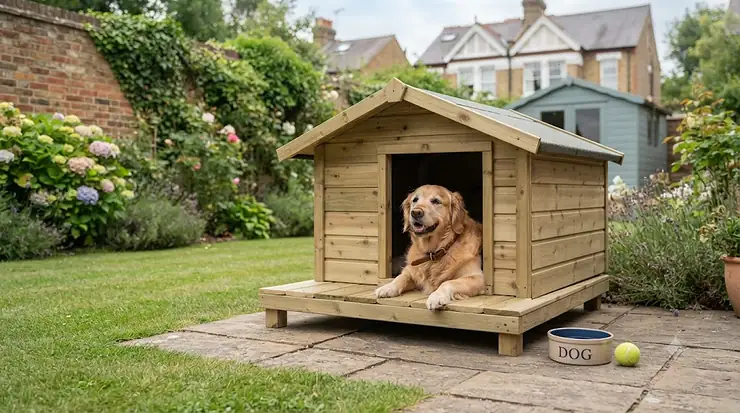
A wooden dog kennel with raised floor is an outdoor shelter built on short legs or a plinth so the sleeping area sits above ground level, keeping the timber base away from standing water, frost and rising damp. That gap — often just five to ten centimetres — does more for a dog’s comfort than almost any other single feature you’ll find on a spec sheet.
If you’ve ever lifted a garden shed after a wet winter and found the underside black with mould, you already understand the problem a raised floor is solving. Timber left sitting directly on grass or bare soil behaves like a sponge. It wicks up moisture, swells, and eventually rots from the bottom up — and a soggy kennel floor happens to be exactly where your dog spends eight or more hours a night. British weather doesn’t make this easy either. Between frequent drizzle, the freeze-thaw cycles of a typical winter, and gardens that rarely drain as well as we’d like, a wooden dog kennel with raised floor isn’t really a luxury upgrade so much as a baseline requirement for anywhere outside a bone-dry, south-facing patio.
This guide has done the legwork. We’ve researched seven genuine, currently available kennels spanning budget, mid-range and premium price points, weighed up what real reviewers say once the novelty wears off, and paired that with honest analysis of which specs actually matter versus which are mostly marketing polish. You’ll also find dedicated sections on damp-proofing, base options and garden drainage — the unglamorous groundwork that decides whether your new kennel lasts five years or fifteen. Let’s get into it.
Quick Comparison Table
Before the deep dive, here’s how the seven kennels stack up at a glance. Sizes are external dimensions, and as with all Amazon listings, treat prices as a guide — always check current pricing before buying.
| Kennel | Best For | Size (W x D x H) | Price Range | Raised Floor Height |
|---|---|---|---|---|
| Samuel Alexander Medium Wooden Dog House | Budget starter kennel | 104 x 69 x 72 cm | £70-£90 | Low plinth |
| VOUNOT Wooden Dog House | Small gardens, compact dogs | 72 x 65 x 83 cm | £60-£75 | Non-slip raised feet |
| PawHut Elevated Wooden Kennel (Natural Wood) | Three-part removable floor | 100 x 65.5 x 68 cm | £75-£90 | Adjustable foot pads |
| PawHut Wave-Roof Wooden Dog House | Rain-shedding roof design | 88 x 75 x 82 cm | £70-£90 | Adjustable foot pads |
| PawHut Elevated Open-Top Kennel | Toy and small breeds | 87 x 58 x 59 cm | £50-£65 | Raised platform |
| Samuel Alexander Large Wooden Dog House | Medium-to-large dogs | 116 x 79 x 82 cm | £95-£120 | Elevated base |
| Rowlinson Large Dog Kennel | Premium, FSC-certified build | 138 x 90 x 94 cm | £140-£180 | Full-height plinth |
Looking at this spread, the VOUNOT Wooden Dog House and PawHut Elevated Open-Top Kennel cover buyers with modest budgets or smaller dogs, while the Samuel Alexander Large Wooden Dog House and Rowlinson Large Dog Kennel are built for bigger breeds that need genuine headroom. Notice, too, that a bigger footprint doesn’t always mean a taller raised floor — some budget kennels use thin foot pads rather than a proper plinth, which matters more than it sounds like on a waterlogged lawn.
💬 Just one click — help others make better buying decisions too! 😊
Top 7 Wooden Dog Kennels With Raised Floors: Expert Analysis
1. Samuel Alexander Medium Wooden Dog House — best budget starter kennel
The Samuel Alexander Medium Wooden Dog House is the kind of kennel most people picture when they think “budget but decent,” and on the numbers, it earns that reputation. At 104cm wide, 69cm deep and 72cm tall externally (with a snugger 93 x 54 x 61cm interior), it’s genuinely sized for small-to-medium breeds rather than being optimistically marketed as such. The slanted, hinged roof lifts fully open for cleaning, and a PVC doorway curtain adds a layer of draught protection that a lot of similarly priced kennels skip entirely.
Based on the spec comparison, what stands out here is the elevated floor sitting the sleeping area off the ground specifically to manage temperature swings — useful given how much a British garden can shift between a damp fifteen degrees and a frosty single figure within the same week. Reviewers consistently report that the timber, while lightweight, holds together well for the price, with one UK buyer specifically praising the fit for a Bedlington terrier and noting the value for money. What most buyers overlook is that “lightweight wood” isn’t automatically a bad thing — it makes the kennel easier to reposition around the garden, which matters more than raw heft if you’re chasing shade in summer.
Pros:
- ✅ Genuinely affordable entry point into raised-floor kennels
- ✅ PVC door curtain adds useful draught protection
- ✅ Lightweight build makes repositioning around the garden easy
Cons:
- ❌ Thinner timber than premium alternatives, so less insulating
- ❌ Small size limits it to smaller and medium breeds only
At around £70-£90, the Samuel Alexander Medium Wooden Dog House represents strong value for owners easing a small-to-medium dog into outdoor housing without overcommitting financially.
2. VOUNOT Wooden Dog House — most compact elevated design for small gardens
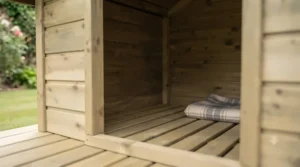
The VOUNOT Wooden Dog House takes a different approach: rather than maximising internal volume, it prioritises a tight footprint (72 x 65 x 83cm) that suits terraced gardens, courtyards and dogs who genuinely prefer a den-like space. The waterproof roof pitches steeply, which on paper means faster water run-off than the shallower slopes used on some rivals, and the non-slip feet keep the whole structure from sliding around on paving or decking.
Here’s what to weigh with a kennel this compact: the raised feet lift the floor enough to break contact with wet ground, but they’re not a full plinth, so on genuinely soggy lawns you’ll still want an additional base layer (more on that later in this guide). The spec sheet won’t tell you this, but user reports suggest assembly is quicker than average — a recurring theme in aggregated review sentiment is that the panel-and-peg construction goes together in well under an hour, which is a real point of difference from kennels that arrive as a hundred loose screws. Reviewers are split on the finish, with some rating it highly and others finding the wood tone inconsistent between batches, so treat the natural-wood colour as a rough guide rather than a guarantee.
Pros:
- ✅ Compact footprint suits small gardens and courtyards
- ✅ Steep waterproof roof sheds rain quickly
- ✅ Reported by buyers as one of the faster kennels to assemble
Cons:
- ❌ Raised feet alone aren’t a substitute for a proper base on wet lawns
- ❌ Wood tone consistency has drawn mixed feedback in reviews
Priced in the £60-£75 range, the VOUNOT Wooden Dog House suits owners short on space who still want the benefits of an elevated design without a large outdoor footprint.
3. PawHut Elevated Wooden Kennel (Natural Wood) — best three-part removable raised floor
The PawHut Elevated Wooden Kennel is built from specially treated fir wood with a genuinely useful practical touch: the floor is split into three separate removable sections rather than one solid panel. Based on the spec comparison, this single design choice does a lot of heavy lifting — it means you can lift out and hose down just the soiled section rather than manhandling an entire floor panel, and it also lets trapped moisture evaporate through the gaps rather than pooling underneath.
At 100 x 65.5 x 68cm externally, it’s rated for dogs up to roughly 30kg and 60cm in body length, putting it solidly in medium-to-large territory. The tilted asphalt roof is a genuine upgrade over the felt or PVC roofing used on cheaper kennels, since asphalt shingle handles UK winters — freeze, thaw, freeze again — noticeably better over several seasons. What most buyers overlook about this model is that the adjustable foot pads aren’t just for looks; on an unlevel patio or slightly sloped lawn, they let you correct the pitch so rainwater doesn’t pool against one wall of the kennel, which is precisely the kind of slow, unnoticed damage that shortens a wooden kennel’s life.
Pros:
- ✅ Three-part removable floor makes spot-cleaning genuinely practical
- ✅ Asphalt roof outperforms felt or PVC in freeze-thaw conditions
- ✅ Adjustable foot pads correct for uneven ground
Cons:
- ❌ Assembly involves more individual panels than simpler designs
- ❌ At 14kg, it’s not something you’ll reposition solo very often
At roughly £75-£90, the PawHut Elevated Wooden Kennel is a sensible mid-range pick for owners who prioritise easy cleaning and durable roofing over a rock-bottom price tag.
4. PawHut Wave-Roof Wooden Dog House — best rain-shedding roof over a raised base
Where the previous PawHut model wins on floor design, the PawHut Wave-Roof Wooden Dog House wins on roof engineering. Its PVC wave-shaped roof is contoured rather than flat-pitched, which — based on the spec comparison — channels water off to both sides faster than a standard single-slope design, reducing the amount of time rain sits pooled against the roofline seams where leaks typically start.
Sized at 82H x 75W x 88Dcm and rated for dogs up to around 20kg and 50cm in body length, it sits in the small-to-medium bracket. The anti-corrosion treated wood frame is paired with a removable floor and adjustable foot pads, echoing the raised-floor logic seen elsewhere in this list but packaged with a roof shape genuinely built with British drizzle in mind rather than adapted from a drier-climate design. What reviewers consistently note in aggregated feedback is that the door dimensions (35.5H x 30.5Wcm) suit smaller and stockier breeds well, but taller dogs may find the entrance a squeeze — worth measuring your dog’s shoulder height against this before ordering.
Pros:
- ✅ Wave-shaped roof sheds water faster than flat designs
- ✅ Anti-corrosion wood treatment aids long-term weather resistance
- ✅ Removable floor and adjustable feet support the raised design
Cons:
- ❌ Door opening is narrow for taller medium breeds
- ❌ Suited to dogs under roughly 20kg, ruling out larger breeds
Expect to pay in the £70-£90 range, making the PawHut Wave-Roof Wooden Dog House a strong mid-tier option specifically for owners in consistently wet parts of the country.
5. PawHut Elevated Open-Top Kennel — best raised floor for toy and small breeds
Not every dog needs a kennel built for a Labrador, and the PawHut Elevated Open-Top Kennel is one of the few genuinely well-specified options for toy and small breeds — think Chihuahuas, Yorkshire terriers, Pomeranians and Maltese. At 82W x 58D x 58Hcm, it’s noticeably smaller than the rest of this list, and the raised platform design is explicit about its dual purpose: keeping the floor away from damp ground while also discouraging other garden animals from using the underside as their own shelter.
Here’s what to weigh: weatherproof solid fir wood with a slanted roof handles drainage well for a kennel this size, and the waterproof painted surface is rated for both indoor and outdoor use, giving you flexibility if you eventually want to bring it inside during particularly harsh weather. The spec sheet won’t tell you this, but reviewers note the compact scale means it heats up with a dog’s body warmth faster than larger kennels — a genuine advantage for small breeds that struggle to self-regulate temperature in cold weather, though it does mean less airflow on hot days, so positioning in shade matters more with this model than most.
Pros:
- ✅ Purpose-sized for toy and small breeds rather than downsized from a larger design
- ✅ Raised platform helps deter other animals from sheltering underneath
- ✅ Suitable for both indoor and outdoor placement
Cons:
- ❌ Too small for anything beyond small breeds
- ❌ Reduced airflow means shade placement matters more in summer
At around £50-£65, the PawHut Elevated Open-Top Kennel is the most accessible entry point on this list for small-breed owners specifically.
6. Samuel Alexander Large Wooden Dog House — best raised kennel for medium-to-large dogs
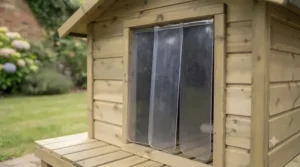
Stepping up in size, the Samuel Alexander Large Wooden Dog House offers a genuinely spacious 105 x 70 x 71cm interior inside an external footprint of 116 x 79 x 82cm — a meaningful jump from the medium version earlier in this list. The asphalt roof is a notable upgrade over the felt roofing found on some same-brand kennels, and it’s again paired with a PVC doorway curtain for additional insulation against wind and driving rain.
Based on the spec comparison, the elevated floor here is doing double duty: keeping the kennel cool in summer by allowing airflow underneath, and reducing cold transfer from frozen ground in winter — a detail that matters more than it sounds for larger breeds with thinner coats, like Boxers or Weimaraners, who lose heat through direct ground contact faster than you’d expect. The 36.5 x 57cm front opening is generous enough for most medium and large breeds to enter comfortably without ducking. Aggregated customer feedback for the smaller sibling model in this range praises overall build quality and sturdiness for the price point, though independent verification specifically for the large size is thinner, so factor in slightly more uncertainty here than with the medium model.
Pros:
- ✅ Spacious interior genuinely suited to medium-to-large breeds
- ✅ Asphalt roof plus PVC curtain doubles up on weatherproofing
- ✅ Elevated floor aids both summer cooling and winter insulation
Cons:
- ❌ At 23kg, this is a two-person assembly and placement job
- ❌ Independently verified reviews specifically for the large size remain limited
Priced around £95-£120, the Samuel Alexander Large Wooden Dog House is a sound mid-to-premium pick for larger breeds that have outgrown starter kennels.
7. Rowlinson Large Dog Kennel — best premium FSC-certified raised kennel
At the top of this list sits the Rowlinson Large Dog Kennel, a noticeably more substantial build at 138cm wide, 90cm deep and 94cm tall — big enough, per the manufacturer, for one large dog or two small-to-medium dogs sharing. Constructed from FSC-certified softwood with 12mm shiplap cladding (the same overlapping-board technique used on quality garden sheds), it’s a different category of build to the flat-pack fir-wood kennels earlier in this list.
What most buyers overlook about this model is the significance of proper tongue-and-groove flooring rather than thin plywood sheets — it’s stiffer underfoot, resists warping better over multiple wet-dry cycles, and sits the dog noticeably further off the ground than the adjustable-foot designs used elsewhere. The mineral roofing felt is dip-treated to protect against rot, and the honey-brown finish is baked into the wood rather than sprayed on top, meaning scuffs and scratches are less likely to expose bare timber underneath. Reviewers consistently note the lifting-lid roof design makes cleaning genuinely easy, and the option to position the door opening on the front or the end gives useful flexibility for awkward garden corners. On paper, this means a kennel built to last considerably longer than budget alternatives, provided you keep up with the preservative reapplication the manufacturer recommends.
Pros:
- ✅ FSC-certified softwood with proper shiplap and tongue-and-groove construction
- ✅ Lifting-lid roof with flexible door placement (front or end)
- ✅ Dip-treated finish and mineral felt roof built for longevity
Cons:
- ❌ Significantly pricier than every other kennel on this list
- ❌ At 44kg, this is not a kennel you’ll casually relocate
Typically priced in the £140-£180 range depending on retailer, the Rowlinson Large Dog Kennel is the clear choice for owners who want a garden-building-grade kennel rather than a flat-pack pet accessory.
Kennel Damp-Proofing: A Practical Guide
Buying any of the kennels above solves half the damp problem — the other half comes down to how you set it up and maintain it. Getting kennel damp proofing right in the first thirty days matters more than most owners expect, because timber that absorbs moisture early develops a memory for it, swelling and shrinking unevenly in every wet spell afterwards.
Start by treating all exposed cut edges with an exterior wood preservative before first use, even on kennels sold as “weatherproof,” since factory treatment rarely reaches surfaces cut during your own assembly. Reapply preservative annually, ideally in early autumn before the wettest months set in. Check the roof seal after the first heavy rain — a common first-30-days mistake is assuming a felt or asphalt roof is watertight straight out of the box, when in fact staples and seams often need a bead of roofing sealant to fully close gaps. Finally, resist the urge to push the kennel flush against a fence or wall; a few centimetres of clearance lets air circulate around the back panel, which is where hidden mould most often takes hold unnoticed.
Real-World Scenarios: Matching Owners to the Right Elevated Kennel
Specs only tell half the story, so here’s how three common situations map onto the kennels above. If you’re renting a flat with a small shared courtyard and a Jack Russell, the compact footprint and quick assembly of the VOUNOT Wooden Dog House suits a space where you can’t commit to a permanent structure. If you’ve got a growing Labrador puppy and a proper back garden, the Samuel Alexander Large Wooden Dog House gives room to grow into rather than outgrowing within a year, and the asphalt roof means you’re not re-shopping after one bad winter.
For a family with an elderly Staffordshire Bull Terrier who spends genuine daytime hours outdoors rather than just sleeping there overnight, the Rowlinson Large Dog Kennel‘s superior insulation and build quality earns back its higher price through comfort during long stretches outside, particularly for a dog whose joints feel the cold more than they used to. And for anyone with a toy breed who mostly wants a shaded retreat rather than full-time housing, the PawHut Elevated Open-Top Kennel avoids paying for space and materials that a five-kilogram dog will never use.
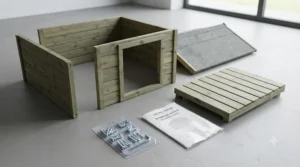
Dog Kennel Base Options and Garden Drainage for Dog Housing
A raised floor only solves part of the moisture equation — what’s directly underneath the kennel matters almost as much. When it comes to dog kennel base options, paving slabs are the most popular DIY choice: a simple 5cm gravel bed topped with slabs gives a level, quick-draining surface that also stops the kennel’s feet sinking into soft lawn over a wet winter. Decking is a workable alternative but needs gaps between boards for drainage, or you risk trapping water beneath the kennel rather than diverting it away.
Garden drainage for dog housing is worth thinking about before you even choose a spot. Avoid the lowest point of the garden, however convenient it looks, since water naturally collects there during heavy rain — precisely what a raised floor is trying to escape from in the first place. A slight fall away from the kennel, even just a couple of centimetres over a metre, encourages surface water to keep moving rather than pooling against the base. For gardens with genuinely poor drainage, a simple French drain — a gravel-filled trench with a perforated pipe — routed away from the kennel position can make a bigger practical difference than any single feature on the kennel itself.
How to Choose a Raised Floor Dog Kennel
Picking the right raised floor dog kennel comes down to a handful of decisions, roughly in this order of importance:
- Size your dog honestly, not aspirationally. Measure nose-to-tail and shoulder height, then add margin — a kennel your dog can barely turn around in defeats the purpose of shelter.
- Match the roof style to your local weather. Steeper pitches and asphalt shingles handle sustained rain better than flat felt roofs, particularly in western and northern UK regions.
- Check the raised floor height, not just its presence. A genuine plinth outperforms thin adjustable feet on consistently wet ground.
- Prioritise a removable or sectioned floor. Cleaning access matters more once the kennel is in daily use than it does on the product page.
- Factor in assembly and repositioning. Heavier premium builds are more durable but harder to move once installed — decide your final spot in advance.
- Look past the headline material claim. “Fir wood” and “solid wood” cover a wide quality range; check cladding thickness and treatment method where listed.
- Budget for base and drainage, not just the kennel. As covered above, the surface underneath often determines longevity more than the kennel’s own price tag.
Elevated Dog Kennel vs Ground-Level Dog Kennel
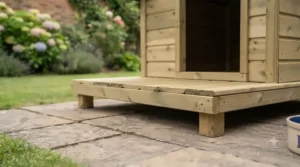
The case for an elevated dog kennel over a flat-bottomed alternative isn’t purely theoretical — it comes down to how timber and moisture interact over time. A ground-level kennel base sits in direct, near-constant contact with soil or grass, absorbing ambient ground moisture even on days when it isn’t actively raining. An elevated design breaks that contact, allowing air to circulate beneath the structure and letting any trapped damp evaporate rather than soak upward into the floor panel.
| Feature | Elevated Kennel | Ground-Level Kennel | Best For |
|---|---|---|---|
| Ground moisture exposure | Minimal — airflow underneath | Continuous direct contact | Elevated: damp gardens |
| Cold transfer in winter | Reduced via air gap | Higher, especially on frozen ground | Elevated: exposed sites |
| Setup complexity | Slightly more assembly | Usually simpler | Ground-level: quick setup |
| Long-term timber lifespan | Generally longer | Shortened by rot risk | Elevated: long-term ownership |
The trade-off is modest added assembly complexity and, in some designs, marginally reduced internal headroom where the plinth eats into vertical space. For anywhere in the UK outside a permanently dry, elevated hardstanding, that trade-off strongly favours the elevated design — the timber lifespan difference alone tends to justify it within two or three wet seasons.
What to Expect: Life With a Dog Kennel Off Ground
Specs describe a kennel; daily life with a dog kennel off ground looks a little different in practice. Expect a genuinely noticeable difference in bedding dryness — owners moving from a ground-level kennel to a raised design consistently report needing to change bedding less frequently, since it’s no longer wicking moisture up from below. Expect, too, a small learning curve for puppies who aren’t used to a step or lip at the entrance; most adjust within days, but very young or very old dogs with mobility issues may need a small ramp added.
On hot days, the airflow gap under a raised floor genuinely does keep the interior a few degrees cooler than a flush-fitted kennel sitting on baked soil or paving — not dramatically, but enough to matter during a heatwave. On the coldest nights, that same gap means slightly more attention to bedding thickness is worthwhile, since less ground-warmth transfers upward than with a ground-level design. None of this is a downside so much as a different set of small adjustments worth knowing about before your dog’s first night in their new kennel.
Common Mistakes When Buying a Wooden Dog Kennel With a Raised Floor
The single most common mistake is buying to the breed-average size rather than to the individual dog in front of you — a “large breed” kennel can still be cramped for an especially long-bodied Labrador or generously built German Shepherd. A close second is ignoring door height relative to shoulder height, which forces dogs to duck awkwardly every single entry and exit, something that becomes a genuine daily irritation over months of use.
Buyers also frequently underestimate positioning: placing a kennel against a fence or in permanent shade might seem sensible in summer but leaves it damp and slow to dry through autumn and winter. Skipping a base layer entirely, on the assumption that a raised floor alone is sufficient, is another recurring issue — as covered earlier, the two work together rather than one replacing the other. Finally, many owners treat the kennel as a one-off purchase rather than an ongoing maintenance item, missing the annual preservative reapplication that keeps warranties valid and timber sound for years rather than a single season.
Safety, Regulations and Damp Compliance Guide
There’s no specific UK regulation governing wooden dog kennel dimensions, but outdoor housing does fall under the Animal Welfare Act 2006, and the accompanying Defra Code of Practice for the Welfare of Dogs sets out expectations that any raised-floor kennel purchase should be measured against: dogs need a comfortable, dry, draught-free resting area, protection from adverse weather including damp and cold, and space to stand, turn around and lie fully stretched out.
The RSPCA’s guidance on keeping dogs outside goes further, noting that shelter and protection from rain, wind and sunlight should always be available, alongside genuine consideration of temperature and ventilation — both of which a well-positioned, well-based raised-floor kennel supports far better than a ground-level alternative left on bare soil. Given how much UK weather varies year to year — the Met Office’s long-term climate data shows persistent regional rainfall patterns across the country — building genuine damp resistance into your setup isn’t optional caution, it’s a fairly direct welfare consideration.
Long-Term Cost & Maintenance
A kennel’s sticker price is only the starting point for total cost of ownership. Preservative treatment typically costs a modest amount annually but adds years of usable life to any timber kennel, making it one of the highest-value maintenance spends available. Roofing material matters here too — asphalt shingle roofs, as used on a couple of kennels in this list, tend to need replacement or resealing less often than basic felt roofing, offsetting some of their higher upfront cost over a five-year ownership window.
| Kennel Tier | Typical Price Range | Annual Upkeep Estimate | Best For |
|---|---|---|---|
| Budget (PawHut Elevated Open-Top Kennel, VOUNOT Wooden Dog House) | £50-£75 | Low-moderate | First-time owners, smaller dogs |
| Mid-range (Samuel Alexander models, PawHut larger models) | £70-£120 | Moderate | Most households |
| Premium (Rowlinson Large Dog Kennel) | £140-£180 | Lower long-term, higher upfront | Long-term, larger-breed ownership |
Interpreting this spread, the premium tier’s higher purchase price is partly offset by reduced replacement frequency — a well-maintained FSC-certified kennel can reasonably outlast two or three budget kennels bought in succession. That said, budget and mid-range options remain entirely sensible for owners without a large dog or a multi-decade ownership horizon, since the total cost gap narrows considerably over a five-year period once basic maintenance is factored in on both sides.
Frequently Asked Questions
❓ What is a raised floor dog kennel?
❓ Do wooden dog kennels need a raised floor?
❓ How do I stop my dog kennel from getting damp?
❓ What should I put under my dog kennel?
❓ How long do wooden dog kennels last outdoors?
Conclusion
Choosing a wooden dog kennel with raised floor ultimately comes down to matching genuine dog size to genuine kennel dimensions, then backing that choice up with the unglamorous groundwork — a proper base, sensible positioning and a habit of annual preservative treatment — that most product pages never mention. Budget options like the VOUNOT Wooden Dog House and PawHut Elevated Open-Top Kennel serve smaller dogs and lighter budgets well, mid-range picks from PawHut and Samuel Alexander cover the majority of medium-to-large households comfortably, and the Rowlinson Large Dog Kennel rewards owners willing to invest upfront for a build that should genuinely outlast several budget alternatives.
Whichever tier you land on, remember that the kennel itself is only doing half the job — the base underneath and the drainage around it decide whether that raised floor keeps working as intended through a full British winter. Treat this guide as your starting point, measure your own dog and garden honestly against it, and you’ll land on a kennel that earns its keep for years rather than one wet season.
Recommended for You
- Weatherproof Wooden Dog Kennel: 7 Best Picks for UK Gardens 2026
- Kennels for Professional Dog Groomers: 7 Best Picks for 2026
- 7 Best Heavy Duty Kennels for Dog Daycare in 2026 (UK Guide)
Disclaimer: This article contains affiliate links. As an Amazon Associate, I earn from qualifying purchases. If you purchase products through these links, we may earn a small commission at no additional cost to you.
✨ Found this helpful? Share it with your friends! 💬🤗
