
In This Article
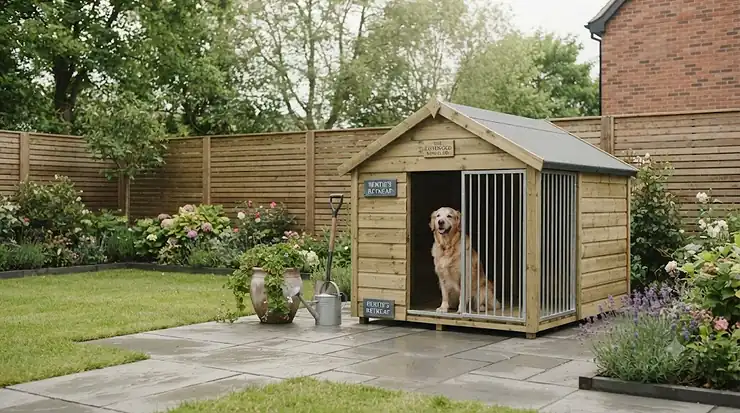
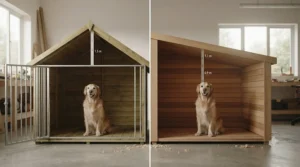
Stand in any garden centre car park on a wet Tuesday and you’ll hear the same debate rumbling between couples: apex roof vs pent roof dog kennel, and does it actually matter? Short answer — yes, more than most buyers realise, and not just because one looks a bit more like a Wendy house. The roof shape on a dog kennel changes how quickly rain clears, how much headroom your dog gets to stand and shake off after a walk, how the whole thing reads against your fence line, and even whether you’ll need to bother the council about planning permission. This guide pulls apart both roof styles properly: where an apex genuinely earns its extra timber, where a pent roof quietly wins on practicality, and which seven real, buyable kennels do each job best.
We researched actual products currently sold to UK buyers, cross-checked specs against manufacturer data, and pulled in aggregated review sentiment rather than inventing glowing testimonials — because a kennel that leaks after six months isn’t a “5-star” kennel no matter what the listing claims. What follows is commentary and comparison, not a copy-paste of an Amazon description: real specs, honest analysis, and practical guidance you can actually act on this weekend. Prices are given as ranges only, since they shift constantly and change by retailer, season and stock level — always check the current price before buying.
By the end you’ll know exactly which roof profile suits your garden, your dog, and your local weather, plus seven genuine kennels worth shortlisting across budget, mid-range and premium price points.
Quick Comparison Table
Before we get into individual products, here’s the headline version of the apex roof vs pent roof dog kennel question — the bit you can screenshot and show your other half.
| Feature | Apex Roof | Pent Roof | Best For |
|---|---|---|---|
| Shape | Two symmetrical sloped panels meeting at a central ridge | Single flat panel sloped from front to back | Apex: traditional gardens · Pent: modern, minimalist plots |
| Headroom | Taller centre point, more standing room for bigger dogs | Lower, more uniform ceiling height throughout | Apex: large/tall breeds · Pent: small/medium breeds |
| Water shedding | Sheds rain both ways off the ridge | Sheds rain in one direction only, needs clear run-off zone | Apex: heavy rainfall areas · Pent: sites with good one-side drainage |
| Wind resistance | Slightly more surface area catches gusts from the side | Lower profile, less wind resistance | Apex: sheltered gardens · Pent: exposed or coastal spots |
| Boundary height rules | Often taller, may hit the 2.5m limit near a fence sooner | Usually lower, easier to keep under permitted development limits | Pent: kennels sited close to a boundary |
| Typical price | Slightly more (extra timber, more complex joinery) | Slightly less (simpler single-slope build) | Apex: those wanting classic looks · Pent: budget-conscious buyers |
So what does this actually mean once you’re stood in the garden with a tape measure? An apex roof dog kennel gives a dog more vertical space to stretch and turn, and it clears standing water from both sides at once, which matters if your garden sits in a naturally soggy spot. A pent roof dog kennel, on the other hand, is the quieter, more space-efficient option — it tucks against a fence or wall without drawing attention, and because it’s lower overall, it’s the easier of the two to keep within permitted development height limits if you’re placing it close to a boundary. Neither style is objectively “better” — it genuinely comes down to your garden’s layout, your dog’s size, and how much you care about the kennel blending in versus standing out.
💬 Just one click — help others make better buying decisions too!😊
Top 7 Apex and Pent Roof Dog Kennels: Expert Analysis
We’ve deliberately mixed roof styles, sizes and price points here — from a modest three-foot starter kennel to a full kennel-and-run setup with insulated flooring. Every product below is a genuine, currently-available UK kennel; nothing has been invented to fill a gap.
1. Pinelap 3×3 Quality Wooden Apex Dog Kennel — pressure-treated budget classic
The Pinelap 3×3 Quality Wooden Apex Dog Kennel is about as close to the archetypal British garden kennel as you’ll find, and its pressure-treated tongue-and-groove construction is precisely why it’s lasted as a bestseller. Built from pressure-treated T&G timber with an apex roof, it’s designed to be assembled without specialist tools, and the treated timber means you’re not racing to slap on your own preservative the week it arrives. In practice, pressure treatment forces preservative deep into the wood grain rather than sitting on the surface, so it keeps resisting rot even after the surface finish has weathered — a meaningfully longer lifespan than untreated softwood kennels at a similar price. This one suits owners with a small to medium dog and a modest budget who still want a proper wooden structure rather than a moulded plastic dome. Aggregated feedback on similar Pinelap timber buildings tends to flag straightforward flat-pack assembly as a strength, with occasional notes that panels can be tight-fitting on first build — a common theme across budget flat-pack kennels generally, not unique to this one.
Pros:
- ✅ Genuine apex roof sheds rain from both sides
- ✅ Pressure-treated timber resists rot long-term
- ✅ Straightforward flat-pack self-assembly
Cons:
- ❌ Panels can be a tight fit on first build
- ❌ No run included, sleeping area only
Expect this one to sit in the lower price bracket, roughly under £150 depending on retailer stock — solid value if you want real timber over plastic without breaking into three figures on labour too.
2. Barkshire Apex Dog Kennel with Opening Roof — hinged roof for easy cleaning
The standout feature of the Barkshire Apex Dog Kennel with Opening Roof is right there in the name: the apex itself hinges open, turning what’s normally an awkward crouch-and-reach clean-out into a proper top-down job. Constructed from solid wood with raised feet that lift the base off cold, damp ground, it comes in small and medium sizing, with the medium offering roughly 70cm of internal width — enough for a spaniel or small collie to turn comfortably. What most buyers overlook about opening-roof kennels is that the hinge itself becomes the weak point over time; based on the spec comparison with fixed-roof rivals, you’re trading a small amount of long-term durability for a genuine, everyday convenience win. Aggregated review sentiment for this kennel is mixed but instructive: several owners report the hinges feeling flimsy under repeated use, while others praise the ventilation the opening roof brings and note it works nicely doubling as a cosy shelter for cats or rabbits too.
Pros:
- ✅ Opens fully for quick, easy cleaning
- ✅ Raised feet keep the floor dry
- ✅ Good ventilation reduces odour build-up
Cons:
- ❌ Hinges reported as flimsy by some owners
- ❌ Wall thickness is fairly thin for harsh winters
Priced in the budget-to-mid range, typically under £200 for the medium size, it’s a smart pick if easy cleaning outweighs raw structural toughness for you.
3. VOUNOT Weatherproof Pet Shelter with Sloped Roof — compact pent design for tight spaces
The VOUNOT Weatherproof Pet Shelter with Sloped Roof takes the opposite design philosophy entirely: a single-slope pent roof on a compact footprint, built for gardens where every square metre of lawn is contested territory. At roughly 75 x 63 x 51cm, key specs here mean something specific in practice — the low overall height keeps it tucked beneath most fence-boundary sightlines, while the non-slip feet stop it skating across patio slabs in a gale. Based on the spec comparison with taller apex alternatives, this is squarely a small-to-medium dog kennel rather than something a Labrador will thank you for; think terriers, whippets, and cats rather than shepherds. Reviewers consistently note the sloped roof drains effectively in normal rainfall, though a handful mention that in genuinely torrential downpours water can pool briefly at the low edge if the kennel isn’t angled with a slight fall away from the structure.
Pros:
- ✅ Low profile fits tight, boundary-hugging spots
- ✅ Non-slip feet add stability on hard surfaces
- ✅ Genuinely weatherproof for its compact size
Cons:
- ❌ Too small for medium-to-large breeds
- ❌ Can pool water at low edge if unlevel
Sitting firmly in the budget tier, often under £80, it’s a sensible pent roof dog kennel pick for smaller pets or as a secondary outdoor shelter rather than a primary residence.
4. PawHut Elevated Wooden Dog Kennel with Asphalt Roof — real-world weatherproofing on a raised base
What most spec sheets bury is that ground contact kills more kennels than weather does, and the PawHut Elevated Wooden Dog Kennel with Asphalt Roof is built around solving exactly that problem. It sits on adjustable legs that raise the entire structure off the ground, paired with genuine asphalt shingle roofing rather than the thin felt strips found on many cheaper kennels. In practice, asphalt shingles handle UK freeze-thaw cycles noticeably better than basic roofing felt, which tends to crack and lift at the edges after a couple of harsh winters — so this is a kennel built with realistic longevity in mind, not just first-impressions styling. The openable top and window with curtain add genuine transformation value too: you get airflow control on warm days and a snug, draught-free interior when it’s foul out. This suits owners in damp or shaded gardens where standing water and ground moisture are the real enemy, more so than rain falling directly onto the roof. Aggregated feedback highlights the elevated base and asphalt roofing as standout strengths, with occasional comments that the window curtain is a nice-to-have rather than genuinely insulating.
Pros:
- ✅ Elevated legs prevent ground damp entirely
- ✅ Asphalt shingles outlast basic felt roofing
- ✅ Window and curtain aid ventilation control
Cons:
- ❌ Adjustable legs add assembly complexity
- ❌ Curtain offers airflow, not real insulation
Mid-range pricing applies here, typically in the low-to-mid hundreds depending on size, reflecting the upgraded roofing and elevated base build.
5. Aivituvin Waterproof Dog House with Porch — anti-bite build with a genuine porch overhang
The Aivituvin Waterproof Dog House with Porch adds a feature that’s easy to underrate until you actually own a chewer: an anti-bite design around the door frame and edges, specifically engineered to resist the gnawing that destroys cheaper kennels within months. The elevated floor keeps the sleeping area dry, while the covered porch section — effectively a mini apex-style overhang at the entrance — gives your dog a sheltered spot to sit and watch the garden without fully committing to going back inside, which matters more for behaviour than it sounds. Here’s what to weigh: the porch adds genuine everyday value for dogs that like to observe rather than hide, but it does add to the overall footprint, so measure your intended spot carefully before ordering. Reviewers consistently flag the anti-chew build quality as a genuine strength versus cheaper alternatives, particularly for younger or more destructive dogs, while a smaller number note the flat-pack instructions could be clearer.
Pros:
- ✅ Anti-bite construction suits destructive chewers
- ✅ Elevated floor keeps sleeping area dry
- ✅ Porch overhang adds sheltered outdoor space
Cons:
- ❌ Larger footprint than porch-free equivalents
- ❌ Assembly instructions criticised as unclear
Expect a mid-range price point, generally comparable to other elevated wooden kennels of similar size, justified by the anti-chew build and porch extension.
6. Benchmark Dog Kennel with Apex Roof, 8ft x 6.5ft Classic Range — full kennel-and-run for serious use
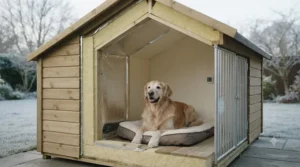
Step up to genuinely commercial-grade construction with the Benchmark Dog Kennel with Apex Roof, 8ft x 6.5ft Classic Range, built on a 45 x 45mm tanalised, pressure-treated frame with a heavy-duty IKO felt roof cover and 10-gauge galvanised mesh forming the run. The apex reaches roughly five feet at its highest point, which in practice means even taller breeds — German Shepherds, Dobermanns, Retrievers — can stand fully upright and turn without ducking, something the smaller kennels on this list simply can’t offer. Screwed rather than nailed panel construction is a small spec detail with an outsized real-world impact: screws hold their grip through seasonal timber movement, while nailed joints tend to work loose after a year or two of expansion and contraction. This is the pick for owners who genuinely need a secure, self-contained outdoor living space rather than an overnight shelter, and professional fitting is typically included in the price, which removes a lot of the assembly headache larger structures usually bring. Because it’s aimed at a more specialist buyer base than mass-market Amazon kennels, verified customer review volume is naturally lower, though feedback that does exist consistently praises the build quality and the fitting service.
Pros:
- ✅ IKO felt roof rated for genuine long-term use
- ✅ Screwed panels resist seasonal timber movement
- ✅ Includes secure galvanised mesh run
Cons:
- ❌ Premium price reflects commercial-grade materials
- ❌ Needs a larger, level garden footprint
This sits at the premium end, running into several hundred pounds depending on exact configuration and any add-ons like insulation, but the specification genuinely matches full-time outdoor housing rather than occasional use.
7. Benchmark Dog Kennel with Pent Roof and Run, 10ft x 4ft Range — long-run pent design for narrow gardens
Rounding out the seven is the Benchmark Dog Kennel with Pent Roof and Run, 10ft x 4ft Range, which solves a very specific garden problem: what to do when your available space is long and narrow rather than square. The pent roof design keeps overall height low and consistent along the full 10ft run, while a separate enclosed sleeping compartment sits at one end with mesh panelling running the remaining length for exercise and airflow. Front height sits around 127cm, tapering to roughly 96cm at the rear — exactly the kind of single-slope drainage profile that clears water efficiently along a long structure without needing a central ridge. Separate access doors for the run and sleeping quarters are a genuinely practical transformation feature, letting you clean and feed without a nervous dog bolting past you into next door’s garden. Based on the spec comparison with square-footprint apex kennels, this is the stronger choice specifically for narrow side-return gardens or terraced housing plots where width is the scarce resource, not length.
Pros:
- ✅ Long, narrow footprint suits terraced gardens
- ✅ Separate doors ease feeding and cleaning
- ✅ Low pent profile eases boundary height limits
Cons:
- ❌ Less headroom than tall apex alternatives
- ❌ Requires a genuinely long, level strip of garden
Pricing lands in the mid-to-premium bracket, broadly similar to the apex-roofed run above, since the material cost is comparable even though the roof geometry differs.
Practical Usage Guide: Setting Up Your Kennel Roof for the First 30 Days
Getting the roof style right on paper is only half the job — how you site and settle the kennel in during its first month determines whether that roof actually does its job for the next decade. Start with orientation: position an apex roof dog kennel so the ridge runs roughly perpendicular to your garden’s prevailing wind direction, which in most of the UK blows from the south-west, reducing the surface area directly battered by gusts. For a pent roof dog kennel, orient the tall front edge to face away from the prevailing wind and rain, so the low back edge — the weaker point structurally — sits in the sheltered lee side of the garden rather than catching the brunt of it.
Base preparation matters more than roof choice in the first month. Sit the kennel on a level, slightly raised base — paving slabs, pressure-treated bearers, or a simple timber platform — rather than directly on soil or grass, which softens and pools water against the base within weeks of heavy rain. Check the roof felt or shingles for any lifted edges after the first properly windy week; a £3 tube of roofing adhesive at week two saves a full re-roof at year two. During the first 30 days, resist the urge to fully seal every ventilation gap “for warmth” — a completely airtight kennel traps condensation, and damp air inside a wooden structure does more long-term damage than a slightly draughty one. Finally, treat any cut edges or drilled fixing points with a compatible wood preservative, since pressure treatment on factory-cut panels doesn’t extend to holes you drill yourself during assembly.
✨ Don’t Miss These Exclusive Deals!
🔍 Ready to give your dog a proper weatherproof home this year? Compare current prices on any of the seven kennels above and check availability before stock runs low ahead of autumn — a solid roof now saves a soggy winter later!
Real-World Scenarios: Which Roof Style Fits Your Situation
The narrow-garden terrace owner. If you’re working with a classic Victorian terrace side-return — three or four feet wide, running the length of the house — a pent roof dog kennel like the Benchmark 10ft x 4ft range above genuinely outperforms an apex here. The low, consistent height slides under boundary sightlines from neighbouring properties, and the single-slope roof clears rainwater along the run’s full length without needing headroom you simply don’t have to spare.
The large-breed owner with a generous garden. If you’ve got a German Shepherd, a Rottweiler, or anything built along similar lines, and your garden has room to spare, an apex roof dog kennel like the Benchmark 8ft x 6.5ft Classic Range earns its extra timber. The taller centre point means your dog can stand fully upright and turn around without stooping — genuinely relevant for welfare, not just comfort, since cramped housing that prevents natural movement falls short of basic outdoor housing guidance.
The budget-first new dog owner. If you’ve just brought home a rescue or a puppy and don’t yet know their full adult size or temperament, starting with a mid-range, moderately sized option like the Pinelap 3×3 Apex or the PawHut Elevated kennel makes sense — enough structure to genuinely protect against weather, without over-committing budget before you know whether your dog will even use outdoor housing regularly.
What Is an Apex Roof vs a Pent Roof Dog Kennel?
An apex roof dog kennel has two sloped panels meeting at a central ridge, like a miniature house roof, giving extra headroom and shedding rain in two directions. A pent roof dog kennel has a single flat panel sloped from a taller front edge to a lower rear edge, draining rain in one direction only. Both are legitimate, weatherproof options — the difference is largely about headroom, footprint, and how the structure sheds water. The apex shape, sometimes called a “gable” roof, is the far older and more traditional profile, borrowed directly from centuries of standard house-roof design — you can read more on the general mechanics of roof pitch and water shedding on Wikipedia’s roof overview, which covers why steeper pitches clear water and snow faster than shallow ones.
How to Choose Between an Apex and Pent Roof Dog Kennel
- Measure your dog standing and stretching upright. Add at least 10-15cm of clearance above their head height when picking internal roof height — this rules out overly compact pent designs for larger breeds immediately.
- Assess your garden’s footprint shape. Square or generous rectangular plots suit apex kennels; narrow, awkward, or boundary-hugging strips favour a low pent profile.
- Check your local rainfall and wind exposure. Coastal or consistently windy gardens benefit from the lower wind resistance of a pent roof; sheltered inland gardens can handle an apex without issue.
- Confirm the boundary distance before you buy. If the kennel sits within 2 metres of a fence or wall, height limits under UK permitted development rules apply regardless of roof type, and a pent design makes staying compliant considerably easier.
- Decide how much you value symmetry versus space-efficiency. Apex kennels tend to look more traditional and “finished” in a classic garden; pent kennels read as more modern and tuck away more discreetly.
- Factor in your maintenance appetite. A ridge join on an apex roof is one more seam that needs occasional checking for gaps; a pent roof has a single continuous slope with fewer joints to maintain.
- Match the roof to the run, if you’re buying both together. Long, thin runs pair naturally with pent roofs; square or compact runs pair naturally with apex roofs, purely from a proportional and drainage-consistency standpoint.
Apex Roof vs Pent Roof Dog Kennel: The Detailed Kennel Roof Style Comparison
Zooming out from individual products, the kennel roof style comparison really comes down to three forces pulling in different directions: headroom, wind resistance, and footprint efficiency. An apex roof wins decisively on headroom — the central ridge gives large and tall breeds proper standing space that a pent roof simply can’t match at an equivalent overall height. But that same ridge means slightly more surface area is exposed side-on to gusts, so in genuinely exposed or coastal gardens, a well-built pent roof’s lower profile can actually prove the more weather-resilient choice over a full winter, despite looking less substantial.
Footprint efficiency tips things the other way for space-constrained gardens. Because a pent roof doesn’t need the structural bracing an apex ridge requires, pent-roofed kennels can often be built slightly narrower for the same internal floor area, which matters enormously in a typical UK garden where every metre is accounted for. Drainage-wise, both styles work when properly sited — the apex sheds water in two directions immediately from the point of contact, while the pent relies on a single, uninterrupted slope that needs a genuinely clear run-off zone at its lower edge to avoid pooling.
| Factor | Apex Roof | Pent Roof |
|---|---|---|
| Headroom for large breeds | Excellent | Moderate to limited |
| Wind resistance in exposed sites | Moderate | Better |
| Footprint efficiency | Standard | More efficient |
| Boundary height compliance | Requires more care | Easier |
| Visual traditionalism | Classic, house-like | Modern, minimal |
Reading across that table, the honest takeaway is that neither roof style is universally “correct” — a Benchmark Dog Kennel with Apex Roof genuinely suits a sheltered, spacious garden with a large dog, while a VOUNOT Weatherproof Pet Shelter with Sloped Roof or the Benchmark Dog Kennel with Pent Roof and Run suit tighter, more exposed, or boundary-constrained plots far better than an apex ever would.
Garden Kennel Roofing Options: Beyond Just Apex and Pent
Once you’ve settled on apex or pent, garden kennel roofing options branch out further than most buyers realise. Some manufacturers offer a “combi” shape — a shallow apex with an extended overhang on one side, effectively hedging between the two — which suits owners who want partial extra headroom without the full wind-catching surface area of a proper apex. Flat-roof kennels exist too, though they’re generally a poor long-term choice for genuinely wet climates: without a meaningful pitch, water sits rather than sheds, accelerating felt degradation regardless of how good the underlying timber is.
Opening or hinged roofs — like the Barkshire Apex Dog Kennel with Opening Roof — represent a functional variant within the apex category rather than a separate roof shape, trading a small amount of long-term structural rigidity for genuinely easier day-to-day cleaning access. Porch-extended designs, like the Aivituvin Waterproof Dog House with Porch, effectively bolt a mini-canopy onto either roof style, giving a sheltered outdoor perch without fully committing to a bigger structure. What most buyers overlook when comparing garden kennel roofing options side by side is that the roofing material layered on top often matters more for longevity than the underlying shape — which brings us neatly to materials themselves.
Kennel Roofing Materials: What’s Actually on Top Matters
The shape sheds water; the material determines how long that shedding actually lasts. Standard roofing felt is the most common budget covering, cheap and easy to replace, but it’s genuinely the shortest-lived option — UK freeze-thaw cycles cause it to crack and lift at seams within a few winters if not periodically checked and resealed. Asphalt shingles, as used on the PawHut Elevated Wooden Dog Kennel, cost more upfront but handle temperature swings noticeably better and typically outlast basic felt by several years. Heavy-duty IKO felt, the covering on the Benchmark Dog Kennel with Apex Roof, 8ft x 6.5ft Classic Range, sits between the two — a reinforced, commercial-grade felt product built for genuinely long-term outdoor structures rather than garden sheds expected to last a decade at most.
EPDM rubber roofing, increasingly common on premium garden buildings generally, is worth considering as an upgrade if you’re commissioning a bespoke kennel: it’s essentially waterproof for decades with minimal maintenance, though it adds meaningfully to build cost. Composite or WPC (wood-plastic composite) roofing panels, used on some thermal kennel ranges, resist rot entirely since there’s no organic wood content exposed to the elements, making them a strong choice for anyone who wants to essentially forget about roof maintenance altogether. Whichever material you land on, a light annual check — clearing debris, checking for lifted edges, resealing any small gaps — adds years to any roof, regardless of the shape underneath it.
Roof Drainage Design: Getting Water Away From Your Dog
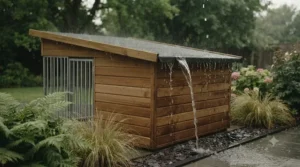
Good roof drainage design isn’t just about the roof itself — it’s about where that water goes once it leaves the roof. An apex roof sheds water down both sides simultaneously, so both sides of the kennel base need clear ground or gravel to absorb or channel runoff away; if one side sits against a fence or wall with no gap, water pools there and slowly rots the base regardless of how good the roof material is. A pent roof concentrates all its runoff along a single edge, which actually makes drainage planning simpler in one sense — you only need to manage one side — but that edge needs a genuinely effective run-off channel, since all the water the whole roof collects funnels through that one line.
UK rainfall patterns aren’t uniform, which matters more than most buyers assume when planning drainage. The Met Office’s long-term climate data shows western and northern regions of the UK receive substantially more annual rainfall than the drier east, and prevailing winds through most of the country blow from the south-west, carrying rain-bearing weather systems with them — you can check regional long-term averages for your own area via the Met Office’s climate data tool. If you’re in Wales, the North West, or western Scotland, investing in a slightly steeper roof pitch and more generous eaves overhang genuinely pays for itself over a wetter decade than a garden in Essex or Kent would ever experience. A simple gravel-filled drainage channel beneath the roof’s lowest run-off edge, regardless of apex or pent, is one of the cheapest upgrades available and one of the most consistently overlooked.
Kennel Roofing Materials and Garden Aesthetics: Making It Look Right
Roof style and roofing material both do double duty — function first, but garden aesthetics matter more than buyers often admit once the kennel is actually sitting in view of the kitchen window every day. An apex roof, with its traditional house-like silhouette, tends to suit period properties, cottage gardens, and anywhere a shed or summerhouse already establishes a “classic outbuilding” visual language — matching your kennel’s roof pitch loosely to your shed’s roofline creates a coherent garden rather than a mismatched collection of structures. A pent roof, by contrast, reads as distinctly more contemporary, and pairs naturally with modern render, composite decking, and minimalist planting schemes where clean horizontal lines are the whole point.
Colour and finish matter just as much as shape for garden aesthetics. A natural or lightly stained timber apex kennel blends into a planted border almost invisibly, while a painted pent kennel in a muted sage or charcoal — echoing the trend seen across modern garden buildings and fence stains — can actually become a deliberate feature rather than something you’re trying to hide behind the shed. If your garden already leans toward a specific aesthetic, it’s worth choosing the roof style that complements it rather than defaulting to whichever kennel happened to be cheapest that week; a kennel you’re genuinely happy to look at is one you’re more likely to keep clean, maintained, and positioned somewhere sensible rather than shoved awkwardly out of sight.
Common Mistakes When Buying an Apex or Pent Roof Kennel
The single most common mistake is buying on size alone without checking roof height clearance for a dog standing on hind legs — a kennel that fits a dog lying down can still feel cramped and claustrophobic when they’re moving around inside it. A close second is ignoring boundary distance rules entirely; plenty of owners buy a tall apex kennel, place it hard against a fence, and only discover the height issue when a neighbour queries it or a council enforcement letter arrives. Skipping base preparation is another recurring error — sitting any kennel, apex or pent, directly on soil accelerates rot regardless of how good the roof itself is, since ground moisture wicks upward through untreated contact points far faster than rain falls from above.
Buyers also frequently underestimate wind exposure, choosing a taller apex design for a genuinely exposed garden where a lower pent profile would have weathered storms with far less stress on the joints. Finally, many people focus entirely on roof shape and completely overlook roofing material quality — a beautifully proportioned apex roof covered in the thinnest available felt will still fail years before a plainer pent roof finished in heavy-duty IKO felt or asphalt shingles.
Long-Term Cost and Maintenance: Apex vs Pent Over Time
Upfront price differences between apex and pent roofs are usually modest — typically a few percent, reflecting the slightly more complex joinery an apex ridge requires. The real cost divergence shows up over years, not at checkout. An apex roof has one additional structural seam — the ridge itself — which needs periodic checking for gaps or lifted material, adding a small recurring maintenance task a pent roof simply doesn’t have. Against that, a pent roof’s single low edge concentrates all runoff into one zone, meaning that specific area experiences more sustained water exposure over time and may need earlier attention to base treatment or drainage clearing.
In practical terms, total cost of ownership comes down more to roofing material than roof shape: a felt-roofed apex kennel and a felt-roofed pent kennel will likely need re-covering on a broadly similar timeline, while upgrading either style to asphalt shingle, heavy-duty IKO felt, or WPC composite roofing extends the interval between maintenance jobs by several years regardless of which shape sits underneath. If you’re weighing cost-per-year rather than sticker price, spending a little more on roofing material upfront — on either an apex or pent design — consistently outperforms saving money on the cheapest felt covering available and re-roofing every couple of winters instead.
Safety, Regulations and Planning Compliance Guide
Kennels fall under the same permitted development rules as sheds and other garden outbuildings in England, and getting this wrong is more common than you’d expect. Under current guidance, an outbuilding sited within 2 metres of any boundary must not exceed 2.5 metres in overall height to remain permitted development, while structures further from a boundary can generally reach up to 4 metres with a dual-pitched (apex-style) roof, or 3 metres with any other roof type, including pent — full detail is available via the Planning Portal’s outbuildings guidance. This is precisely why a pent roof dog kennel is often the more forgiving choice for anyone siting a structure close to a fence line — its lower typical profile makes staying comfortably under that 2.5-metre threshold far easier than with a tall apex design.
Beyond planning, welfare guidance matters just as much as legal compliance. The RSPCA’s advice on keeping dogs outdoors is unambiguous that an outdoor kennel must allow a dog to stand, turn, stretch and lie down comfortably, with proper shelter from rain, wind and direct sun, and that temperature extremes need managing year-round rather than assumed away — full guidance is available on the RSPCA’s living outside advice page. Whichever roof style and product you choose from this list, cross-check the internal dimensions against your dog’s actual size standing and turning, not just their length lying down, and never treat outdoor housing as a substitute for genuine daily company and exercise.
Apex and Pent Roof Kennels for Different Dogs and Owners
For large and giant breeds, apex roof dog kennels are close to essential — the extra headroom genuinely changes how comfortably a dog can move inside, and options like the Benchmark Dog Kennel with Apex Roof, 8ft x 6.5ft Classic Range are specifically proportioned for this. For small and toy breeds, a compact pent design like the VOUNOT Weatherproof Pet Shelter with Sloped Roof offers plenty of headroom relative to their size while taking up minimal garden footprint. For multi-dog households or anyone housing two dogs that get along but still need separate defined space, a pent-roofed kennel-and-run combination like the Benchmark Dog Kennel with Pent Roof and Run, 10ft x 4ft Range provides the length needed for a proper divided run without demanding excessive width. First-time outdoor-kennel owners, meanwhile, are often best served starting mid-range with something like the PawHut Elevated Wooden Dog Kennel with Asphalt Roof — solid enough to genuinely protect against a full UK winter, without the commitment level of a full commercial-grade run setup.
Frequently Asked Questions
❓ What is the difference between an apex roof and a pent roof dog kennel?
❓ Which roof style is better for a large dog kennel?
❓ Do dog kennels need planning permission in the UK?
❓ What roofing material lasts longest on a dog kennel?
❓ Can a pent roof kennel handle heavy UK rainfall?
Conclusion
The apex roof vs pent roof dog kennel decision ultimately isn’t about which shape is objectively superior — it’s about matching the roof to your dog’s size, your garden’s footprint, your local weather, and how close you’re siting the structure to a boundary. Apex roofs earn their keep through extra headroom and confident two-way drainage, making them the natural choice for larger breeds and more spacious, sheltered gardens. Pent roofs earn theirs through a lower profile, easier planning compliance, and genuinely efficient use of narrow or awkward plots. Both, done properly with decent roofing material and sensible siting, will keep a dog dry, comfortable and safe through a full British winter.
Across the seven kennels covered here — from the budget-friendly Pinelap 3×3 Quality Wooden Apex Dog Kennel through to the commercial-grade Benchmark Dog Kennel with Apex Roof, 8ft x 6.5ft Classic Range and its pent-roofed sibling — there’s a genuinely suitable option whatever your garden shape, dog size, or budget looks like. Measure carefully, check your boundary distances before you commit, and choose roofing material as deliberately as you choose the shape sitting on top of it. Get that combination right, and you’ll be having this same “apex or pent” conversation with a neighbour in ten years’ time, not replacing a rotten roof of your own.
✨ Don’t Miss These Exclusive Deals!
🔍 Take your search for the perfect apex roof vs pent roof dog kennel further today. Click through on any of the seven picks above to check current pricing and availability, and give your dog a genuinely weatherproof home this year! 🐾
Recommended for You
- Raised Floor Wooden Kennel for Large Dogs: 7 Best Picks 2026
- Insulated Wooden Dog Kennel UK: 7 Best Winter Picks 2026
- 7 Best Wooden Dog Kennels Under £150 in 2026 (Honest Guide)
Disclaimer: This article contains affiliate links. As an Amazon Associate, I earn from qualifying purchases. If you purchase products through these links, we may earn a small commission at no additional cost to you.
✨ Found this helpful? Share it with your friends! 💬🤗
