
In This Article
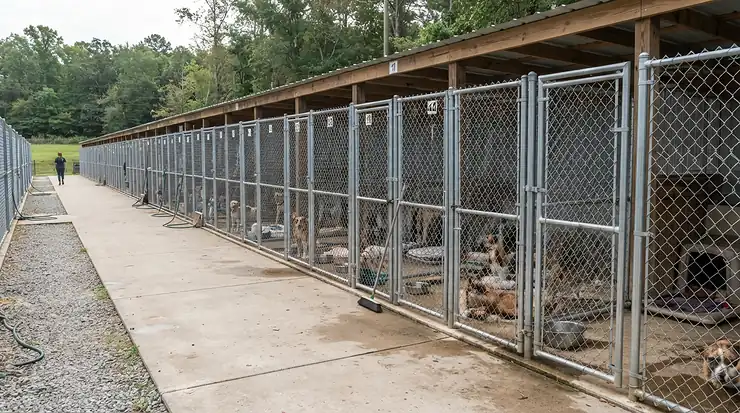
A block of dog kennels looks like a simple purchase on screen. Then the delivery lorry reverses onto your drive and you discover you’ve bought infrastructure. One kennel is a shed with opinions. A block of dog kennels is drainage, airflow, sight-lines, noise, security and, depending on what you do with the dogs, a licence.

That last point catches people out. In England, the Animal Welfare (Licensing of Activities Involving Animals) (England) Regulations 2018 require a licence if you breed three or more litters in a 12-month period. You also need one if you advertise a business selling dogs, even from fewer litters. So if you’re a serious hobby breeder, trainer or boarder weighing up a kennel block, the layout you pick can shape the inspection you face later.
Here’s the plain version of what follows. I’ve researched seven real options, from handmade timber kennel-and-run units to a bespoke multi-unit dog kennel built by a UK manufacturer. I explain what each spec means in practice, and where a product is really a building block for a row of dog kennels rather than a complete block.
A few honest caveats. Product details come from manufacturer and UK retailer listings, not hands-on testing, and I haven’t used any of these. Where I couldn’t verify a meaningful pool of buyer reviews, I say so. Listings, sizes and stock change, so check current price and availability on Amazon UK before you commit.
Along the way I cover kennel block construction, ventilation in kennel blocks, and breeder facility planning, because the best product on earth can’t rescue a badly planned site.
Quick Comparison: 7 Options for a Block of Dog Kennels at a Glance
| Product | Format | Dogs Housed | Price Range | Best For |
|---|---|---|---|---|
| Yorkshire Garden Buildings Dog Kennel Run | Handmade single kennel and run | 1 | Roughly £600–£1,000 by size | Budget starter unit |
| Forest Garden Wooden Dog Kennel with Run | Double-tier kennel and run | Up to 2 | £800–£900 range at one retailer | Two-dog households |
| Mercia 10 x 6ft Staffordshire Dog Kennel and Run | Single kennel with mesh run | 1–2 (check maker guidance) | Check current price | Building a row of dog kennels unit by unit |
| Summer Garden Buildings Apex Shiplap Twin Kennel and Run 203 | Twin kennel with two covered runs | 2, housed separately | Check current price (fitting offered) | Keeping two dogs apart |
| Lucky Dog 3-Run Euro Style Kennel with Common Wall | Steel panel runs, shared walls | 3 | Around £1,100–£1,300 at one UK retailer | Modular outdoor containment |
| Benchmark Kennels Premium Double Wooden Dog Kennel 8 x 8ft | Double kennel, galvanised run | 2 | £1,700–£1,900 range | Heavy-duty, professional-style use |
| Garden and Animal Structures multi-bay dog kennel blocks | Bespoke multi-bay timber block | Made to order | Quote-led | Breeders needing a true kennel block |
Look at the pattern in the table. Only the Summer Garden Buildings Apex Shiplap Twin Kennel and Run 203, the Lucky Dog 3-Run Euro Style Kennel with Common Wall, the Benchmark Kennels Premium Double Wooden Dog Kennel 8 x 8ft and the bespoke option from Garden and Animal Structures are genuinely multi-unit. The rest are single units that you could line up into a row of dog kennels, with all the groundwork that implies. If you’re still deciding between “buy several singles” and “buy one block”, the layout section later in this guide covers it.
💬 Just one click — help others make better buying decisions too!😊
Top 7 Block of Dog Kennels Options: Expert Analysis
1. Yorkshire Garden Buildings Dog Kennel Run — handmade UK starter unit
This one earns its place by being the entry ticket. It’s a handmade timber kennel with an attached wire-mesh run, and the listing offers several sizes, including an 8 x 4 shiplap version.
The spec sheet describes solid timber walls, a pitched roof, a raised floor and a timber-roofed run. The raised floor matters more than it sounds: it keeps bedding off cold, damp ground, which is the usual enemy of wooden kennels. The covered run means dogs aren’t stuck in the rain just to stretch their legs.
Based on the specs, I’d say this suits someone building a small kennel block gradually, one unit per season. It’s less obviously right for a licensed breeder who wants uniform bays and fast cleaning. I couldn’t verify a large pool of independent reviews for this exact product, so check recent feedback on the listing for delivery condition and panel fit.
Pros:
- ✅ Handmade in the UK, several sizes
- ✅ Raised floor helps keep bedding dry
- ✅ Covered run gives shelter outdoors
Cons:
- ❌ Single unit, so you’ll add groundwork per bay
- ❌ Few verifiable independent reviews found
Pricing runs from roughly £600 to £1,000 depending on size (check current price). That makes it fair value for a single dog, but not a bargain once you multiply it across a whole row.

2. Forest Garden Wooden Dog Kennel with Run — best budget two-dog design
The standout here is the double-tier layout. The sleeping kennel and the run are separate sections, each reachable on its own. That’s more useful than it sounds, because you can clean the run without disturbing a dog that’s asleep.
The walls use 12mm tongue-and-groove cladding, and the timber is pressure-treated with a 10-year warranty against rot and insect attack. The warranty is the real number to watch. It signals that the maker expects decades of weather rather than a couple of seasons, though warranties usually exclude poor groundwork.
Argos lists it as suitable for two dogs. My read is that this works for two compatible dogs who don’t mind sharing, not for breeding bitches who need separation. Reviewers’ views weren’t something I could verify at scale, so look for comments on assembly time and roof felt quality.
Pros:
- ✅ Kennel and run cleaned independently
- ✅ Treated timber with 10-year anti-rot warranty
- ✅ Suits two compatible dogs
Cons:
- ❌ No internal partition for separating dogs
- ❌ Stated capacity is modest for large breeds
The price sits in the £800–£900 range at one major UK retailer. It’s strong value as a two-dog starter, and weaker as the core of a larger kennel block.
3. Mercia 10 x 6ft Staffordshire Dog Kennel and Run — best for building a row
Think of this as the Lego brick of the list. It’s a UK-made kennel with a stable door between the sleeping area and a large mesh run, and the full-height roof makes the whole structure feel open and easy to clean.
The walls use 12mm interlocking shiplap, the floor is made of interlocking boards, and the apex roof carries mineral felt. The maker states it must sit on a firm, level base such as concrete or slabs. That’s the line most buyers skim past, and it’s the one that decides whether the doors still shut in year three.
If you’re assembling a row of dog kennels, the shared footprint makes planning easy. Order several, pour one base, and you’ve got consistent bays. I couldn’t verify a meaningful review pool for it, so check recent comments for delivery damage and fixings.
Pros:
- ✅ Stable door links shelter and run
- ✅ Full-height roof keeps things airy
- ✅ Repeatable footprint for rows
Cons:
- ❌ Needs a concrete or slab base
- ❌ Not a ready-made block
Check current price, as it varies by retailer. For breeders happy to build a bay at a time, it’s good value; for anyone wanting a finished kennel block, it isn’t.
4. Summer Garden Buildings Apex Shiplap Twin Kennel and Run 203 — twin bays under one roof
The headline feature is separation. The 8ft x 8ft footprint holds two kennels and two covered runs, with partitions dividing the structure into two separate sections. That’s the first real multi-unit dog kennel on this list.
The frame uses 2-inch planed timber, the run has heavy-duty galvanised mesh on a substantial timber frame, and the floor joists are spaced closely for strength. Closely spaced joists mean the floor shouldn’t flex under a big dog’s weight, a common failure point on cheaper timber kennels. Internal hinged doors with cut-out openings let dogs move around while the door stays closed.
My analysis is that this suits a breeder or owner with two dogs who can’t share, such as a bitch in season. The sections pass through a normal single door, which helps if access is tight. I couldn’t verify detailed reviews for this exact model; check the listing for feedback on fitting and timber quality.
Pros:
- ✅ Two fully separate kennels and runs
- ✅ Heavy-duty planed frame and galvanised mesh
- ✅ Sections fit through a standard doorway
Cons:
- ❌ Eight-foot footprint limits very large breeds
- ❌ Pricing unclear without a postcode check
Check current price, since fitting charges vary by area. For two-dog separation, the design is hard to beat at this level.
5. Lucky Dog 3-Run Euro Style Kennel with Common Wall — modular steel, three runs
This is a different animal. It’s a steel panel system with three runs sharing two common walls, each with its own door. The panels are 5ft wide and 6ft high, finished in black powder coat.
The 6ft height matters because older council licence conditions commonly specified about 1.8m so staff could stand and clean comfortably. The vertical bars are spaced about 2.5 inches apart, which the maker says may be too wide for small breeds and puppies. That’s a genuine warning, not boilerplate: a small head or paw can get stuck.
The catch is that these are runs, not sleeping shelters. You’d need to add insulated kennels, so treat this as one component of a kennel block rather than a finished one. I found no verifiable independent review pool, so check the listing’s feedback.
Pros:
- ✅ Modular, so layouts can change later
- ✅ 6ft height allows easy staff access
- ✅ Durable powder-coated finish
Cons:
- ❌ No sleeping shelter included
- ❌ Wide bar spacing unsuitable for small dogs
The price is around £1,100–£1,300 at one UK retailer, with resellers charging notably more, so check current price. It’s solid value as an outdoor run system for medium and large dogs.
6. Benchmark Kennels Premium Double Wooden Dog Kennel 8 x 8ft — best heavy-duty double
The standout is construction rather than cleverness. It uses pressure-treated European timber, 12mm tongue-and-groove cladding, a raised floor, an OSB3 roof under heavy-duty felt, screwed panels and galvanised steel run panels.
Screwed rather than nailed panels mean you can tighten or replace sections as the timber moves. Galvanised run panels also resist rust better than painted mesh in wet British winters. A bigger 8 x 10ft version exists, around £1,900–£2,100 at the same retailer, if your dogs are large.
Argos lists the 8 x 8ft version as suitable for two dogs and positions it for gardens or professional settings. It’s new to the listing, so I couldn’t verify a substantial review pool; check back for early buyer feedback before you commit.
Pros:
- ✅ Pressure-treated timber with raised floor
- ✅ Screwed panels allow repairs and adjustments
- ✅ Galvanised run panels resist rust
Cons:
- ❌ Highest unit price on this list
- ❌ Limited track record, so few reviews
The £1,700–£1,900 range is high, but spread across two dogs and a decade of use the long-term value stacks up better than it first appears.
7. Garden and Animal Structures multi-bay dog kennel blocks — bespoke breeder-grade bays
This is the only true kennel block here: a UK manufacturer in Stoke-on-Trent that lists multi-bay dog kennel blocks alongside kennels, runs and dog cabins. It’s family-run and a Made in Britain member, according to its member profile.
Because it’s made to order, you can specify bay count, run size and layout to fit a licence plan. That’s the key advantage over off-the-shelf singles: the building is designed around your approved layout, not the other way round.
I can’t give detailed specs because they depend on your order, and I couldn’t verify a large pool of independent reviews. My advice is to ask for a written specification covering ventilation, insulation, dividers and warranty before paying a deposit.
Pros:
- ✅ Bay count and layout made to order
- ✅ UK-based family manufacturer
- ✅ Suited to licensed breeding set-ups
Cons:
- ❌ Quote-led pricing, so no easy comparison
- ❌ Lead times likely longer than stock units
Pricing is quote-led, so check current price directly. For a serious breeder, a bespoke block usually represents better value than stitching singles together.
From Plan to Pen: Kennel Block Construction Done Right
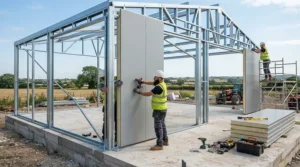
Kennel block construction fails at the groundwork stage far more often than at the timber stage. Here’s a practical sequence that goes beyond what any product listing tells you.
- Survey and licence first. Check your local authority’s licensing requirements before ordering, since your plan may need approval.
- Pour a proper base. Mercia states its kennel must sit on concrete or slabs, and the same logic applies to every timber unit. Give the slab a gentle fall towards a drainage channel.
- Think drainage per bay. Dogs Trust’s design notes describe drains on both sides of each kennel so urine can’t pass from one kennel to its neighbour. Copy that principle on a smaller scale.
- Install solid dividers. Solid lower panels stop nose-to-nose barking and cross-contamination, while mesh above lets air move.
- Plan the sight-lines. Kennelbuild’s seven-unit suite for Royvon Dog Training used a monoblock style so no two kennels face each other. Staring matches across a corridor wind dogs up.
- Add ventilation and a roof overhang (see the ventilation section below).
- Fit outward-opening doors with positive latches. Dogs lean on doors.
For the first 30 days, check every fixing after the first heavy rain, because timber settles. Walk the block at dusk to spot light leaks and gaps, re-tighten latches, and reseal any cut ends. The classic first-month mistakes are skipping the base fall, forgetting a hose point, and placing the block where neighbours hear every bark.
Real-World Scenarios: Which Kennel Block Fits Your Life?
Specs mean nothing without a situation. Here are three profiles, using budget, space and frequency of use to match product to person.
Scenario 1: The hobby breeder with two bitches. Budget: £1,500–£2,500. Environment: back garden, urban neighbours. Use: year-round, with whelping twice a year. The Summer Garden Buildings Apex Shiplap Twin Kennel and Run 203 gives separation in one footprint. Add a heated whelping space indoors rather than relying on the kennel.
Scenario 2: The working-dog trainer with six dogs. Budget: £6,000 and up. Environment: rural plot with space. Use: daily, all weather. A bespoke multi-unit dog kennel from Garden and Animal Structures, or a monoblock built by a specialist like Kennelbuild, makes more sense than six singles. Uniform bays mean uniform cleaning.
Scenario 3: The foster home with four medium dogs. Budget: around £3,000. Environment: a field-side paddock. Use: flexible, as dogs come and go. Modular panels like the Lucky Dog 3-Run Euro Style Kennel with Common Wall adapt as numbers change, though you’ll need shelters on top.
If you have one or two dogs and no licence implications, the Forest Garden Wooden Dog Kennel with Run is usually all you need.
What Is a Block of Dog Kennels?
A block of dog kennels is a purpose-built group of connected kennel bays, usually sharing walls, a roof and services such as drainage and ventilation. Each bay typically has its own sleeping area and run. The design keeps dogs separate, simplifies cleaning, and lets breeders, boarders and trainers house several dogs efficiently on one site.
That definition sounds tidy, but “block” covers a lot of ground. Some blocks are a single timber building with partitions inside. Others are a kennel block with a central corridor, bays on both sides, and runs outside. Others are simply a row of dog kennels sharing a base.
In practice, the three things that separate a true kennel block from a collection of kennels are shared structure, shared services and shared sight-line planning. Shared structure saves cost per bay. Shared services mean one drainage run and one electrical feed. Shared sight-line planning is the clever bit, because it determines whether your dogs are calm or climbing the walls.
How to Choose a Block of Dog Kennels
Follow these seven steps in order, because each one narrows the next.
- Count your dogs, then add headroom. Plan for the maximum you’ll ever keep, not today’s number, since extra bays are easier to build now than later.
- Check licensing. Breeders keeping three or more litters in a year need a licence in England, so the block must satisfy the inspector.
- Pick the layout. Single row, back-to-back or monoblock each have trade-offs, covered below.
- Prioritise ventilation and insulation. Sleeping areas need fresh air without draughts, plus protection from temperature extremes.
- Choose materials for cleaning. Impervious, sealed surfaces beat bare wood.
- Budget for groundwork. Bases, drainage and services often cost as much as the kennels themselves.
- Compare warranties and lead times. A 10-year anti-rot warranty only matters if the maker will honour it.
Skip step 6 and you’ll learn the lesson the expensive way. When comparing a multi-unit dog kennel against several singles, make sure you’re comparing total installed cost, not the headline figure.
Ventilation in Kennel Blocks: Fresh Air Without the Draught
Ventilation in kennel blocks is the single most under-planned feature, and the one that quietly drives dog health. Stale, damp air breeds odour, condensation and respiratory trouble. Too much uncontrolled draught chills sleeping dogs. The goal is moving air without a gale across the bed.
Older council licence conditions, drawn up under the Breeding of Dogs Act, asked for ventilation to all interior areas without excessive, localised draughts. They also asked for some part of the sleeping area to stay between roughly 10°C and 26°C. England’s current regime is built on the 2018 Regulations, but those older conditions remain a handy yardstick.
Dogs Trust’s published kennel design notes show one approach. They describe natural ventilation driven by building orientation and solar shading, with fresh air entering the sleep area around the dog-flap door. A fan-assisted option sits behind it, with airflow adjustable across a range of air changes per hour. That’s a charity building at scale, but the principle holds for a small kennel block: let nature do most of the work, and keep a mechanical back-up.
For timber blocks, practical measures include:
- Ridge or gable vents with insect mesh
- Gaps at the eaves to create cross-flow
- Raised floors to stop damp rising
- Adjustable louvres you can close in a gale
Indoor, enclosed monoblocks need more. Veterinary and boarding-style buildings often use mechanical extraction, and the right air-change rate depends on dog numbers and room volume. Don’t guess; ask a ventilation specialist to size it.
Row of Dog Kennels vs Block of Dog Kennels: Which Layout Wins?
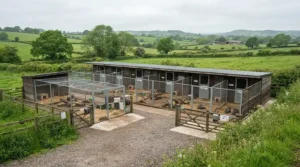
A row of dog kennels is a single line of bays, usually side by side along one wall or fence. A block of dog kennels groups bays back-to-back, in an L or U shape, or inside a single monoblock building. Both work. The right choice depends on your dogs, plot and budget.
| Layout | Footprint | Sight-lines | Cost per Bay | Best For |
|---|---|---|---|---|
| Single row of dog kennels | Long and thin | All dogs see the same direction | Lowest at small scale | Gardens and 2–4 dogs |
| Back-to-back kennel block | Compact | Dogs face outwards, away from each other | Moderate | Breeders on tight plots |
| Monoblock building | Largest and enclosed | Fully controlled by design | Highest upfront | Licensed breeders and boarders |
The table shows why a row of dog kennels is the natural entry point: it’s cheap, simple and expandable. However, rows put every dog in line of sight of every passer-by, and noise carries along the whole line. A back-to-back kennel block shrinks the footprint and controls what each dog sees, while a monoblock gives the most control at the highest cost.
If you’re pairing a Mercia 10 x 6ft Staffordshire Dog Kennel and Run into a row, plan the dividers so dogs can’t touch noses. For a monoblock approach, a specialist builder or bespoke maker is the realistic route.
Breeder Facility Planning: Layouts That Satisfy Inspectors
Breeder facility planning starts on paper, long before the first post goes in. In England, the local authority applies a risk-based rating when licensing, and for new breeding licences a vet inspection is typically part of the process, paid for by the applicant. Trading Standards’ Business Companion guidance on licensing animal activities explains that general licence conditions are built on the five welfare needs in the Animal Welfare Act 2006.
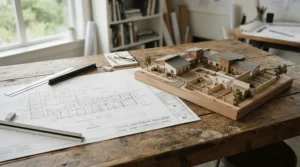
Several older council conditions give useful planning markers. Kennel construction should secure the dog. Each occupied kennel should be cleaned daily. Isolation facilities should sit physically apart from the main kennels, with one older set specifying at least 5m. A whelping area should give staff direct access without disturbing the wider kennel population.
Translating that into a plan:
- Put the whelping and isolation spaces at opposite ends of the site
- Keep a clean-to-dirty flow so you never carry waste past puppies
- Leave a service corridor wide enough for a barrow
- Allow for future bays on the drawing, even if you never build them
Always check current local requirements with your council, since rules differ across England, Scotland, Wales and Northern Ireland.
Long-Term Cost and Maintenance of a Kennel Block
The sticker price is the cheapest part of the story. Total cost of ownership includes groundwork, drainage, annual treatment of timber, replacement felt, cleaning supplies and, for licensed premises, fees and inspections.
| Option | Upfront Cost | Ongoing Maintenance | Best For |
|---|---|---|---|
| Forest Garden Wooden Dog Kennel with Run | Roughly £400–£450 per dog (shared by two) | Annual timber treatment, felt checks | Small households |
| Benchmark Kennels Premium Double Wooden Dog Kennel 8 x 8ft | Roughly £850–£950 per dog (shared by two) | Lower, thanks to pressure-treated timber | Long-term heavy use |
| Lucky Dog 3-Run Euro Style Kennel with Common Wall | Roughly £370–£430 per run, plus shelters | Powder-coat touch-ups | Flexible outdoor runs |
These per-dog figures are my own rough arithmetic from the retailer price ranges above, not quoted prices, so check current price before budgeting. The comparison shows how cheap runs can look until you add the shelters they lack. The pricier Benchmark Kennels Premium Double Wooden Dog Kennel 8 x 8ft costs more upfront, but heavier materials usually mean fewer replacements over ten years.
Maintenance is mostly dull and effective: treat timber each year, inspect felt after storms, clear drains weekly, and replace worn latches before a dog tests them.
Safety, Welfare and Licensing: UK Rules to Check
Safety planning for a block of dog kennels isn’t glamorous, but it protects both the dogs and your licence. Beyond the welfare-needs framework in the Animal Welfare Act 2006, think about escape risks, fire and heat.
Council guidance on dog breeding shows how licensing works in practice. You can read an example from Tunbridge Wells Borough Council’s dog breeding licensing page, which sets out the qualifying activities and application steps. Boarding is licensed separately under the same 2018 framework in England.
Practical safety checks for your kennel block:
- Escape-proofing: double-latched gates and no gaps beneath mesh
- Fire safety: extinguishers, a clear escape route and sensible electrical installation by a qualified electrician
- Injury hazards: smooth timber, no projecting screws, safe metal edging
- Heat and cold: shade, insulation and heating where a dog needs it
- Emergency plan: what happens if a dog escapes or someone is injured
Treat this as a checklist for conversation with your local authority, not a legal opinion. Rules change, and I’m not a lawyer.
✨ Ready to Plan Your Kennel Block?
🔍 Take your kennel set-up to the next level with the options above. Click any highlighted product to check current pricing and availability, then match your choice to your dogs, your plot and your licence plan. 🐕
FAQs
❓ Do I need planning permission for a kennel block?
❓ How big should each bay in a multi-unit dog kennel be?
❓ Is a kennel block warm enough for winter?
❓ Can I put a row of dog kennels in my garden?
❓ How do I compare kennel block construction quotes?
The Verdict on Choosing a Block of Dog Kennels
A good block of dog kennels is part building, part welfare plan and part long-term investment. The cheapest option rarely stays cheapest once groundwork, drainage and maintenance arrive, and the most elaborate rarely suits a two-dog household.
So here’s how I’d narrow it down, based on the specs and the research above. For one or two dogs on a budget, the Forest Garden Wooden Dog Kennel with Run or Yorkshire Garden Buildings Dog Kennel Run are sensible starting points. If you want to build a row of dog kennels bay by bay, the Mercia 10 x 6ft Staffordshire Dog Kennel and Run gives you a repeatable unit. For separation between dogs, the Summer Garden Buildings Apex Shiplap Twin Kennel and Run 203 is the practical pick. For modular runs, look at the Lucky Dog 3-Run Euro Style Kennel with Common Wall, remembering you’ll add shelters. For heavy, professional-style use, the Benchmark Kennels Premium Double Wooden Dog Kennel 8 x 8ft is built tough. And for a licensed breeder who needs a proper multi-unit dog kennel, a bespoke maker like Garden and Animal Structures is the logical conversation to start.
Whatever you choose, plan the base, ventilation and sight-lines first, and the kennels second. That’s the difference between a block your dogs thrive in and one you end up rebuilding.
Recommended for You
- Whelping Box Kennel: 7 Best Safe Picks For UK Breeders (2026)
- Triple Dog Kennel: 7 Ultimate Picks For UK Gardens (2026)
- Double Dog Kennel: 7 Best Picks For Two Dogs In the UK (2026)
Disclaimer: This article contains affiliate links. As an Amazon Associate, I earn from qualifying purchases. If you purchase products through these links, we may earn a small commission at no additional cost to you.
✨ Found this helpful? Share it with your friends! 💬🤗
