
In This Article
A double vs triple dog kennel comparison is really a question of how many separate compartments you need under one roof: two or three. Double units house a pair of dogs, triple units house three, and each option trades footprint, cost per compartment and future flexibility differently.
Sounds simple. It isn’t. Pick the wrong layout and you’ll either pay for a compartment that sits empty or squeeze a third dog into a space designed for two. Neither ends well, for your wallet or your dogs.
Here’s the honest starting point. The RSPCA doesn’t necessarily agree with keeping dogs outside, though it isn’t illegal, and it is specific about what a kennel must offer. Each dog needs room to walk, run, wag its tail, stand on its hind legs, stretch and lie down without touching another animal or the walls. Every comparison in this guide is built around that yardstick.
Below you’ll find seven real products, from garden timber units to indoor crate furniture, plus a frank look at comparing dog kennel sizes, space per dog, cost per compartment and upgrading kennel size later. One caveat up front: genuine triple options are thin on the ground at retail, because most are quoted as made-to-order builds. Where I couldn’t verify something, I say so.
Double vs Triple Dog Kennel at a Glance
Before the deep dive, here’s the quick version of the double vs triple kennel decision. Figures are illustrative ranges drawn from the products reviewed below; check current prices before you commit.
| Feature | Double kennel | Triple kennel |
|---|---|---|
| Dogs housed | Two | Three |
| Cost per compartment | Around £900–£1,000 (timber unit with run) | Around £400–£770 (panel-only run, no shelter) |
| Footprint | Compact (8 x 8ft to 8 x 10ft) | Long and narrow (15ft+ for three runs) |
| Upgrade flexibility | Limited once built | Higher if panel-based and modular |
| Best for | Benchmark 8 x 8ft for two medium dogs | Lucky Dog 3-Run for a modular, run-style setup |
Looking at the table, the triple route wins on price per compartment, but only because the Lucky Dog 3-Run is a panel system without a sleeping shelter. A fair kennel configuration comparison has to add a shelter to that figure. The Benchmark 8 x 8ft costs more per dog, yet arrives as a complete unit with a raised floor and a felt roof.
💬 Just one click — help others make better buying decisions too!😊
Top 7 Double vs Triple Dog Kennel Picks: Expert Analysis
I’ve weighted this list toward honest fit rather than flash: garden timber, modular panels, indoor furniture and portable fabric. Reviews are summarised as aggregated sentiment only, and where I found none for a specific product, I say so.
1. Benchmark Kennels Premium Double Wooden Dog Kennel (8 x 8ft) — best all-round garden double
This is the model that makes the case for a double: the same per-dog footprint as a single kennel, at a lower cost per head.
The listing describes pressure-treated European timber, 12mm tongue-and-groove cladding, a raised floor, an OSB3 roof with heavy-duty felt, screwed panel construction and galvanised steel run panels. In practice, a raised floor keeps the sleeping boards off damp ground, screwed panels can be tightened and repaired over the years, and galvanised mesh shrugs off the rust that wrecks cheaper runs.
Based on the spec comparison, 8ft by 8ft works out at roughly 5.9 m² overall, so about 3 m² per dog. That matches the Benchmark Single 8 x 4ft almost exactly, which is the clever bit. It suits two medium dogs from the same household; two large breeds will want the bigger sibling below.
On reviews: the product listing appeared new, with no verifiable product-level ratings. Manufacturer-level Trustpilot feedback for Benchmark Kennels is positive about build quality and the fitting teams, with one reviewer noting some hiccups while ordering.
Pros:
- ✅ Raised floor and felt roof suit British weather
- ✅ Per-dog space matches a single kennel
- ✅ Screwed panels allow future repairs
Cons:
- ❌ Major outlay compared with crates or fabric options
- ❌ Hard to convert into a triple later
Price: around £1,800 (check current price). Strong value if two dogs will definitely share the garden for years.
2. Benchmark Kennels Premium Double Wooden Dog Kennel (8 x 10ft) — extra room for bigger breeds
Same build language as its smaller sibling, but with two extra feet of depth where it counts.
At 80 sq ft, the Benchmark 8 x 10ft offers about 7.4 m² overall, which is roughly 3.7 m² per dog. The extra length typically goes to the run, and that matters because dogs use run space far more than they use sleeping space. If you’ve ever watched a Labrador pace a short run, you’ll understand why those extra feet are not a luxury.
My analytical take: the price gap between the two doubles is small relative to the total spend, around £200 more for roughly 16 extra square feet. For a pair of spaniels or collie crosses, that’s arguably the better buy. For two terriers, it’s overkill.
On reviews: as with the 8 x 8ft model, I couldn’t verify product-level ratings. The manufacturer-level Trustpilot sentiment is the best proxy available, and it skews towards praise for finish and installation, including from owners of Benchmark’s triple units.
Pros:
- ✅ Roughly 3.7 m² per dog overall
- ✅ Same galvanised run panels and felt roof
- ✅ Small price step up from the 8 x 8ft
Cons:
- ❌ Needs a larger, well-levelled garden footprint
- ❌ Still fixed at two compartments
Price: around £2,000 (check current price). Good value per square foot, if your garden can host it.
3. Lucky Dog 3-Run Euro Style Kennel with Common Wall — only true triple on this list
Three runs, two common walls and three doors: the clearest example of a triple dog kennel that I could verify at retail.
Panels are 5ft wide and 6ft high with a black powder-coat finish, and the listing gives a vertical bar spacing of 2.5 inches. That points to roughly 2.3 m² per run, with a full-height wall that gives staff or owners standing headroom. The listing itself cautions that the bar spacing may not suit smaller breeds or puppies, which is honest and worth heeding.
Here’s what the spec sheet won’t shout: I found no mention of a roof or a sleeping shelter. Treat this as the run half of a kennel unit, and budget separately for insulated sleeping boxes.
On reviews: I couldn’t verify product-level customer ratings for this model, so I won’t characterise them. The listing emphasises modular panels that can be reconfigured later, which is a genuine strength for upgrading kennel size later.
Pros:
- ✅ Three doors give each dog independent access
- ✅ Modular panels allow later reconfiguration
- ✅ Lowest cost per compartment in this list
Cons:
- ❌ No sleeping shelter or roof mentioned
- ❌ Bar spacing unsuited to small breeds
Price: roughly £1,200 at one UK retailer and well above £2,000 via resellers (check current price). Excellent per-compartment value if you add shelters.
4. PawHut Double Wooden Dog House with Porch — budget porch shelter for small dogs
A cabin-style double that looks the part, with a catch you need to read before buying.
The listing gives overall dimensions of 59 x 63.5 x 39.25 inches (about 150 x 161 x 100 cm), with a raised floor, removable bottom panels, an openable roof and curtain-style door protection. The porch is a nice touch for sheltered lounging. That footprint works out at only about 1.2 m² per dog, which is why the weight guidance matters: it’s designed for small to medium dogs up to 33 lb. A retailer answer on one listing indicated that figure is the combined total for both dogs.
In plain English: this is a shelter for two small dogs, not a kennel for two beagles, and certainly not a replacement for a proper run.
On reviews: the small sample I found (two ratings on one US retailer page) averaged 3 out of 5, with one reviewer reporting a strong chemical smell and cracked boards. Two ratings prove very little, but check recent UK reviews before you buy.
Pros:
- ✅ Porch gives sheltered outdoor lounging
- ✅ Openable roof simplifies cleaning
- ✅ Lowest barrier to entry for two small dogs
Cons:
- ❌ Weight limit appears to be combined, not per dog
- ❌ Early review sample flags quality concerns
Price: check current price. Likely modest, so value depends entirely on your dogs staying small.
5. PawHut Dog Crate Furniture for Large Dogs and Small Dogs — indoor furniture crate with divider
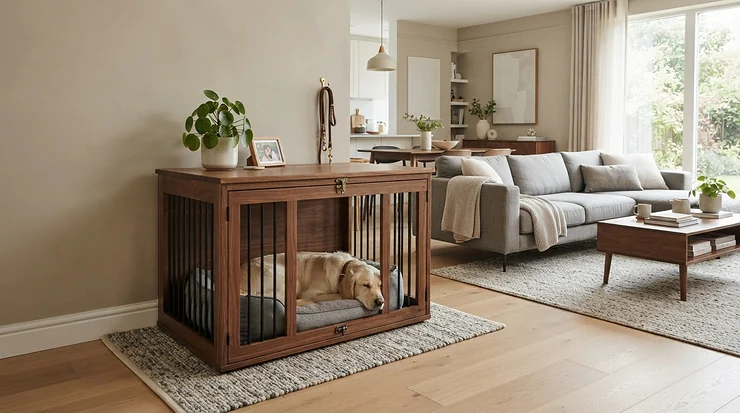
The indoor answer to double vs triple dog kennel thinking: one cabinet, one removable divider, two layouts.
Listings show roughly 88.5 x 120 x 60 cm overall, built from MDF and steel with two lockable sliding doors. With the divider in, each room is suited to small dogs under about 35cm in body length and 8kg; remove it and one dog under about 60cm and 30kg can use the full space. That 8kg limit is the real story, because it tells you this is a toy-breed solution, not a family-dog kennel.
Reviewers on retail listings of PawHut’s sliding-door furniture crates praise easy assembly and clear instructions. A recurring complaint concerns the sliding doors, which a determined dog can push aside; one owner resorted to tying them shut. Plan on adding a secure clip or latch.
Pros:
- ✅ Doubles as a side table or TV stand
- ✅ Divider converts two rooms into one
- ✅ Sliding doors save floor space
Cons:
- ❌ Sliding doors can be pushed open
- ❌ Room sizes only suit very small dogs
Price: check current price; it sits well below timber options, so value hinges on dog size.

6. PawHut 71″ Dog Crate Furniture with Removable Divider — longest indoor layout with storage
Think of it as the 120cm model’s longer, tidier cousin, with shelving built in.
The listing gives overall dimensions of about 70.9 x 23.6 x 34.3 inches (roughly 180 x 60 x 87 cm). It offers two small dogs up to 18 lb each, or one large dog up to 66 lb with a body length of about 23.6 inches. Adjustable feet matter more than they sound, since wobbly crate furniture on a wonky floor is how doors start to misalign.
Here’s the honest comparison: at 180cm long, there’s room on paper for a third compartment, but the design only supports one divider. If you want a genuine triple kennel indoors, you’re looking at custom furniture or a modular wire system.
On reviews: I found a retailer listing but no verifiable review set, so treat durability as unproven.
Pros:
- ✅ Built-in storage keeps leads and food close
- ✅ Adjustable feet cope with uneven floors
- ✅ One-large or two-small flexibility
Cons:
- ❌ Only one divider, so no triple option
- ❌ Review evidence not verifiable
Price: check current price. Fair value for flat-dwellers who want furniture that earns its floor space.
7. One for Pets Portable 2-in-1 Double Pet Kennel — grows and shrinks with your pack
A fabric double that unzips into one big space or splits into two, which makes it a surprisingly smart way to test upgrading kennel size later.
The listing describes a double that measures 20 x 20 x 39 inches (roughly 51 x 51 x 99 cm), usable as two separate crates, one large connected crate, or two connected crates with a separator. It folds flat, has seat-belt fixings and comes with a carry case. In practice, that means roughly 50cm-square compartments suited to small and medium dogs, and a design that doubles as car transport.
Fabric won’t survive a determined chewer, so this is for calm dogs and short stays. Use it as a flexible travel or visiting-dog solution rather than as a permanent home.
On reviews: I couldn’t verify ratings beyond the retailer’s own description, so I won’t claim customer consensus either way.
Pros:
- ✅ Three layouts from one product
- ✅ Folds flat for storage and travel
- ✅ Seat-belt fixing for car use
Cons:
- ❌ Fabric unsuited to chewers
- ❌ Limited to small and medium dogs
Price: check current price. Reasonable value as a flexible secondary kennel.
Here’s how the seven stack up side by side.
| Product | Type | Compartments | Key size | Price range | Best For |
|---|---|---|---|---|---|
| Benchmark 8 x 8ft | Timber and run | 2 | About 5.9 m² | Around £1,800 | Two medium dogs outdoors |
| Benchmark 8 x 10ft | Timber and run | 2 | About 7.4 m² | Around £2,000 | Two larger dogs |
| Lucky Dog 3-Run | Panel runs | 3 | About 2.3 m² per run | £1,200–£2,300 | Modular triple layouts |
| PawHut Double Dog House | Wooden house | 2 | About 2.4 m² total | Check current price | Two small dogs |
| PawHut 120cm Crate Furniture | Indoor furniture | 2 or 1 | 120 x 60cm | Check current price | Toy breeds indoors |
| PawHut 71″ Crate Furniture | Indoor furniture | 2 or 1 | 180 x 60cm | Check current price | Small dogs with storage |
| One for Pets 2-in-1 | Fabric crate | 2 or 1 | 51 x 51 x 99cm | Check current price | Travel and flexibility |
The pattern is clear: only the timber doubles and the panel triple are genuine outdoor kennels, while the other four serve small dogs indoors or on the move. If you’re weighing a garden double vs triple dog kennel purchase, the first three rows are your real shortlist. Everything below the line is a different category answering a different question.
Comparing Dog Kennel Sizes: What the Numbers Actually Mean
Comparing dog kennel sizes sounds like a ruler job, but listings mix feet, inches, centimetres and square metres with abandon. A little translation goes a long way.
Start with the conversion. 8ft is about 2.44m and 5ft is about 1.52m. So an 8 x 8ft unit covers roughly 5.9 m², an 8 x 10ft unit about 7.4 m², and a 5 x 5ft run about 2.3 m². The Benchmark Single 8 x 4ft comes to roughly 3 m² for one dog, which is why the Benchmark 8 x 8ft is such a tidy comparison: it keeps that 3 m² per dog while housing two.
Next, separate total footprint from usable sleeping area. A listing quoting 64 square feet may devote half to the run. Roofed sleeping space is what protects a dog from rain and cold, while the run is where it moves.
Finally, remember that dimensions are not weight limits. The PawHut Double Dog House can look generous on paper, yet its guidance caps dogs at around 33 lb, apparently combined. Size and suitability are different questions, and the number on the listing rarely answers both.

Space Per Dog: How Much Room Each Dog Really Needs
Space per dog is where the double vs triple dog kennel debate gets serious. A triple only works if each of the three compartments is genuinely big enough, and the footprint adds up fast.
For a practical benchmark, look at what licensed boarding kennels in England must provide. The statutory guidance requires a sleeping area of at least 1.9 m² for new builds, with a higher standard of 2.85 m². It also asks for a floor area at least twice what a dog needs to lie flat, and a roof over at least half of each run.
You’re not a licensed boarder, but these numbers are a useful sanity check. A 5ft square run at about 2.3 m², like the Lucky Dog 3-Run, clears the sleeping-area minimum on paper, but it’s a run rather than a sleeping area, so you still need shelter. The Benchmark 8 x 8ft and Benchmark 8 x 10ft deliver roughly 3 m² and 3.7 m² per dog overall, which comfortably supports a roofed sleeping area plus a run.
The guidance also expects multiples of every resource, such as beds, bowls and toys, equal to or greater than the number of dogs. Budget for that. Three dogs means at least three of everything, and a third compartment that lacks its own bed is only half built.
Cost Per Compartment: Where Double vs Triple Pricing Lands
Cost per compartment is the cleanest way to compare a double vs triple kennel, because it strips away the headline price and asks what each dog’s space really costs. The numbers below are indicative ranges based on retailer listings at the time of research.
| Setup | Approx. outlay | Compartments | Approx. cost per compartment | Best For |
|---|---|---|---|---|
| Benchmark Single 8 x 4ft | Around £1,100 | 1 | Around £1,100 | One dog, no plans to add |
| Benchmark 8 x 8ft | Around £1,800 | 2 | Around £900 | Two dogs, best value outdoors |
| Benchmark 8 x 10ft | Around £2,000 | 2 | Around £1,000 | Two larger dogs |
| Lucky Dog 3-Run | £1,200–£2,300 | 3 | Around £400–£770 | Triple run, shelter extra |
Reading the table, the double format shaves roughly 18% off the per-dog cost of the single, which is a solid saving for planning ahead. The Lucky Dog 3-Run looks cheapest per head, but remember it’s panel-only. Add three insulated sleeping boxes and the gap narrows quickly. I couldn’t verify a stable price for builder-made triples, so treat any figure for those as a quote-dependent unknown.
One more angle: buying a Benchmark Single 8 x 4ft now and a second single later would cost around £2,200 in total, versus around £1,800 for the Benchmark 8 x 8ft bought upfront. If a second dog is likely, that’s a real saving.
Kennel Configuration Comparison: Layouts, Dividers and Shared Walls
A proper kennel configuration comparison goes beyond the number of compartments. Layout decides noise, privacy, cleaning and how stressed your dogs feel.
Side-by-side runs (like the Lucky Dog 3-Run, with two common walls and three doors) are cheap and easy to supervise. The downside is the middle dog, which has a neighbour on each side. Based on how shared mesh behaves, the centre compartment often becomes the noisiest, because that dog sees and hears everything.
Back-to-back or L-shaped layouts reduce sight lines but need more garden. Indoor furniture crates such as the PawHut 120cm Crate Furniture avoid the issue by separating rooms with a solid divider.
Official guidance backs this thinking. Where a dog poses a health or welfare risk, an adjoining wall must be full height and width, and each kennel unit should give the dog somewhere to avoid seeing other dogs, using screens, blankets or high-sided beds. Doors should open inwards, and units should offer 1.8m of headroom for cleaning.
In a triple, I’d lean towards solid dividers between at least two compartments, or half-height solid panels with mesh above. You keep airflow without handing every dog a front-row seat to its neighbours.
Upgrading Kennel Size Later: Planning for a Third Dog
Upgrading kennel size later is the part most buyers skip, and it’s the part that bites hardest. Dogs arrive. Puppies grow. A double that felt perfect in March can feel cramped by the following spring.
The most upgrade-friendly route is a modular panel system. The Lucky Dog 3-Run is marketed as a modular design that allows future configuration changes, so you can extend or reshape the layout as needs evolve. At the other end, fabric options such as the One for Pets 2-in-1 can switch between one large and two small compartments without tools.
Timber units are the least flexible. A built Benchmark 8 x 8ft won’t become a triple, though a builder may offer extensions or additional units; it’s worth asking before you order. Several Trustpilot reviewers mention triple and four-run kennels from the same manufacturer, which suggests multi-unit blocks are part of the range.
A practical rule: buy for the dog pack you’ll have in two years, not today. If a third dog is plausible, consider a larger double now and add a separate unit later, or go modular from day one. And remember the earlier arithmetic: buying a double upfront beats adding a second single later by a clear margin.
How to Choose Between a Double vs Triple Dog Kennel
Choosing between a double vs triple dog kennel is easier with a checklist. Work through these steps in order.
- Count your dogs now and in two years. A third dog on the horizon changes the maths completely.
- Measure adult size and weight. Weight limits such as the 33 lb guidance on the PawHut Double Dog House can rule a product out in seconds.
- Decide indoor or outdoor. Furniture crates and fabric kennels are indoor or travel solutions; timber and panel units are garden solutions.
- Check compatibility. Dogs that love each other can share a compartment, but dogs that squabble need separation. When in doubt, plan one compartment per dog.
- Check ground and access. Level, drained ground matters, and long triple blocks need straight, clear space.
- Compare cost per compartment, not headline price. Add shelters, bedding and delivery before you compare.
- Confirm regulations if boarding. Licensed activity follows stricter space and welfare conditions than home use.
Practical Setup and Maintenance Guide for Multi-Dog Kennels
A kennel that’s installed badly will fail long before the timber does. These steps cover the first month and beyond.
Setup. Level the base first and make sure water can drain away. Official guidance is blunt: no standing water from cleaning or urine, and drains must stay unblocked. Position the sleeping area away from prevailing wind, and keep a clear working path to every door.
First 30 days. Introduce dogs to compartments gradually, with familiar bedding and short sessions. Provide a bed, bowl and toy per dog. Check every latch, especially on sliding-door furniture; owners report dogs nudging unlocked doors open, so add a secondary clip.
Maintenance schedule.
- Daily: remove faeces, refresh water, check bedding is dry.
- Weekly: disinfect surfaces with pet-safe products, inspect mesh and joints.
- Annually: re-treat exposed timber and re-tighten screws. Official guidance expects timber to be treated and waterproofed, with only non-toxic products.
Temperature. Aim to keep part of the sleeping area between roughly 10°C and 26°C, the range used in boarding standards. Add insulation and ventilation rather than relying on luck.
Common first-month mistakes. Skipping the introduction period, overfilling bedding until it traps damp, and leaving gaps small dogs can squeeze through.
Real-World Scenarios: Matching a Kennel to Your Household
Specs only help if they fit a life. Here are three realistic profiles.
The family with two spaniels, a medium garden and a seven-year horizon. Two medium dogs, daily outdoor time, weather to contend with. The Benchmark 8 x 10ft gives roughly 3.7 m² per dog and a roofed, raised sleeping area. It’s the premium pick, but at around £2,000 it’s priced for decades of use rather than a couple of seasons.
The flat-dweller with two toy dogs. Indoors, small dogs, limited floor space. The PawHut 71″ Crate Furniture or PawHut 120cm Crate Furniture keeps both dogs safe while doubling as a side table. Keep within the 8kg-per-room guidance, and check the sliding-door latch.
The small side business. If you’re boarding other people’s dogs for profit, you’re regulated. HMRC’s trading allowance matters for whether you count as a business, and a licence follows if you do. A modular layout such as the Lucky Dog 3-Run, with proper roofed shelters added, is easier to expand as bookings grow, but you’ll need to meet licensing standards for sleeping area, roofs and separation.
✨ Ready to Compare Current Options?
🔍 Take your kennel plans to the next level with these carefully chosen products. Click on any highlighted item to check current pricing and availability, and match each one to your dogs’ size, number and daily routine.
Double vs Triple Dog Kennel vs Separate Single Kennels
The real alternative to a double vs triple dog kennel isn’t another multi-compartment unit; it’s buying single kennels one at a time. Both routes work, but they behave differently.
| Feature | Double or triple unit | Separate singles | Best For |
|---|---|---|---|
| Cost per dog | Lower, as shown with the Benchmark 8 x 8ft | Higher, such as the Benchmark Single 8 x 4ft twice | Planning ahead: unit |
| Flexibility | Fixed layout (timber) or modular (panels) | Easy to add or move | Uncertain future: singles |
| Space use | Shared walls save room | Needs gaps between units | Small gardens: unit |
| Separation | Depends on divider type | Complete | Incompatible dogs: singles |
Singles win on flexibility and separation, while doubles and triples win on cost per compartment and compactness. If your dogs are best friends and your garden is tight, a unit makes sense. If one is a nervous rescue that needs space from the other, singles or a solid-divided unit are safer. The deciding factor is rarely the product; it’s the dogs’ temperament.
Common Mistakes When Buying a Double vs Triple Dog Kennel
A few predictable errors account for most regret. Avoid these and you’re ahead of the field.
- Buying for today’s dog, not next year’s. A puppy grows, and a compartment sized for an adolescent beagle may not suit an adult.
- Trusting the listing’s size over its weight guidance. The PawHut Double Dog House shows how a generous footprint can still carry a tight weight limit.
- Treating a run as a kennel. The Lucky Dog 3-Run is a run system; without a roofed sleeping shelter, it isn’t a complete home.
- Ignoring bar spacing. The manufacturer itself warns that 2.5-inch spacing may not suit smaller breeds or puppies.
- Skipping the roof. Official standards expect at least half of each run to be roofed for good reason: shade and shelter.
- Forgetting the third compartment’s real cost. Beds, bowls and enrichment all multiply with dog count.
- Assuming dogs will share nicely. Even friendly dogs may need separate resting spots.
Safety, Regulations and Compliance for UK Kennels
Home owners have light-touch obligations; licensed boarders have heavy ones. Know which category you fall into.
For personal use, the key duty is welfare. The RSPCA expects shelter from rain, wind and direct sun, and a kennel large enough for separate sleeping and activity areas.
If you board other people’s dogs as a business in England, the Animal Welfare (Licensing of Activities Involving Animals) (England) Regulations 2018 apply, as set out in Schedule 4 of the regulations. Key points from the guidance:
- Sleeping areas in new builds must be at least 1.9 m², with 2.85 m² as the higher standard.
- Each run needs a waterproof roof over at least half its area.
- Only dogs from the same household may share a kennel unit, with written owner authorisation.
- Wire mesh must not exceed 50mm by 50mm squares, and each unit needs about 1.8m headroom.
Wales and Scotland publish their own conditions, so check your local authority. Whatever your category, choose materials without sharp edges, keep drains clear and treat timber with non-toxic products. Safe isn’t a feature on a spec sheet; it’s a habit.

FAQ
❓ Is a double vs triple dog kennel better for two dogs that get along?
❓ Can two dogs share one kennel compartment?
❓ How much does a double dog kennel cost in the UK?
❓ Can I turn a double kennel into a triple later?
❓ What size run does each dog need?
Conclusion
The double vs triple dog kennel decision comes down to three questions: how many dogs, how big, and how likely is change. For two medium dogs and a garden, the Benchmark 8 x 8ft is the dependable pick, and the Benchmark 8 x 10ft is the upgrade for bigger breeds. If three dogs, a modular layout and a tighter budget per compartment matter more, the Lucky Dog 3-Run earns its place, as long as you add proper shelters. For toy breeds indoors, the PawHut 120cm Crate Furniture and PawHut 71″ Crate Furniture work within strict weight limits, while the PawHut Double Dog House suits very small dogs and the One for Pets 2-in-1 suits flexibility and travel.
Measure first, plan for the pack you’ll have in two years, and compare cost per compartment rather than headline price. A kennel that fits your dogs now and still fits when the household grows is worth more than any bargain.
Recommended for You
- Kennel For Breeding Dogs: 7 Essential Picks For UK Breeders (2026)
- Block Of Dog Kennels: 7 Best Proven Picks For UK Breeders (2026)
- Whelping Box Kennel: 7 Best Safe Picks For UK Breeders (2026)
Disclaimer: This article contains affiliate links. As an Amazon Associate, I earn from qualifying purchases. If you purchase products through these links, we may earn a small commission at no additional cost to you.
✨ Found this helpful? Share it with your friends! 💬🤗
