

In This Article
A whelping box kennel is a purpose-built, sheltered enclosure where a dam gives birth and nurses her litter for the first weeks of life. It keeps puppies contained, warm and clean, includes low interior rails so she can’t crush them against the walls, and gives her a quiet den she can leave and return to freely.

Here’s what first-time breeders tend to discover too late: it isn’t furniture, it’s safety equipment. The Kennel Club’s whelping guidance describes the box as a space that keeps puppies safe during birth and for several weeks afterwards. That stretch of weeks is where weak setups come unstuck. A box that works on day one can be too small by week three, too awkward to disinfect before litter two, or too easy for a wriggly puppy to escape on day twenty-one.
This guide compares seven real products sold on Amazon UK, from a disposable cardboard kit to a UK-made PVC pen, and goes well beyond the spec sheet. Along the way you’ll get a breakdown of whelping box safety features, a practical nursing kennel layout, a checklist for puppy-proofing kennels, and a postnatal dog care setup for the first month. Think of it as puppy whelping housing explained by someone who reads the small print so you don’t have to.
A quick note on sources: Amazon blocks automated reading of its review pages. The review sentiment below therefore comes from retailer listings, breeder forums and seller feedback elsewhere, and I say so where a pool is thin or unverifiable. Prices are ranges only and change often, so check the current listing before you buy.
Quick Comparison: Best Whelping Box Kennel Options at a Glance
Seven boxes, three price tiers, one question: which suits your dam, your room and your plans for future litters? The table below is a snapshot, and the detailed breakdowns follow. Sizes are in centimetres so you can measure against your own dog (nose to tail-tip, remember). Price brackets are ranges rather than exact figures because prices on Amazon move constantly.
| Product | Material | Approx. size | Price bracket | Best For |
|---|---|---|---|---|
| Disposable Cardboard Whelping Box Kit with Pig Rails | Cardboard (single-use) | Kit; check size on listing | Around £50 | One-off litters on a tight budget |
| Duckygoo Oxford Fabric Whelping Box | 600D Oxford fabric | 61 × 61 × 64 cm up to 127 × 127 × 64 cm | Budget; check current price | Small homes needing flat storage |
| EZwhelp EZclassic | Injection-moulded plastic | About 71 × 71 cm inside (28 in model) | Mid-range; check current price | Small breeds, repeat litters |
| PawHut Whelping Box 2m x 1m | Pinewood and MDF | 206 × 100 × 50 cm | Mid-range; check current price | Medium to large dams needing two zones |
| VEVOR Plastic Dog Whelping Box | PE frame, PET panels | 154 × 100 × 60 cm (medium) | Mid-range; check current price | Discreet monitoring, easy cleaning |
| BingoPaw Wooden Whelping Box with Tempered Glass | Wood and tempered glass | 120 × 118 × 60 cm | Around £170 | Living-room visibility |
| Tekplas Whelping Box | UK-made PVC | 92.5 × 92.5 × 40 cm | Premium; check current price | Regular breeders, small to medium dams |
Looking at the comparison above, the Disposable Cardboard Whelping Box Kit with Pig Rails is the cheapest way in, but it only makes sense for a one-off litter. If you want a hygienic surface you can reuse, the EZwhelp EZclassic, VEVOR Plastic Dog Whelping Box and Tekplas Whelping Box justify their higher cost. The PawHut Whelping Box 2m x 1m is the roomiest choice for bigger dams. Budget buyers should note that the Duckygoo Oxford Fabric Whelping Box trades easy sanitising for portability.
💬 Just one click — help others make better buying decisions too!😊
Top 7 Whelping Box Kennel Picks: Expert Analysis
Each pick below is judged on what its specs mean in a real spare room. The questions are how easy it is to disinfect, how it protects puppies, and whether it will still make sense at week four.
1. Disposable Cardboard Whelping Box Kit with Pig Rails — cheapest route to a spotless start
The big idea is delightfully simple: when the litter leaves, the box goes in the recycling.
Supplied flat in kit form with pig rails included, it lists at around £50 on Amazon UK at the time of research. Cardboard is porous, which sounds like a flaw until you remember it’s single-use. The biggest hygiene headache with any whelping box kennel is disinfecting it between litters, and a disposable box sidesteps that entirely. The rails matter most, because they leave a gap so a heavy dam can’t pin a puppy against the wall.
Based on the spec comparison, this suits a one-off litter in a quiet utility room or spare bedroom, where buying a far pricier box you’ll never use again feels daft. It’s a poor fit for big, messy litters, and puppies past three weeks or so will test cardboard with their teeth. Cardboard also softens when wet, so you’ll want a waterproof liner underneath.
Review sentiment is hard to verify for this listing. Breeder forums offer a clue, though: one UK poster says she simply buys a cardboard box and bins it after each litter, purely to dodge the cleaning.
Pros:
- ✅ Disposable, so no between-litter disinfecting
- ✅ Pig rails supplied in the kit
- ✅ Lowest upfront cost of the seven
Cons:
- ❌ Weakens when damp or soiled
- ❌ Chewable once puppies get lively
Around £50 per litter: sensible for one litter, poor value if you’ll breed again.

2. Duckygoo Oxford Fabric Whelping Box — folds flat when the litter has gone
Not every home has a spare room, and this is the option for people who want their living room back by the weekend.
It’s built from 600D Oxford fabric, a rating that describes yarn thickness. In practice that means tear-resistant enough for a calm dam, but not for a four-week-old puppy with a point to prove. The listing includes an absorbent whelping pad and several sizes, from a compact 61 × 61 × 64 cm version up to a roomy 127 × 127 × 64 cm.
Fabric packs flat, which suits flats, rentals and one-litter households. The trade-off is hygiene. Welfare researchers at Purdue recommend non-porous materials that can be sanitised between litters, and fabric simply can’t match plastic there. The listing title also doesn’t mention pig rails, so check the photos and be ready to add your own.
I couldn’t verify review themes on the Amazon UK page, so there’s no honest way to say how it survives week four. Treat it as unproven on the point that matters most.
Pros:
- ✅ Folds flat for storage between litters
- ✅ Absorbent whelping pad included
- ✅ Sizes from compact to large
Cons:
- ❌ Porous fabric is harder to disinfect
- ❌ Pig rails not mentioned in the listing title
Typically priced below rigid plastic or wooden boxes (check current price); fair value for a single litter.
3. EZwhelp EZclassic — breeder-favourite plastic with removable rails
The signature feature is a rail assembly that comes out once puppies are strong enough to need the floor space.
The Amazon UK listing covers the 28 in × 28 in size, roughly 71 cm square inside, though larger 38 in and 48 in versions exist. Injection-moulded plastic walls lock together with tall posts, and a two-piece door lets the dam come and go while puppies stay put. Because the walls are non-porous, you can wipe them down with detergent, disinfectant or bleach. There’s no rigid floor, though: a canvas liner and reusable pad do that job.
That 71 cm interior suits small breeds. One US retailer reviewer with a dam of roughly 9 kg (20 lb) said she had ample room and that puppies could shelter under the rails. Anything larger should size up, using the nose-to-tail test.
On a US retailer listing for this size the average is 4.7 stars from 47 ratings, a small but positive pool.
Pros:
- ✅ Wipe-clean plastic walls
- ✅ Removable rails give a growth path
- ✅ Lightweight, tool-free assembly
Cons:
- ❌ The 28 in size suits small dams only
- ❌ Canvas liner needs frequent washing
Upper-mid bracket for a small box (check current price); good value if reused across several litters.
4. PawHut Whelping Box 2m x 1m — two-room layout for the second fortnight
Once puppies hit about two weeks, this box lets mum have a space of her own.
At 206 × 100 × 50 cm, it’s a pinewood-and-MDF pen split into two rooms with three removable doors, including one in the middle. The puppy side is sealed against draughts while the dam’s side is fenced for airflow, and non-slip pads sit underneath. Removing the middle door reopens access when you want it.
That 2 m length clears the nose-to-tail rule for most medium dams and many large ones, which is the real selling point. Wood is porous, though. A breeder interviewed on the Pure Dog Talk podcast points out that raw wood can’t be properly disinfected, so line it with waterproof pads and think of it as a one-or-two-litter box. The listing mentions railings without specifying low pig rails, so check before buying.
Review data is thin. One US retailer listing of the same design shows 3.0 stars from just 10 ratings, plus a cheerful five-star comment. That’s too small a sample to call.
Pros:
- ✅ Two-room design suits the weaning stage
- ✅ Generous length for larger dams
- ✅ Non-slip pads protect floors
Cons:
- ❌ Wood is hard to disinfect between litters
- ❌ Assembly required, around 17 kg to move
Mid-range bracket (check current price); solid value for a home breeder who needs space.
5. VEVOR Plastic Dog Whelping Box — clear panels for discreet monitoring
Transparent walls mean you can watch from the sofa without hovering over her.
The medium model measures 154 × 100 × 60 cm and is built from a PE frame with ten PET panels, ABS connectors and TPE suction cups. It weighs about 11.75 kg, and a larger version reaches roughly 193 × 124 × 76 cm for big breeds. The suction cups help on smooth floors, though I’d still test it on laminate before relying on it. The door lock matters later, when three-week-old puppies start plotting escapes.
Plastic is non-porous, so it wipes clean. VEVOR states that its boxes include interior rails, but confirm that on your exact listing, because rails are non-negotiable. A nervous dam may also prefer fewer pairs of eyes at close range, so a sheet over one side is worth having.
The same design has collected large review pools, several hundred ratings across sizes, on US retailer pages. I couldn’t verify specific themes on Amazon UK.
Pros:
- ✅ Non-porous plastic cleans easily
- ✅ Transparent panels for discreet monitoring
- ✅ Lockable door deters escapes
Cons:
- ❌ Rails need confirming on the exact listing
- ❌ Size variants are confusing, so check cm
Mid-range bracket (check current price); good value if you want visibility and easy cleaning together.
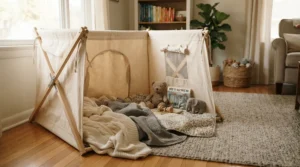
6. BingoPaw Wooden Whelping Box with Tempered Glass — a living-room-friendly viewing window
If the whelping area has to live where guests might see it, this one at least looks intentional.
It measures 120 × 118 × 60 cm, combining a wooden frame with tempered glass panels, a protective ledge and a waterproof pad. It lists at around £170 on Amazon UK. That protective ledge is the pig rail by another name: a shelf that holds the dam’s body away from the wall, leaving puppies an escape pocket.
Tempered glass is designed to break into small, blunt pieces rather than shards, but it is still glass. Keep it on a stable, non-slip surface and away from rowdy household traffic. A very large, restless dam is probably better in plastic. The wooden frame is porous, so use the waterproof pad generously.
I couldn’t verify review themes for this listing, and the design is newer than the long-established plastic boxes. Treat it as promising rather than proven.
Pros:
- ✅ Protective ledge works as a pig rail
- ✅ Waterproof pad included
- ✅ See-through panels look tidy indoors
Cons:
- ❌ Heavier and more fragile than plastic
- ❌ Wooden frame is still porous
Around £170: fair for the finish, expensive if all you need is function.
7. Tekplas Whelping Box — UK-made PVC built for repeat breeders
This is the one for people who’d rather buy once than replace a box every other litter.
The Amazon UK listing is 92.5 × 92.5 × 40 cm in white. Tekplas, a UK PVC manufacturer, also lists 117.5 cm and 130 cm squares and wall heights of 40 to 60 cm elsewhere, and says it will customise sizes. PVC is non-porous, so it wipes down quickly between litters. Wall height needs thought: sides should hold puppies in but let the dam leave without a struggle, so 40 cm suits small to medium dams better than very large ones.
Measure first. A 92.5 cm square suits a dam whose nose-to-tail length is comfortably below that. Other versions of this range come as fully enclosed or with gaps, so check which one the Amazon listing shows.
Review evidence is limited to seller feedback on another marketplace, which praises the build quality and communication but briefly. That’s encouraging, not conclusive.
Pros:
- ✅ UK-made PVC wipes clean quickly
- ✅ Wider sizes and heights available elsewhere in the range
- ✅ Built for repeated litters
Cons:
- ❌ Premium price compared with fabric or cardboard
- ❌ Rail and door details vary by version
Premium bracket (check current price); pays back across several litters, poor value for one.
How to Choose a Whelping Box Kennel: 7 Steps That Prevent Regret
Short answer first: measure your dam, pick a surface you can sanitise, insist on rails, and plan the room before the box. Here’s the longer version, in order of importance.
- Measure your dam from nose to tail-tip. UK pet-care guidance from Lassie says the box should be at least that long, and she needs room to stretch out rather than curl into a doughnut.
- Match the material to your plans. Non-porous plastic or PVC sanitises between litters, while wood and fabric are fine for a single litter but tougher to disinfect.
- Demand pig rails. They’re the single feature that stops overlay, so if a listing doesn’t mention them, assume you’ll be adding your own.
- Check wall height against exits. Sides should stop puppies climbing out but still let her leave easily, so look for lower doors or removable panels.
- Look for a dam-only zone. Two-room designs like the PawHut Whelping Box 2m x 1m give her a retreat once the puppies are around two weeks old.
- Think about assembly and storage. Tool-free plastic and flat-folding fabric save a weekend of swearing, while heavy wood and glass don’t.
- Plan the location before you buy. Quiet, draught-free, away from foot traffic, with a socket nearby if you’re adding heat.
Skip step seven and even the best whelping box kennel will sit in the wrong corner, which is the weakest link in most puppy whelping housing plans.
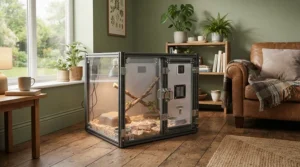
Whelping Box Safety Features That Actually Matter
Marketing pages love gimmicks, while welfare guidance is blunter. These whelping box safety features earn their place:
- ✅ Pig rails: a low shelf inside the walls, commonly cited at roughly 5-10 cm off the floor and a few centimetres out from the wall. It gives puppies an escape pocket if she leans.
- ✅ Smooth edges: Purdue University’s Croney Research Group warns that sharp edges can injure the mammary glands and raise the risk of mastitis.
- ✅ Non-porous surfaces: plastic and plexiglass can be sanitised between litters, which porous wood and fabric struggle with.
- ✅ A stable base: non-slip pads or suction cups, as on the PawHut Whelping Box 2m x 1m and VEVOR Plastic Dog Whelping Box.
- ✅ Secure latches: a door lock that stops a curious puppy popping out unsupervised.
Features that don’t matter much? Fancy colours, bundled “feeding kits” you’d source better elsewhere, and anything that looks lovely but can’t be wiped down. When comparing whelping box safety features, rails and cleanability beat aesthetics every time. The Kennel Club also advises against hay, wood shavings or straw inside the box, since they can damage puppies’ skin and eyes.
Puppy-Proofing Kennels: A Problem-and-Solution Guide
Good puppy-proofing kennels thinking starts before the puppies can walk. Here are the five problems that crop up most.
The week-three escape artist
Puppies learn to climb faster than you’d believe. Taller walls, a lid or a door lock, like the one on the VEVOR Plastic Dog Whelping Box, buy you time. Taller Tekplas Whelping Box variants exist elsewhere in its range.
The chewer
Cardboard and fabric are vulnerable. Keep cables outside the pen and choose heating with a chew-resistant cord.
The slider
Smooth floors cause splayed legs and wobbly starts. Non-slip pads, suction cups and a rubber-backed bed under the liner all help.
The gap trap
Check panel gaps carefully. Tekplas lists both fully enclosed and gapped versions, and fully enclosed is the safer default for tiny limbs.
The damp problem
Small puppies chill quickly on wet surfaces, as Lassie’s guidance warns. A waterproof pad plus quick changes of soiled bedding keeps them dry.
Treat puppy-proofing kennels as a rolling checklist, repeated weekly as the litter grows.
Nursing Kennel Setup: Zones, Heat and Layout
Think of the nursing kennel as three zones in one footprint: a warm den, a cooler resting patch for her, and later a toilet area. Getting the layout right matters more than any single product.
The Kennel Club says the box should initially be kept at roughly 29-32°C. Heat only part of the box, though. A guest on the Pure Dog Talk podcast stresses that the box must be big enough for the dam to get away from the heat while puppies can still reach her. Put a thermometer at puppy level, not at your eye level, and check it twice daily.
Choose a quiet, low-traffic spot. The same podcast suggests draping a sheet over surrounding pens for privacy during the birth itself. Set the box up well ahead, ideally a week or more, because the Kennel Club stresses giving her time to get used to it. Bedding should be washable and easy to replace, and any heat pad or lamp should carry UKCA or CE marking.
A good nursing kennel feels boring: stable, dim, warm and predictable. Boring is exactly what a new mother wants.
Postnatal Dog Care Setup: The First Four Weeks
A solid postnatal dog care setup is mostly routine. Welfare researchers advise cleaning the whelping area daily, and they suggest popping puppies into a small, towel-lined box or carrier while you do it. Keep her water within reach and the bedding dry, and avoid hay or straw as the Kennel Club recommends.
Here’s a rough shape for the month:
- Week one: keep the heat steady, keep the room quiet, and check the box at regular intervals.
- Week two: if you have a two-room box, such as the PawHut Whelping Box 2m x 1m, give her access to her own side.
- Weeks three to four: add washable flooring beside the box for a toilet area. The box can be extended or the rails removed on designs like the EZwhelp EZclassic once puppies are strong enough.
Keep your vet’s number on the wall. The PDSA’s whelping guide is clear that if you’re worried about your dog, you should contact your vet rather than waiting. A well-planned postnatal dog care setup makes spotting problems easier, because everything is where you expect it.
Puppy Whelping Housing: Choosing the Right Room and Flooring
Where you put the box often matters as much as which box you buy. Breeder guidance from Dogs NSW lists a laundry, a back bedroom, a garage or a corner of a kennel block as typical whelping rooms. Whichever you pick, it needs reliable heating, good ventilation without draughts, and a hard-wearing floor you can wipe.
The Pure Dog Talk podcast adds a practical flooring tip: lay a sheet of linoleum big enough for the box and an extra patch where puppies can toilet as they grow. That turns puppy whelping housing into a staged system rather than a single box.
Garages and outbuildings can work, but only with dependable heating and safe electrics. Keep her away from the front door, the washing machine and anything else that bangs or thuds. Compare each room’s noise, temperature and cleanability, and choose the quietest, not the biggest.
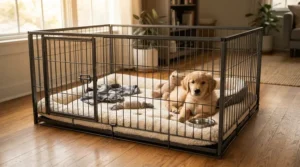
Whelping Box Kennel vs Traditional Alternatives
Plenty of breeders improvise, so it’s fair to ask whether a purpose-built whelping box kennel is worth it at all. Here’s how it stacks up.
| Option | Biggest plus | Biggest drawback | Best For |
|---|---|---|---|
| Purpose-built box (e.g. EZwhelp EZclassic) | Rails and cleanable surfaces designed in | Higher upfront cost | Regular breeders |
| Dog crate | Already owned | Often too small, usually no pig rails | Emergencies only |
| Paddling pool | Cheap, soft sides | Rails usually missing | Small, calm dams |
| Disposable Cardboard Whelping Box Kit with Pig Rails | No cleaning between litters | Not durable | One-off litters |
Looking at the comparison above, a crate is the weakest alternative, even though the Kennel Club accepts that you can use one if it’s suitable and keeps mum and puppies safe. Paddling pools are a surprisingly popular fix: Purdue’s welfare group calls a plastic kiddie pool an easy, affordable option. One UK breeder on a forum said she preferred a pool with soft sides to any box she’d used. The catch is that most pools lack pig rails and smooth curved walls give tiny puppies little grip. For first-timers, purpose-built or disposable boxes with rails remain the safer starting point.
Real-World Scenarios: Which Pick Suits Which Breeder?
These are illustrative scenarios, not testimonials.
Scenario one: the first-timer in a flat. A Cavalier-sized dam, one planned litter, a tight budget and no storage. The Disposable Cardboard Whelping Box Kit with Pig Rails or the Duckygoo Oxford Fabric Whelping Box fit best, with a waterproof liner and a thermometer. The trade-off is hygiene, which matters less when the box is single-use.
Scenario two: the hobby breeder with a Labrador-sized dam. One litter every year or two, a spare room, and a need for length. The PawHut Whelping Box 2m x 1m or the larger VEVOR Plastic Dog Whelping Box work, and the VEVOR’s clear panels let you check puppies without disturbing her.
Scenario three: the repeat breeder with a small breed. Two litters a year, regular disinfecting, and no patience for replacements. The EZwhelp EZclassic or Tekplas Whelping Box will cost more upfront but repay it through reuse. If your living room doubles as the nursery and appearance matters, the BingoPaw Wooden Whelping Box with Tempered Glass is the tidy compromise.
✨ Don’t Miss These Exclusive Deals!
🔍 Take your litter preparation to the next level with these carefully selected whelping box kennel options. Click on any highlighted item to check current pricing and availability. These picks will help you create a safe, warm and calm start your puppies will thrive in!
Long-Term Cost and Maintenance of a Whelping Box Kennel
The cheapest box is not always the cheapest outcome. Using the Disposable Cardboard Whelping Box Kit with Pig Rails (around £50 per litter) against a reusable box at around £170, like the BingoPaw Wooden Whelping Box with Tempered Glass, the break-even arrives sooner than you’d think.
| Litters | Disposable cardboard total | Reusable box at around £170 | Best For |
|---|---|---|---|
| 1 | Around £50 | Around £170 | One-off litters |
| 2 | Around £100 | Around £170 | Two litters, no further plans |
| 3 | Around £150 | Around £170 | Break-even zone |
| 4 | Around £200 | Around £170 | Regular breeders |
Looking at the comparison above, the disposable route wins for one or two litters. By the third litter the reusable box is roughly level, and by the fourth it’s ahead. These figures ignore cleaning materials, replacement liners and your time, all of which favour plastic or PVC. Budget for disinfectant, spare washable pads and replacement liners, and wash fabric parts after every litter.
Common Mistakes When Buying a Whelping Box Kennel
The same errors crop up again and again.
- ❌ Buying too small. If your dam can’t stretch out, she’ll be miserable and puppies may be squashed.
- ❌ Ignoring pig rails. A box without them needs rails added before whelping day.
- ❌ Choosing wood for many litters. It’s hard to disinfect, as the Pure Dog Talk guest warns.
- ❌ Overlooking exits. Walls too high make her struggle, and walls too low let puppies out.
- ❌ Buying too late. The Kennel Club stresses giving her time to settle in, so a last-minute box is a poor start.
- ❌ Using the wrong bedding. Hay, straw and wood shavings can harm skin and eyes.
- ❌ Choosing a high-traffic spot. Noise and foot traffic can unsettle even a calm dam.
A short pre-purchase checklist, covering size, surface, rails, exits and location, prevents nearly all of these.
UK Regulations and Licensing: Does Your Whelping Setup Count?
In England, you need a dog breeding licence if you run a business that breeds and advertises dogs for sale, or if you breed three or more litters in any 12-month period and sell any of the puppies. Your council arranges an inspection before issuing a licence, and you must show the dogs are kept in suitable accommodation. Breeding without a licence can lead to up to six months in prison or an unlimited fine.
The licensing regulations also say breeding bitches must be adequately supervised during whelping, and records must be kept. Each puppy must be microchipped and registered before sale. This guidance applies to England, so check your own nation’s rules if you’re in Scotland, Wales or Northern Ireland.
Practically, a well-chosen whelping box kennel won’t make you compliant on its own, but it helps meet the “suitable accommodation” test. If you add electrical heating, confirm it carries UKCA or CE marking.
FAQ
❓ Can I use a dog crate as a whelping box kennel?
❓ What is the best whelping box kennel for large breeds?
❓ Can a whelping box kennel double as a puppy playpen?
❓ Is a plastic whelping box kennel worth paying more for?
❓ How far ahead should I buy a whelping box kennel?
Conclusion
The right whelping box kennel isn’t the fanciest one, it’s the one that fits your dam, your room and your plans. For a one-off litter, the Disposable Cardboard Whelping Box Kit with Pig Rails or the Duckygoo Oxford Fabric Whelping Box keep costs down. If you’ll breed again, the EZwhelp EZclassic, VEVOR Plastic Dog Whelping Box and Tekplas Whelping Box reward you with surfaces you can disinfect. The PawHut Whelping Box 2m x 1m suits larger dams who need space, and the BingoPaw Wooden Whelping Box with Tempered Glass works for homes where looks and visibility matter.
Whichever you pick, the fundamentals stay the same: a box long enough for her to stretch out, rails that protect puppies, a surface you can keep clean, and a quiet, warm spot. Pair it with a sensible nursing kennel layout, solid puppy-proofing kennels checks and a calm postnatal dog care setup, and you’ve done most of what you can to give the litter a safe start.
✨ Don’t Miss These Exclusive Deals!
🔍 Take your litter preparation to the next level with these carefully selected whelping box kennel picks. Click on any highlighted item to check current pricing and availability. These tools will help you create a safe, warm and welcoming start your puppies will thrive in!
Recommended for You
- Triple Dog Kennel: 7 Ultimate Picks For UK Gardens (2026)
- Double Dog Kennel: 7 Best Picks For Two Dogs In the UK (2026)
- Portable Dog Run: 7 Proven Picks For UK Gardens & Trips (2026)
Disclaimer: This article contains affiliate links. As an Amazon Associate, I earn from qualifying purchases. If you purchase products through these links, we may earn a small commission at no additional cost to you.
✨ Found this helpful? Share it with your friends! 💬
