In This Article
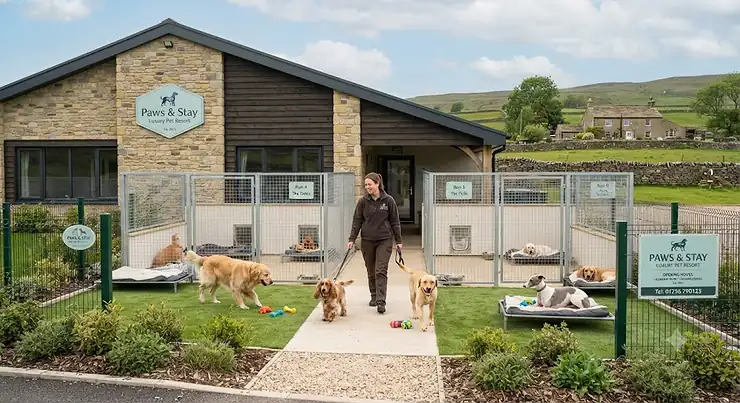
Anyone who has ever tried to hose out a badly designed dog run at seven in the morning, in the rain, with a queue of drop-offs due at nine, will tell you the same thing: the kennels you choose on day one shape every single day that follows. Commercial dog kennels for boarding business use are not garden hobby kennels wearing a suit. They are structural, load-bearing, license-scrutinised pieces of equipment that a local authority inspector will measure, a pack of excitable Labradors will test to destruction, and your bank balance will feel every time you get the spec wrong. In simple terms, commercial dog kennels for boarding business use are purpose-built housing units, runs and support systems designed to hold multiple unrelated dogs safely, hygienically and legally under the Animal Welfare (Licensing of Activities Involving Animals) (England) Regulations 2018.
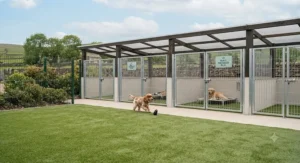
This guide walks through seven real, currently available products that cover the structural, hygiene, comfort and security sides of a boarding operation, then digs into the boarding kennel equipment decisions, the boarding business regulations you cannot dodge, the kennel capacity planning maths that determines your ceiling on income, and the customer trust and safety habits that turn first-time bookers into five-star reviewers. Whether you are converting a paddock into your first six-run site or expanding an established kennels business past twenty dogs, the goal here is the same: fewer expensive surprises, and a facility that a licensing officer, a nervous spaniel owner and your own aching back can all live with happily.
Quick Comparison Table
| Product | Category | Price Range | Best For |
|---|---|---|---|
| Doghealth 8cm Bar Dog Run Panels | Structural kennel panels | £90-£230 per panel | Modular runs, budget-conscious expansion |
| PawHut Galvanised Steel Dog Run Kennel | Prefab outdoor kennel | £130-£260 | Fast-start budget kennels |
| ANIGENE Surface Disinfectant Cleaner 5L | Hygiene & disinfection | £20-£45 | Daily cross-infection control |
| Rubberco Interlocking Rubber Kennel Tiles | Flooring | £15-£30 per m² | Joint-friendly, non-slip flooring |
| Kuranda Aluminium Chew-Proof Kennel Bed | Bedding | £110-£200 | High-turnover, chew-heavy kennels |
| Reolink RLK8-520D4-5MP PoE CCTV Kit | Security & monitoring | £280-£420 | Overnight monitoring, insurance compliance |
| “Starting Your Own Dog Home Boarding Business” (Tamsin Stone) | Business & compliance guide | £8-£15 | First-time operators, licensing prep |
A quick glance at that table tells its own story: this is not a single-product decision, it is a system. Structural panels and prefab kennels solve the “where do the dogs sleep” problem, but without decent flooring underneath, a disinfection routine around them, and a bed that survives a Staffie’s jaws, the whole set-up underperforms. Budget operators can start with the Doghealth 8cm Bar Dog Run Panels and the Rubberco Interlocking Rubber Kennel Tiles, adding the Reolink RLK8-520D4-5MP PoE CCTV Kit once cash flow allows. Premium or higher-capacity sites should budget for all seven from the outset, because retrofitting security and hygiene systems into a live, licensed kennels is far more disruptive than building them in from day one.
💬 Just one click — help others make better buying decisions too!😊
Top 7 Commercial Dog Kennels & Equipment for Your Boarding Business: Expert Analysis
1. Doghealth 8cm Bar Dog Run Panels — fully modular, escape-resistant panel system
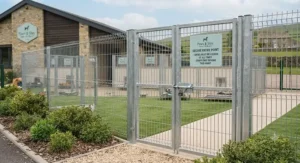
Doghealth’s bar panels are the backbone product for anyone building runs from scratch, and the standout feature is right there in the name: the 8cm bar spacing is tight enough to stop a determined terrier posting its head through the gap, which is exactly the kind of detail an inspector checks first. Built from galvanised steel with a welded frame, the panels bolt together via embedded L-brackets, and because they are sold in 2ft and 4ft widths at multiple heights, you can configure anything from a single 6ft run to a full bank of ten without buying a bespoke structure. Based on the spec comparison with cheaper welded-mesh alternatives, the bar design also resists the “weak spot chewing” that lets bored dogs bend and eventually breach thinner wire mesh over months of use. This is squarely a product for operators who want to phase their build: start with four runs, add four more next spring, and never end up with mismatched, incompatible kennel sections. Reviewers consistently report that the panels are heavier and more rigid than budget welded-mesh competitors, though several note that assembly with the floor brackets takes two people and a fair bit of patience on an uneven base.
Pros:
- ✅ Genuinely modular — expand runs without replacing existing panels
- ✅ Tight 8cm bar spacing suits small and escape-prone breeds
- ✅ Galvanised finish holds up well against daily hosing
Cons:
- ❌ Needs a properly levelled, ideally concrete base to bolt to
- ❌ Roof panels and gates are sold separately, adding to the total spend
Priced per panel in the £90-£230 range depending on height and width, a full six-run block will typically run into four figures once gates and corner panels are added — but as a long-term structural investment for a boarding business, that cost amortises over a decade or more of use, which makes it solid value.
2. PawHut Galvanised Steel Dog Run Kennel — quickest route from empty yard to licensed kennel
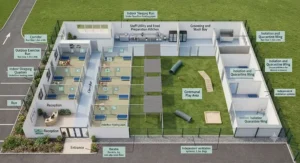
The PawHut Galvanised Steel Dog Run Kennel earns its spot here because it ships as a near-complete unit rather than a build-it-yourself panel system, and for a first-time operator racing towards a licensing inspection date, that speed matters. The standout feature is the integrated roof and part-covered run, which means new owners are not scrambling to source separate roofing after the fact. Specification-wise, the galvanised steel frame and mesh panels are rated for outdoor use, with a sloped roof that sheds rain rather than pooling it — a detail that directly affects the “adequate shelter from weather” standard assessed under UK boarding licence inspections. What most buyers overlook about this model is that its prefabricated size (commonly around 1.9m x 1.9m footprint per unit) makes it easy to plan capacity in whole-unit increments rather than guessing panel counts, which simplifies both budgeting and space planning on a new site. Aggregated review sentiment on comparable PawHut galvanised runs is generally positive on build quality for the price point, with a recurring theme that the roof and door hardware benefit from an extra check and re-tightening after the first few weeks of settling.
Pros:
- ✅ Arrives largely pre-configured, cutting build time significantly
- ✅ Sloped, part-covered roof included as standard
- ✅ Straightforward to plan capacity in whole-kennel units
Cons:
- ❌ Less flexible than panel systems if your plot shape is irregular
- ❌ Door latches often need reinforcing for persistent escape artists
Expect to pay somewhere in the £130-£260 range per unit, making this one of the more accessible entry points into commercial dog kennels for boarding business start-ups, though multi-unit sites will still want to check current pricing and bulk options before committing.
3. ANIGENE Surface Disinfectant Cleaner 5L — vet-grade, kennel-safe disinfection at scale
No boarding kennels licence survives an inspection without a credible disinfection routine, and ANIGENE Surface Disinfectant Cleaner 5L is the standout choice here because it is formulated specifically for animal environments rather than repurposed from general commercial cleaning stock. The concentrate kills bacteria, viruses, fungi and yeast without relying on bleach, ammonia or phenols, which matters practically: phenol-based products are genuinely toxic to dogs and cats if residue lingers on paws or bedding, so a formula built to be non-corrosive and animal-safe removes a real welfare risk rather than just ticking a paperwork box. Diluted correctly, a 5-litre concentrate stretches across weeks of daily kennel turnover cleaning, which matters enormously for total cost of ownership once you are running ten or more runs. Reviewers consistently note that the unscented version is the one to stock for kennels rather than the fragranced options, since strong scents can irritate a dog’s far more sensitive nose and mask, rather than solve, odour problems. Made in the UK, it is also one of the few disinfectants explicitly marketed toward kennels, catteries, breeders and daycare facilities rather than households.
Pros:
- ✅ Formulated to be safe around animals, not just effective
- ✅ Concentrate format keeps cost-per-clean low at scale
- ✅ No bleach, phenols or ammonia in the formulation
Cons:
- ❌ Requires accurate dilution — guesswork wastes product and reduces efficacy
- ❌ Contact time (typically several minutes) must be respected for full effect
At around £20-£45 for a 5-litre concentrate depending on fragrance option, this is genuinely one of the cheapest line items on this whole list relative to how central it is to both licensing compliance and disease control.
4. Rubberco Interlocking Rubber Kennel Tiles — the flooring upgrade dogs actually notice
Concrete is the default kennel floor because it is cheap and easy to hose, but the standout feature of Rubberco Interlocking Rubber Kennel Tiles is that they solve concrete’s three biggest welfare drawbacks in one product: cold conduction, slip risk, and joint impact. Manufactured from heavy-duty SBR or EPDM rubber and available in 17mm or 25mm interlocking tile format, the tiles cushion hips and elbows on landing and lying, which is particularly relevant for older boarders, large breeds already prone to joint issues, and puppies still developing their skeletal structure. Here’s what to weigh: interlocking tiles are more labour-intensive to keep spotless than a single seamless rubber roll, because waste can gather in the seams — but they win back that time by being trivially easy to lift, replace individually if damaged, and reconfigure if you resize a run later. What the spec sheet won’t tell you, but kennel operators consistently note in trade forums, is that dogs visibly prefer lying on rubber over bare concrete within the first day, settling faster and pacing less — a small behavioural signal that maps directly onto lower stress and, indirectly, fewer noise complaints from neighbouring runs.
Pros:
- ✅ Cushions joints, meaningfully reducing impact stress
- ✅ Non-slip surface even when wet, cutting fall risk
- ✅ Damaged tiles replace individually rather than the whole floor
Cons:
- ❌ Seams between tiles need more thorough scrubbing than seamless rolls
- ❌ Higher upfront cost per square metre than bare concrete
Budget roughly £15-£30 per square metre, and treat it as a welfare and injury-prevention investment rather than pure decoration — the reduction in slip-related vet call-outs alone tends to justify the spend over a season or two.
5. Kuranda Aluminium Chew-Proof Kennel Bed — the bed that survives a determined chewer
Bedding is where cheap consumer products meet their match in a commercial setting, and the Kuranda Aluminium Chew-Proof Kennel Bed stands out because its fabric-channel design physically prevents a dog from getting a direct bite on the material — the fabric is recessed into the frame rather than left as an exposed edge. Built from an all-aluminium frame rated for larger and stronger dogs, it is the heavier-duty sibling to Kuranda’s PVC-framed beds, and it is explicitly the version most commercial kennels, shelters and daycares choose once they have been through a season of replacing cheaper cushion beds. Based on the spec comparison with standard raised beds, the elevated cot design also keeps dogs off cold concrete or damp rubber flooring, improving air circulation underneath for cooler summer resting and reducing contact with any residual moisture after cleaning. Reviewers with years of kennel use consistently report that beds bought seven or more years ago are still in service, with replacement fabric — rather than a whole new bed — being the only ongoing cost, which flips the usual “buy cheap, replace often” bedding cycle on its head.
Pros:
- ✅ Chew-resistant fabric channel design, built for daily kennel abuse
- ✅ Elevated design improves hygiene and temperature regulation
- ✅ Replacement fabric extends bed life well beyond a single dog’s stay
Cons:
- ❌ Higher upfront cost than a basic kennel mat or cushion bed
- ❌ Aluminium frame adds weight versus the PVC-framed version
Expect around £110-£200 per bed depending on size, and note that buying in bulk for a full kennel run bank is where the long-term saving over disposable bedding really compounds.
6. Reolink RLK8-520D4-5MP PoE CCTV Kit — overnight eyes, insurance-friendly documentation
Security cameras are not glamorous, but the Reolink RLK8-520D4-5MP PoE CCTV Kit earns its place because it directly supports two commercial pressures every boarding kennels faces: proving what happened if a dog is injured or escapes, and reassuring nervous owners that their pet is genuinely watched overnight. The kit’s standout feature is its 8-channel PoE NVR bundled with four 5MP outdoor cameras and a 2TB hard drive, giving continuous night-vision recording without relying on Wi-Fi stability, which matters in a rural kennels location where broadband can be patchy. On paper this means you get roughly 100ft of night-vision range per camera and enough storage for weeks of rolling footage before it overwrites — in practice, that translates into a genuinely useful evidence trail for insurance claims, disputes over pre-existing injuries, and the increasingly common owner request to “just check the app and see how she’s settling in.” Reviewers consistently praise the picture clarity and motion-detection alerts, while a recurring criticism is that the free mobile app, while functional, is not as polished as some subscription-based competitors.
Pros:
- ✅ PoE wired system avoids Wi-Fi dropouts in rural kennel locations
- ✅ Night vision and motion detection cover unattended overnight hours
- ✅ 2TB storage gives weeks of footage for disputes or insurance claims
Cons:
- ❌ Wired PoE installation is more involved than a plug-and-play Wi-Fi camera
- ❌ Companion app functionality trails premium subscription rivals
Priced in the £280-£420 range for the full kit, this sits firmly in “professional infrastructure” territory rather than an optional extra — several UK insurers now ask boarding businesses directly whether CCTV coverage exists before quoting liability cover.
7. “Starting Your Own Dog Home Boarding Business” by Tamsin Stone — the compliance and business-planning primer
Not every essential purchase is steel and concrete. “Starting Your Own Dog Home Boarding Business” stands out precisely because it addresses the paperwork side that trips up more new operators than any faulty kennel panel ever will: licensing, insurance, tax registration, and writing a boarding agreement that actually protects you. Written specifically for the UK market, it walks through meeting government regulations, marketing a fledgling business, and keeping on top of the ongoing admin that a busy kennels owner otherwise pushes to the bottom of the pile. Based on the spec comparison with generic small-business guides, its value here is specificity — dog boarding licensing sits under distinct legislation with its own inspection standards, and generic “how to start a business” material simply does not cover the star-rating system or higher-standards criteria that determine your licence length. What most first-time buyers overlook is that the book’s ten worksheets function as a genuine planning tool, not just reading material, prompting you to actually calculate start-up costs and pricing before you have sunk money into the wrong kennel configuration. Aggregated feedback highlights it as a practical, no-nonsense starting point, with the main honest caveat being that regulations move on, so it should be read alongside current gov.uk guidance rather than treated as a standalone legal reference.
Pros:
- ✅ UK-specific guidance on licensing, insurance and tax registration
- ✅ Ten practical worksheets for real business and pricing planning
- ✅ Written for the exact regulatory framework covering kennels
Cons:
- ❌ Regulatory detail can date faster than the printed edition
- ❌ Business-planning content, not a substitute for structural building advice
At roughly £8-£15, it is the cheapest item on this list by a wide margin, and arguably one of the highest-leverage — a licensing rejection or a badly worded boarding agreement will cost you vastly more than the book itself.
Setting Up Your Boarding Kennels: A Practical Installation & Maintenance Guide
Getting commercial dog kennels for boarding business use physically installed is only step one; keeping them licence-ready every single day is the real job. Start with the base: a level, well-drained concrete or compacted hardcore surface is non-negotiable before you bolt down any panel system, because uneven ground stresses joints, creates pooling that undermines hygiene, and will fail an inspection outright. Once panels are up, run a first-30-days checklist covering bolt tension (steel settles and loosens after initial use), gate latch security, and drainage flow under real hosing conditions rather than a dry test. Build a maintenance rhythm around your disinfection product’s actual contact time rather than a quick wipe-and-move-on approach — most vet-grade disinfectants need several minutes of dwell time to achieve full bactericidal and virucidal action, and rushing this step is the single most common corner cut in busy kennels. A common mistake in the first month is under-ordering consumables: new operators consistently underestimate how quickly bedding, disinfectant and bowl replacements run through when occupancy climbs, so build a two-week buffer stock rather than reordering on the day you run out.
Real-World Scenarios: Matching Kennel Setups to Your Boarding Business
Picture three very different operators, all searching for commercial dog kennels for boarding business use, all needing different answers. First, the weekend converter: someone with a paddock, a day job, and six months to get licensed before quitting to run kennels full-time. Their priority is a phased build — starting with the Doghealth 8cm Bar Dog Run Panels for four runs, basic Rubberco Interlocking Rubber Kennel Tiles, and the ANIGENE Surface Disinfectant Cleaner 5L to nail the hygiene standards inspectors check first, expanding structurally as bookings and confidence grow. Second, the family taking over a struggling twelve-run site: here the priority flips toward fast compliance and reassurance, meaning the PawHut Galvanised Steel Dog Run Kennel units for a quick capacity boost, paired immediately with the Reolink RLK8-520D4-5MP PoE CCTV Kit to rebuild trust with an existing but wary customer base inherited from the previous owner. Third, the premium “doggy hotel” operator targeting affluent, image-conscious clients who tour the facility before booking — for them, every visible touchpoint matters, so the Kuranda Aluminium Chew-Proof Kennel Bed in every run and immaculate rubber flooring throughout are non-negotiable brand signals, not luxuries.

Your Kennel Buying Decision Framework
If you are choosing between structural systems first: choose modular bar panels when your plot is irregular or you plan to expand in stages, because they adapt without waste. If speed to licensing matters more than flexibility: choose prefabricated galvanised units, because they compress build time into days rather than weeks. If your existing customer base has raised safety concerns: prioritise CCTV and disinfection upgrades over cosmetic ones, because trust rebuilds faster through demonstrated safety than through new paint. If your margins are tight in year one: sequence spend as structure, then hygiene, then flooring, then bedding, then security — in that order — since licensing hinges on the first two, and the remainder can be phased in as occupancy revenue arrives.
What Is Commercial Dog Kennels for Boarding Business Equipment, Exactly?
The full answer sits across structure, hygiene, comfort and monitoring, but the short version is worth repeating: commercial dog kennels for boarding business use means any housing, run, flooring, disinfection, bedding or security product specified to hold multiple dogs safely, meet UK licensing welfare standards, and survive daily commercial-intensity use rather than occasional domestic wear. The dog kennel boarding licensing statutory guidance sets out precisely which physical and operational standards this equipment needs to satisfy before a local authority will issue a licence at all.
How to Choose Commercial Dog Kennels for a Boarding Business
- Confirm your licence category first. Kennel boarding, home boarding and dog day care sit under different statutory guidance with different minimum standards, so specify equipment against the correct category before buying anything.
- Size runs to the dog, not the average. Minimum run dimensions scale with dog size under welfare regulations, so plan for your largest expected boarder in every run, not a generic mid-size assumption.
- Prioritise drainage and disinfection compatibility. Choose flooring and panel materials that a vet-grade disinfectant can actually penetrate and rinse clean, not just materials that look tidy.
- Separate structural budget from ongoing consumables budget. Panels and prefab units are one-off capital spend; disinfectant, bedding replacement and consumables are recurring — budget both honestly.
- Build in redundancy for isolation. Higher licence standards expect a means of isolating a sick or incoming dog, so plan at least one flexible run for this from the outset rather than retrofitting later.
- Factor security and evidence into the spec. CCTV coverage increasingly affects both insurance premiums and dispute resolution, so treat it as core infrastructure, not an afterthought.
- Plan for growth in modular increments. Whichever structural system you choose, make sure it can expand without replacing what you have already paid for.
Kennel Capacity Planning: How Many Runs Does Your Business Need?
Kennel capacity planning is where enthusiasm most often outruns arithmetic. The instinctive approach — “how many runs can this plot physically fit” — is the wrong starting question; the right one is “how many bookings can I realistically staff, clean and exercise properly per day.” A single competent handler can typically manage attentive care for somewhere in the region of eight to twelve dogs per shift, once feeding, walking, cleaning and administering medication are all accounted for, so a twenty-run site is really a two-to-three-staff commitment, not a solo operation with a bigger yard. Layer occupancy seasonality on top: school holiday and Christmas periods can push bookings toward full capacity while quieter months sit at a fraction of that, so sizing purely for peak demand risks paying for empty, disinfected runs most of the year. A sensible framework is to build your minimum viable capacity first — enough runs to cover realistic average bookings plus a buffer of roughly 20% — and treat any expansion beyond that as a second-phase build funded by first-year trading, rather than a single oversized up-front investment that strains cash flow before you have a single review to your name.
Boarding Kennel Equipment Checklist: Features That Actually Matter (And Those That Don’t)
Marketing copy around boarding kennel equipment loves to highlight colour options and decorative roofing, but inspectors and dogs care about neither. What actually matters: bar or mesh spacing appropriate to the smallest breed you will board, drainage gradient that clears standing water within minutes of hosing, disinfectant compatibility with the flooring material you choose, and secure double-gate or airlock entry systems that prevent a bolting dog reaching a public area. What matters far less than buyers assume: premium paint finishes, elaborate roofline designs, and branded kennel signage — nice for photographs, irrelevant to welfare compliance or dog wellbeing. Reviewers who have been through a licensing inspection consistently note that officers spend far more time checking drainage, ventilation and isolation provision than they spend admiring aesthetics, a useful reality check when a supplier tries to upsell decorative extras ahead of functional ones.
Common Mistakes When Buying Boarding Kennel Equipment
The single most common mistake is buying structural kennels before confirming licensing requirements with the local authority, only to discover a run falls short of minimum size or an isolation space is missing, forcing an expensive retrofit. A close second is underestimating flooring’s role in welfare scoring — many new operators treat flooring as cosmetic and default to bare concrete, then find themselves adding rubber matting reactively after an inspection flags joint-injury risk on hard surfaces. Third, buyers frequently under-spec disinfection, choosing a general-purpose cleaner over a formulation genuinely tested for animal environments, which can either fail to control kennel cough transmission or, worse, leave residues that irritate paws and airways. Finally, many first-time operators delay CCTV installation until after an incident forces the issue, rather than building it in from day one when it is far cheaper to wire and far more reassuring to prospective customers browsing your listing.
Boarding Kennels vs Home Boarding: Which Business Model Wins?
Commercial dog kennels for boarding business use and home boarding are licensed under related but distinct standards, and the choice between them is really a choice about scale, liability and lifestyle. Kennel boarding supports far higher capacity — a well-designed site can house dozens of unrelated dogs safely with proper separation — but demands significant upfront capital in structure, flooring, hygiene and security equipment, plus ongoing staffing. Home boarding, by contrast, needs almost none of that structural spend, since dogs typically stay within a family home environment, but capacity is inherently limited (commonly capped around three to four dogs at a time under standard licensing conditions) and the operator’s own home absorbs all the wear, mess and risk that a purpose-built site would otherwise contain. For an operator with capital and an appetite to manage staff, kennel boarding scales into a genuine business; for someone prioritising flexibility and lower start-up cost, home boarding offers a gentler entry point with a hard ceiling on growth.
Building Customer Trust and Safety Into Every Booking
Customer trust and safety is not a marketing slogan in this industry; it is the entire product, because owners are handing over a family member they cannot supervise themselves. Practical trust-building starts with transparency: publishing your licence number and star rating, since these are public record and increasingly checked before booking. It continues with visible hygiene routines — a disinfection schedule that owners can see evidence of during a facility tour speaks louder than any claim in a brochure. CCTV coverage, communicated clearly rather than hidden in small print, reassures anxious owners and gives you an evidence trail if a dispute ever arises. Vaccination requirements deserve equally clear communication: reputable UK boarding kennels routinely require up-to-date core vaccinations plus kennel cough cover, and the BSAVA vaccination guidance is a useful reference point when setting or explaining your own policy to nervous first-time customers. Finally, a written boarding agreement covering medical emergencies, medication administration and unexpected costs protects both parties and, handled well, actually increases trust rather than feeling bureaucratic.
Safety, Regulations & Compliance: UK Boarding Business Licensing Guide
Boarding business regulations in England sit under the Animal Welfare (Licensing of Activities Involving Animals) (England) Regulations 2018, which replaced the older Animal Boarding Establishments Act framework and introduced the star rating system now used to assess every licensed kennels, cattery and home boarder. Every commercial operator must hold a licence from their local authority before accepting a single paying booking — operating unlicensed is a criminal offence, not a grey area. Licences run for up to three years depending on your assessed risk and welfare standard, with low-risk, high-standard operators earning the maximum term and lower-scoring businesses facing shorter licences and more frequent inspection. Wales and Scotland currently continue to license under the older Animal Boarding Establishments Act 1963, so cross-border operators need to check which framework applies to each site rather than assuming uniform UK-wide rules. Beyond licensing, insurers, business rates, food hygiene (if you offer feeding services beyond an owner’s own supplies), and employment law if you take on staff, all layer additional compliance obligations on top of the core animal welfare licence — treating boarding business regulations as a one-off application rather than an ongoing operational discipline is one of the fastest routes to a shortened licence or a failed renewal.
Long-Term Cost & Maintenance of a Boarding Kennel Business
Total cost of ownership for commercial dog kennels for boarding business use extends well past the initial structural spend. Panels, prefab units and flooring are largely one-off capital costs, amortising over a decade or more with basic upkeep, but disinfectant, bedding replacement, licence renewal fees, insurance premiums and staffing represent a recurring annual outlay that dwarfs the initial build within a few years of operation. A useful way to frame return on investment is cost-per-boarding-night: divide your total annual running cost by realistic annual occupied nights, and compare that figure against your pricing to see genuine margin rather than headline day-rate income. Equipment choices ripple through this calculation directly — a chew-proof bed that lasts seven years costs less per year than a cheap cushion replaced every few months, and a disinfectant concentrate that stretches further reduces cost-per-clean meaningfully once you are running double-digit occupied runs daily. Maintenance discipline protects that investment: a simple weekly structural check of bolts, gates and drainage, alongside a documented cleaning log, both extends equipment life and gives you ready evidence at licence renewal time.
✨ Ready to Spec Out Your Own Boarding Kennels?
🔍Compare the products above against your site plan, confirm your licensing category with your local authority, and start with the structural and hygiene basics before adding the extras — a properly sequenced build saves both money and stress.
FAQ
❓ What licence do I need for a commercial dog boarding kennels business in the UK?
❓ How much does it cost to set up commercial dog kennels for a boarding business?
❓ How many dogs can one member of staff care for in a boarding kennels?
❓ What vaccinations do dogs need before boarding in commercial kennels?
❓ Is rubber flooring worth it for a dog boarding kennels business?
Conclusion
Building or upgrading commercial dog kennels for boarding business use always comes down to the same layered decision: structure first, hygiene and safety close behind, comfort and monitoring completing the picture. The seven products covered here — from Doghealth 8cm Bar Dog Run Panels and the PawHut Galvanised Steel Dog Run Kennel through to ANIGENE Surface Disinfectant Cleaner 5L, Rubberco Interlocking Rubber Kennel Tiles, the Kuranda Aluminium Chew-Proof Kennel Bed, the Reolink RLK8-520D4-5MP PoE CCTV Kit and “Starting Your Own Dog Home Boarding Business” — cover that full stack whether you are launching a modest four-run site or scaling an established kennels business. Kennel capacity planning and boarding business regulations deserve just as much attention as the equipment itself, because a beautifully built kennels that fails its licence application, or is staffed beyond what welfare standards allow, is not a business at all. Get the sequencing right, document your compliance as you go, and let customer trust and safety guide every purchasing decision, and the equipment choices above will serve your kennels — and the dogs in it — for years to come.
🐾 Start Building Your Boarding Kennels the Right Way
🔍 Take another look at the seven picks above, check current pricing and availability, and match each one against your own site plan and licensing category. The right equipment, bought in the right order, is what turns a converted paddock into a genuinely trusted boarding business your customers recommend.
Recommended for You
- Affordable Commercial Kennel Setup Under £800: 7 Real UK Picks 2026
- Commercial Kennels Under £1000: 7 Real Options for 2026
- Double Dog Kennel for Breeders: 7 Brilliant Picks for 2026
Disclaimer: This article contains affiliate links. As an Amazon Associate, I earn from qualifying purchases. If you purchase products through these links, we may earn a small commission at no additional cost to you
✨ Found this helpful? Share it with your friends! 💬🤗
