
In This Article
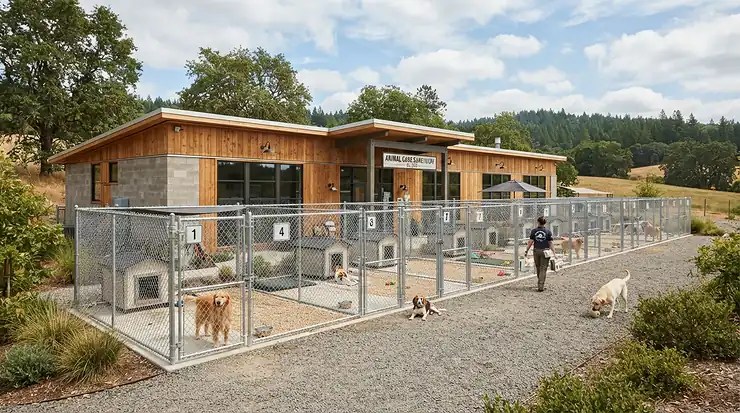
A commercial dog kennel is a purpose-built, licensed facility where dogs are housed for a fee, usually for boarding, day care, breeding or rehoming. Unlike a garden kennel, it must meet strict legal standards on space, hygiene, security, staffing and record-keeping, and your local council inspects all of it.

Here’s what nobody mentions at the start of the commercial dog kennel dream. The romantic part (dogs! cuddles! a Labrador asleep on your foot!) is roughly a fifth of the job. The rest is drainage, disinfectant schedules and spreadsheets. If you’re weighing up a commercial kennel as a business, think of this guide as the sober, slightly sarcastic friend who has read the small print so you don’t have to.
In England, commercial boarding falls under the Animal Welfare (Licensing of Activities Involving Animals) (England) Regulations 2018. The statutory guidance for local authorities explains what inspectors actually look for.
Below you’ll find a kennel business starter guide, a frank look at kennel business types and initial investment costs, advice on choosing a kennel supplier, and seven real products from Amazon UK that earn their place around a business dog kennel.
One honest caveat first. The main kennel units (a sleeping area with an attached run) come from specialist manufacturers, not Amazon baskets. Amazon does the supporting cast brilliantly: transport crates, isolation kennels, pens and runs. That’s what we compare here. I haven’t hands-on tested any of them, so the analysis rests on specifications, the licensing rules and what real reviewers report.
Commercial Dog Kennel Quick Comparison: 7 Supporting Buys at a Glance
| Product | Role in a Kennel Business | Best For | Price Range* |
|---|---|---|---|
| Ellie-Bo Standard Folding Crate (36-inch) | Van and reception crate | Tight budgets, collection services | around £45–£70 |
| Savic Dog Residence | Sturdy transport and holding crate | Medium breeds, long-term use | around £60–£150 |
| MidWest iCrate (42-inch) | Large-dog holding crate | Calm large dogs, flexible layouts | around £60–£95 |
| MidWest Ultima Pro | Heavy-gauge crate | Strong, determined dogs | around £90–£180 |
| Petmate Ultra Vari Kennel | Isolation and nervous-arrival kennel | Quiet recovery space | around £50–£170 |
| Ellie-Bo Heavy Duty Play Pen | Modular pen | Day care, whelping, reception | around £60–£130 |
| PawHut Outdoor Dog Run | Covered outdoor run | Home-based starters, day care | around £120–£350 |
*Indicative ranges at the time of research; sizes vary and prices change, so check the current price.
Looking at the comparison above, the Ellie-Bo Standard Folding Crate (36-inch) wins on cost per crate. If your clients include powerful breeds, though, the extra spend on the MidWest Ultima Pro buys a thicker wire gauge. The Petmate Ultra Vari Kennel is the odd one out, being enclosed plastic rather than wire, and that is exactly its value for nervous or unwell dogs.
💬 Just one click — help others make better buying decisions too!😊
Top 7 Commercial Dog Kennel Equipment Picks: Expert Analysis
1. Ellie-Bo Standard Folding Crate (36-inch) — budget workhorse for transport
If a commercial kennel had a utility player, this would be it. The 36-inch model (EB-BLACKS36) folds flat and the packed listing weight is roughly 12 kg, so one person can load it into a van without a chiropractor on standby. Two doors and dual sliding latches make positioning flexible, and the removable alloy-steel tray slides out for disinfecting between dogs. That matters when licence guidance expects kennels to be disinfected at every change of occupancy.
Based on the spec sheet, this is a collection-and-delivery crate or a reception holding space, not a boarding bed. The guidance says transport crates must let a dog stand, lie down and turn round, with good ventilation and a firm fixing. A 36-inch suits medium breeds, not a Newfoundland.
Reviewers consistently describe it as sturdy and good value, and they like the sizing guidance. Two cautions turn up: one reviewer found a metal sliver from a weld on the 30-inch, and another warns that trays rust if left wet.
Pros:
- ✅ Light enough for one-person van loading
- ✅ Removable tray speeds up disinfection
- ✅ Two doors give flexible placement
Cons:
- ❌ Standard-duty wire for strong chewers
- ❌ Trays need drying to avoid rust
Expect to pay around £45–£70; check the current price. Verdict: the best entry-level value on this list.

2. Savic Dog Residence — thick-bar reputation that lasts
The standout here is longevity. Reviewers repeatedly say the bars feel thicker than rival brands, and one owner reports two crates still looking good after more than a decade. The cage is metal mesh with a removable plastic tray, folds in a few movements and has two carry handles. Sizes run from compact (76 x 53 x 61 cm) up to 107 cm.
That plastic tray wipes down easily, which suits a hygiene-obsessed business, though a determined chewer may target it. The manufacturer’s own guidance says the Residence should be used on a temporary basis only. That actually fits a kennel business well, because it’s a holding and transport crate, not a bedroom.
Reviewer sentiment is mostly warm, but not uniformly so. One buyer received a crate with rust and peeling paint, another struggled with hidden assembly instructions, and a third said the height didn’t match the listing. Check dimensions against your van before ordering.
Pros:
- ✅ Reviewers praise sturdy, thick bars
- ✅ Removable plastic tray cleans quickly
- ✅ Folds flat with carry handles
Cons:
- ❌ Heavy for one-handed moving
- ❌ Occasional finish and listing-accuracy complaints
Prices rise with size, from around £60 to £150. Verdict: good mid-range value if you want fewer replacements.
3. MidWest iCrate (42-inch) — flexible large-dog holding crate
This is the crate that appears at the top of most roundups, and for good reason. The 42-inch size accommodates large breeds, includes a divider panel and a leak-proof tray, and folds flat without tools. Slide-bolt latches keep it secure.
The catch, which editorial reviewers flag, is that the wire gauge is standard rather than heavy-duty. The spec sheet won’t tell you that a Houdini-type dog may need cable ties at the corners or a different crate entirely. For calm dogs the MidWest iCrate is lighter and easier to move around a kennel block than heavier wire.
Reviewers commonly describe it as dependable for house-trained, relaxed dogs and less so for escape artists. Strong breeds are the recurring caveat.
Pros:
- ✅ Folds flat with no tools
- ✅ Divider panel adds size flexibility
- ✅ Lighter than heavy-gauge alternatives
Cons:
- ❌ Standard gauge wire, not heavy-duty
- ❌ May need reinforcing for strong dogs
Typically around £60–£95 depending on size and retailer. Verdict: the sensible default for calm large dogs.
4. MidWest Ultima Pro — thickest wire gauge in the range
This is where you go when the iCrate worries you. The manufacturer describes it as professional-gauge steel, with 7 and 9 gauge wire, designed for chewers and stronger dogs. Two slide-bolt latches per door, a divider and a leak-proof pan are included.
Thicker wire means heavier crates. Reviewers say so plainly, with one finding it too heavy to travel with unless it stays built in the vehicle, and another liking the weight as an anchor for pen walls. Opinion on the latches differs: one editorial review suggests they may not hold against a very powerful escape artist, while a rescue-foster reviewer says it contained a notoriously determined dog. Availability on amazon.co.uk can vary, so check listings.
Pros:
- ✅ Heaviest-duty wire in the MidWest range
- ✅ Multiple doors suit corner positioning
- ✅ Weight adds stability
Cons:
- ❌ Too heavy for frequent carrying
- ❌ Reviewer opinion on latches is mixed
Expect around £90–£180 depending on size. Verdict: worth it for strong dogs, overkill for spaniels.
5. Petmate Ultra Vari Kennel — enclosed calm for nervous dogs
The standout is privacy. The plastic shell, metal door and wire vents create a den-like space, and the listings describe it as built to suit IATA standards. Guidance says each dog must be able to avoid visual contact with other dogs, so an enclosed kennel is genuinely useful for anxious arrivals, post-op recovery or an isolation corner (check airline rules separately for any air transport).
Sizes include a medium (32 x 22.5 x 24 inches) for 30–50 lb dogs and a large (48 x 32 x 35 inches) for 90–125 lb dogs. US listings carry ratings of around 4.3–4.5 stars from several hundred reviews. Reviewers praise sturdiness, and one says an anxious dog couldn’t tear it apart. Common complaints are hard-to-clean grooves, no top handle on some sizes and a door lock that failed on one unit.
Pros:
- ✅ Enclosed, den-like and calming
- ✅ Strong shell resists chewing
- ✅ Moulded moat contains spills
Cons:
- ❌ Grooves trap dirt and slow cleaning
- ❌ Lock durability reported as patchy
Expect around £50–£170 depending on size. Verdict: a smart niche buy.

6. Ellie-Bo Heavy Duty Play Pen — modular and properly solid
This is the flexible one. Six modular panels at 80 cm high let you build a pen to fit whatever corner, reception area or whelping space you have, and you can add extra sections.
The panels are heavy, and for once that’s a feature. A reviewer says the sturdy construction matters because a rickety enclosure unnerves animals, and another uses extra sets when looking after additional family pets. The honest limitation is height. Eighty centimetres suits pups and small to medium dogs, but athletic jumpers will clear it. This is a day-care or reception tool, not a licensed boarding run, since boarding units must meet fixed sizes and security standards.
I couldn’t verify a large pool of reviews specific to commercial use, so treat the sentiment above as domestic-use feedback.
Pros:
- ✅ Modular layout adapts to any space
- ✅ Heavy, stable panels resist knocking
- ✅ Extra sections can be added
Cons:
- ❌ 80 cm too low for jumpers
- ❌ Panels are bulky to store
Typically around £60–£130. Verdict: great value for day care and whelping flexibility.
7. PawHut Outdoor Dog Run — covered space for home-based starters
The standout is the weatherproof roof. These runs use galvanised steel frames with a UV-resistant cover and a lockable door, and some versions include rotating feeder bowls. Licence guidance expects a waterproof roof over at least half of any exercise run, so the canopy is relevant.
There’s a spec to scrutinise, though. Several listings I checked show a 6.5 cm mesh. Statutory guidance caps square mesh at 50 x 50 mm where dogs can access it, so these runs don’t fit the guidance as licensed kennel runs. They also rely on cable ties and steel wire for fixing. Versions vary, so verify current dimensions. They’re better suited to day care, a home-based service or supervised exercise.
I couldn’t verify enough UK reviews to summarise honestly, so read current feedback on assembly and gate latches before buying.
Pros:
- ✅ Galvanised frame resists rust
- ✅ Roof cover offers shade and shelter
- ✅ Lockable door adds basic security
Cons:
- ❌ Mesh may exceed licensing limits
- ❌ Assembly looks fiddly
Typically around £120–£350 depending on size. Verdict: useful, but check mesh specs before relying on it commercially.
✨ Don’t Miss These Exclusive Deals!
🔍 Take your commercial kennel kit to the next level with these carefully selected products. Click on any highlighted item to check current pricing and availability, and build a setup your clients will trust!
Kennel Business Starter Guide: Your First 90 Days
Think of this kennel business starter guide as a three-act play, minus the dramatic pauses.
Days 1–30: validate and check the law. Phone your local council’s licensing team before you buy a single crate. Ask whether your site needs planning permission, because it often does. A Derbyshire couple reportedly built four kennels, then learned after an enforcement visit that they needed change-of-use consent. Register with a vet who can handle your caseload, since the guidance expects this. Then request insurance quotes.
Days 31–60: build and write. Order your main kennel units from a specialist supplier. Write your procedures, because licensing requires written processes for feeding, cleaning, transport, disease control and the death or escape of an animal. Draft an emergency plan covering fire and heating breakdowns. Buy the supporting kit from this guide: crates for the van, an isolation kennel, pens for reception.
Days 61–90: soft launch. Take a few friendly regulars first. Build your register (arrival dates, microchip numbers, vaccination records, emergency contacts) and keep records for at least three years. Practise your emergency drill with whoever works for you.
A practical tip: photograph everything, because your records and inspection notes can save you hours. Treat this kennel business starter guide as a checklist, then adapt it to your council’s specific rules.

Real-World Scenarios: Three Kennel Owners, Three Budgets
Scenario 1: the rural barn conversion. You’re converting a farm outbuilding into eight boarding units on a mid-range budget, open year-round. The main units come from a specialist supplier. From Amazon, you’d want a Ellie-Bo Standard Folding Crate (36-inch) for the collection van and a Petmate Ultra Vari Kennel for nervous or unwell dogs. Add a MidWest iCrate (42-inch) for large arrivals waiting at reception.
Scenario 2: the suburban day-care starter. You’ve got a secure garden, a small budget and 8–10 regular dogs, five days a week. Day care has its own licence conditions, and the guidance states that day-care activity must be assessed separately. Your best buys are the Ellie-Bo Heavy Duty Play Pen for puppy sessions and a Savic Dog Residence for quiet downtime between play. Treat the PawHut Outdoor Dog Run as a supplementary exercise area, not a licensed boarding unit.
Scenario 3: the groomer adding boarding. You already have premises and regulars. Strong breeds come through your door, and you can’t have a Husky testing weak wire. Invest in a MidWest Ultima Pro for those dogs and a Petmate Ultra Vari Kennel for stressed clients. These suit short stays, not licensed overnight units.
Commercial Kennel vs Business Dog Kennel: Is There a Difference?
In casual conversation, a commercial kennel and a business dog kennel get used interchangeably. In practice, the distinction is useful.
A commercial kennel is the physical thing: the building, the units, the runs, the drains. It’s measured in square metres, headroom and mesh gauge. A business dog kennel is the operating enterprise: the licence, the insurance, the staff, the brand, the booking system and the reputation. You can own beautiful commercial kennels and still run a rubbish business dog kennel, and vice versa for about six minutes before the inspector arrives.
Why does this matter? Because buyers often over-invest in the first and under-invest in the second. The statutory guidance expects documented training policies, written procedures and 24-hour checks as much as it expects sturdy walls. A gleaming building without a trained team and clear records won’t earn a good star rating.
The practical takeaway is to budget for both. Put money into commercial kennel construction, then ring-fence a proportion for the operating side: insurance, staff training, software and marketing. Our initial investment costs section below shows how those lines stack up.
Kennel Business Types: Which Model Suits You?
Understanding kennel business types early saves expensive U-turns. Under the English regulations, boarding in kennels, home boarding and day care for dogs are separate licensable activities, while dog breeding is covered by its own schedule.
| Model | Setup Demands | Income Pattern | Best For |
|---|---|---|---|
| Boarding kennel | Highest: purpose-built units, runs, staff | Holiday-driven peaks | Owners with land and capital |
| Home boarding | Lower: safe domestic setting | Smaller, steadier | Solo operators |
| Day care | Medium: play areas, supervision | Weekday regulars | Suburban sites |
| Breeding kennel | Specialist: separate licence and units | Sales-based | Experienced breeders |
Looking at this comparison, boarding kennels demand the most capital but offer the most scalable capacity. Day care is easier to start but needs dependable staffing every weekday. One rule that catches people out: units housing rescue or breeding dogs must be kept separate from boarding units, with extra disease-control precautions. Mixing business types under one roof needs careful planning, not wishful thinking.
Initial Investment Costs: What to Budget Before Opening
Initial investment costs vary wildly depending on whether you convert an existing building or build new. The table below gives planning categories, not quotes, so get at least three written quotes for anything significant.
| Cost Category | Indicative Range | Notes |
|---|---|---|
| Council licence | Varies by council | Oxford lists £380 plus vet fee |
| Planning and professional fees | Low hundreds to low thousands | Depends on site |
| Main kennel units and groundwork | Typically the biggest line | Quote per unit |
| Supporting kit (crates, pens, bedding) | Hundreds to low thousands | Items from this guide |
| Insurance | Annual premium | Depends on size and dog numbers |
| Working capital | A few months of costs | Slow starts are normal |
The headline figure is the council licence. As an example, Oxford City Council’s published fee for boarding cats and/or dogs is £380 plus a vet fee where required (from 1 April 2025). Other councils publish different tables, so check yours.
Interpreting the table, the licence is the smallest big number and the building is the biggest. The mistake isn’t underestimating the kennel units, it’s forgetting working capital. Because new businesses rarely fill from day one, many owners are surprised by how long that cushion has to last. Keep initial investment costs honest by asking suppliers for fully installed prices, not just unit prices.
How to Choose a Commercial Dog Kennel: 6 Steps
To choose a commercial dog kennel, start with licence compliance, then check size, materials, security, climate control and expandability. Here’s the order I’d use:
- Start with the licence conditions. For new builds, each kennel unit’s sleeping area must be at least 1.9 square metres, with an attached run. A 42-inch crate is roughly 0.76 square metres, which is why crates can’t replace units.
- Check surfaces and drainage. Interior surfaces should be smooth, waterproof and non-slip. Drains must keep standing water out and stop toes and claws catching.
- Test the security. Look for two physical barriers between a dog and the outside world. Mesh must be at least 2 mm wire and no larger than 50 x 50 mm squares.
- Plan the climate. Insulation and ventilation should keep part of the sleeping area between 10°C and 26°C.
- Design the layout for people too. Units need at least 1.8 metres of headroom, and facing units need a corridor ideally 1.2 metres wide.
- Think ahead. Modular designs let you add units when demand grows, rather than rebuilding.

Choosing a Kennel Supplier: What to Ask Before You Sign
Choosing a kennel supplier is closer to hiring a builder than buying a product, so treat it that way. UK manufacturers describe themselves in different ways. Easy Animal in Stone, Staffordshire, says it makes insulated, thermal kennels fitted with high-security locks. Kennelstore describes itself as a large dog-housing retailer offering delivery and fitting, and The Dog House markets insulated kennel systems. These are the companies’ own claims, so verify them with references.
Questions worth asking:
- Does the design meet the current statutory guidance? Ask them to show how, not just say so.
- What is the insulation specification? Remember the 10–26°C expectation.
- Is installation included? Fully installed pricing prevents nasty surprises.
- Can I speak to a recent customer? A licensed kennel owner will tell you what the brochure won’t.
- What are the lead times and warranty terms?
My honest read: choosing a kennel supplier on price alone is the classic mistake, because the cheapest quote often leaves out groundwork, drainage or fitting. Compare like for like, and make sure your council licensing officer is happy with the plans before you pay a deposit.
Safety, Regulations and Licensing: What Inspectors Check
Here’s a plain-English tour of the conditions in Schedule 4 of the 2018 Regulations and the supporting guidance.
Staffing. The guidance says each member of staff should care for 25 dogs or fewer. The required higher standard is at least one full-time member of staff for every 15 dogs kept.
Health. Dogs need current vaccinations against parvovirus, distemper, hepatitis and leptospirosis, with primary courses finished at least two weeks before boarding. You must have an isolation facility for sick or infectious dogs, or a written arrangement with a vet.
Hygiene. Occupied kennels are cleaned daily, disinfected at least weekly and at every occupancy change. Faeces are removed at least twice a day.
Exercise. Dogs need to be exercised away from their kennel at least once daily, and no more than six dogs per person can be walked at once.
Emergencies. You’ll need a written emergency plan, fire detection and a designated key holder within 30 minutes’ travel.
This guidance applies to England. Wales, Scotland and Northern Ireland have different rules, so check locally. The practical lesson is that compliance is a daily habit, not a one-off inspection.
Common Mistakes When Buying for a Commercial Dog Kennel
Mistake 1: treating crates as kennel units. As covered, a crate is nowhere near the 1.9 square metre sleeping area. Use crates for transport and holding.
Mistake 2: buying before checking planning. Building first and asking later is how enforcement letters happen.
Mistake 3: ignoring mesh specifications. That attractive run with 6.5 cm mesh might look fine and still fail the 50 x 50 mm rule.
Mistake 4: skimping on isolation. One infectious dog without a separate space can empty a kennel block. The Petmate Ultra Vari Kennel is a handy short-term solution, but you still need the proper isolation arrangement.
Mistake 5: underestimating weight. The MidWest Ultima Pro is superb at resisting chewing, but reviewers say it’s heavy. If you’ll move it daily, you’ll regret it.
Mistake 6: forgetting the people. Training policies, records and staffing ratios matter as much as steel. Facilities without documentation struggle at inspection regardless of how good the units look.
Long-Term Cost and Maintenance: The Bit Brochures Skip
Running costs are where a business dog kennel proves itself. Daily cleaning, weekly disinfection and occupancy-change cleaning all consume time and chemicals. Disinfectants must be virucidal as well as bacteriocidal, which affects what you buy.
Equipment ages too. Trays can rust if left wet, as an Ellie-Bo Standard Folding Crate (36-inch) reviewer warned, so build drying into the routine. Plastic items like the Petmate Ultra Vari Kennel need scrubbing in their grooves. The Savic Dog Residence and MidWest iCrate (42-inch) should be checked for loose welds and latch wear, and any sharp edge is a licence issue as well as a welfare one.
On the financial side, licensing generally applies when boarding is run as a business, and councils often reference HMRC’s trading allowance guidance when deciding what counts. Speak to an accountant about your own position.
A sensible habit is a monthly equipment walk-round with a simple checklist: latches, welds, trays, panels, hinges. Replacing a £50 crate is far cheaper than an injury claim.

FAQ
❓ How much does a commercial dog kennel licence cost?
❓ Do I need planning permission for a commercial dog kennel?
❓ Can I use crates instead of proper kennel units for boarding?
❓ How many dogs can one staff member look after?
❓ What temperature should a commercial kennel stay at?
Conclusion
A commercial dog kennel is a serious business, and the good news is that seriousness can be learned. Start with the law: licence conditions, planning, staffing and records. Choose your main units from a specialist supplier who can show how they meet the guidance, and budget realistically for initial investment costs, including that dull but vital working capital.
Then fill in the supporting cast sensibly. The Ellie-Bo Standard Folding Crate (36-inch) and MidWest iCrate (42-inch) cover everyday transport and holding. The Savic Dog Residence suits owners who want durability, and the MidWest Ultima Pro handles the strong-willed. The Petmate Ultra Vari Kennel gives anxious dogs a calmer corner, the Ellie-Bo Heavy Duty Play Pen adds flexible day-care space, and the PawHut Outdoor Dog Run can supplement exercise provision, provided you’ve checked mesh specifications first.
If you remember one thing, make it this: crates and runs support a licensed kennel, they don’t replace it. Get that right and you’ll avoid the costliest mistakes.
✨ Ready to Equip Your Kennel?
🐾 Click on any highlighted product above to check current pricing and availability, then build a kit that keeps dogs safe, calm and comfortable. Your future regulars are already waiting!
Recommended for You
- Grooming Business Kennel: 7 Proven Picks For UK Salons (2026)
- Dog Daycare Kennel Setup: 7 Essential Buys For UK (2026)
- Boarding Kennel Equipment: 7 Essential Buys For UK Owners (2026)
Disclaimer: This article contains affiliate links. As an Amazon Associate, I earn from qualifying purchases. If you purchase products through these links, we may earn a small commission at no additional cost to you.
✨ Found this helpful? Share it with your friends! 💬🤗
