
In This Article
Somewhere between “my dog needs a bit of outdoor space” and “the felt has peeled off the roof again,” most British owners have a small moment of reckoning. A weatherproof dog kennel sounds like a simple purchase — four walls, a roof, done — until you actually live through a Welsh February with one. Rain doesn’t fall in this country so much as it commutes, arriving daily, sideways, and with real intent. If the kennel you bought was designed with a fair-weather country in mind, it will tell on you within a season: a soggy floor, a musty smell, a dog who’d rather sleep on the patio.
So what is a weatherproof dog kennel? It’s an outdoor shelter built with sealed or treated materials, a sloped and waterproofed roof, raised or insulated flooring, and enough structural rigidity to resist wind-driven rain, standing water, and temperature swings — keeping the interior genuinely dry rather than just “roofed.” That distinction between roofed and dry matters enormously here, because the UK racks up around 156 days of rain a year on average, and that’s before you factor in the extra soaking that western and upland regions get from Atlantic weather systems, as the Met Office explains in its rainfall guidance.
This guide walks through seven real kennels sold in the UK right now — wooden, plastic, and steel — with honest analysis of how each holds up against wind, damp, and the particular cruelty of a British December. You’ll get a straight comparison table, a proper look at felt versus shingle roofing, timber treatment advice, guttering tricks nobody puts in the product description, and a decision framework so you’re not guessing. Full affiliate disclosure: this post contains Amazon Associates links, and if you buy through one we may earn a small commission at no extra cost to you.
Quick Comparison: Weatherproof Dog Kennels at a Glance
| Kennel | Material | Roof Type | Best For | Price Guide |
|---|---|---|---|---|
| PawHut Wooden Dog Kennel (109L) | Fir wood | Asphalt/felt-style shingle | Budget wooden all-rounder | Under £150 |
| VOUNOT Wooden Dog House | Pine/fir | Waterproof sloped felt roof | Compact gardens, small-medium dogs | Under £120 |
| Confidence Pet Wooden Kennel with Water Bowls | Furniture-grade wood | Felt-covered pitched roof | Mid-range with built-in storage | £150-£250 range |
| Easipet Plastic Kennel (940) | Moulded plastic | Sealed one-piece plastic roof | Zero-maintenance, wipe-clean | Under £100 |
| PawHut Weatherproof Plastic Dog House | HDPE plastic | Integrated waterproof roof | Small dogs, damp gardens | Under £120 |
| vidaXL Galvanised Steel Dog House | Galvanised steel | Weather-resistant metal roof | Chewers, exposed coastal gardens | £200-£350 range |
| vidaXL Large Steel Kennel Enclosure (7.37m²) | Powder-coated steel | PE canopy roof | Large breeds needing run + shelter | £350-£550 range |
Looking at the spread above, the real story isn’t wood-versus-plastic-versus-steel in the abstract — it’s what each material does when it’s actually wet. The Easipet Plastic Kennel and PawHut Weatherproof Plastic Dog House need essentially no maintenance because there’s no timber to treat, which suits owners who’d rather not think about roofing twice a year. The wooden options, meanwhile, look nicer and insulate better in cold weather, but that warmth-retaining timber is precisely what needs re-treating annually or the felt roof will eventually let water find the seams. If you’re short on time and long on rain, that trade-off should shape your decision more than price alone.
💬 Just one click — help others make better buying decisions too!😊
Top 7 Weatherproof Dog Kennels: Expert Analysis
1. PawHut Wooden Dog Kennel (109L) — best budget wooden all-rounder
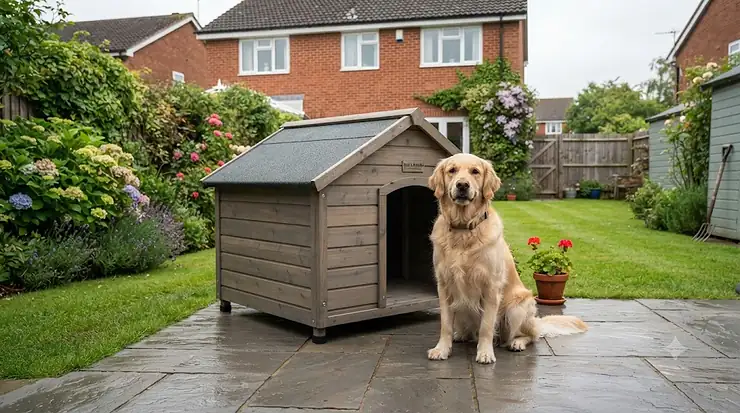
The PawHut Wooden Dog Kennel is the kind of sensible, unglamorous purchase that quietly does its job for years, provided you treat it properly. It measures 109L x 79W x 72H cm, built from fir wood with a water-resistant treatment and an asphalt-style shingle roof pitched to shed rainwater rather than pool it.
On paper, the raised base is the feature that matters most: it lifts the kennel off wet grass, which is exactly where damp and cold creep in on cheaper ground-level houses. The two side windows add cross-ventilation, which sounds minor until you realise a sealed box in August heat is its own kind of weatherproofing failure. Reviewers on this kennel line consistently describe assembly as fiddly but manageable with two people, and note the timber holds up well once the joints are re-sealed after the first winter.
This suits owners with a medium dog (up to roughly 20kg) and a garden that gets a fair mix of sun and rain rather than constant exposure. Budget-conscious buyers will appreciate that it needs no extra roofing work out of the box, though a yearly timber reseal — covered later in this guide — will roughly double its working life.
Pros:
- ✅ Raised floor keeps bedding away from ground damp
- ✅ Openable roof makes cleaning genuinely easy
- ✅ Ventilation windows prevent summer heat build-up
Cons:
- ❌ Untreated joints need annual resealing in wet regions
- ❌ Assembly instructions are light on detail
Priced in the sub-£150 range, this is solid value for a first outdoor kennel, especially if you’re prepared to do a bit of annual upkeep rather than expecting a “buy it and forget it” product.
2. VOUNOT Wooden Dog House — best compact pick for small gardens
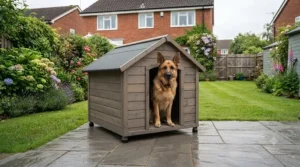
The VOUNOT Wooden Dog House trims the footprint down to 72x65x83cm, aimed squarely at small-to-medium dogs and owners without acres of patio to spare. Its standout feature is the steeply sloped felt roof, which does more real work against standing water than a flatter design ever could.
Slope angle is one of those specs nobody explains properly, so here it is: the steeper the pitch, the faster water runs off before it has a chance to seep through seams or pool against fixings. VOUNOT’s roof line sheds rain quickly, and the pine-fir frame is finished to resist rot at the base — the part of any wooden kennel that fails first, since it sits closest to wet ground even with feet or a raised edge.
This is a strong match for terrier-sized and smaller breeds in flats-with-gardens or terraced housing, where every square foot of outdoor space counts. Aggregated review sentiment for this model tends to praise the compact stability in wind, with occasional notes that very large dogs will find the interior tight — which tracks, since it wasn’t built for them.
Pros:
- ✅ Steep felt roof pitch sheds rain fast
- ✅ Compact footprint suits small gardens and patios
- ✅ Stable in wind despite the smaller frame
Cons:
- ❌ Too small for medium-large breeds
- ❌ Felt roof will need replacing every few years
At under £120, it’s an efficient buy for owners who want genuine weatherproofing without kennel-sized ambitions.
3. Confidence Pet Wooden Kennel with Water Bowls — best mid-range with built-in storage
The Confidence Pet Wooden Kennel steps up in both size and thinking. At 129.5 x 99 x 93cm, it’s built from furniture-grade wood with a felt-covered pitched roof, and it throws in two stainless steel water/food bowls plus a small lockable side chest for leads, toys, or treatment products.
What most buyers overlook about this model is the “side yard” concept — a small enclosed anteroom effectively separating the sleeping area from the entrance. In a downwind-driving-rain scenario, that buffer zone stops water blowing straight onto bedding every time the dog goes in or out, which flat single-chamber kennels simply can’t manage. The kennel sits roughly 4 inches off the ground, another small but meaningful choice for damp gardens.
Based on the spec comparison with the other wooden options here, this is the one built for owners who want a semi-permanent garden fixture rather than a basic shelter — good for families with a dedicated kennel spot who’ll get years of use if the roof felt is maintained. Real review feedback flags occasional shipping damage to the roof panel and floor support that needs reinforcing on arrival, so a quick structural check before first use is worth the ten minutes.
Pros:
- ✅ Side yard buffers bedding from driving rain
- ✅ Includes bowls and a lockable storage chest
- ✅ Elevated 4-inch base resists ground damp
Cons:
- ❌ Reported shipping damage to roof/floor on some units
- ❌ Floor may need extra support reinforcement
In the £150-£250 range, it’s pricier than the basics, but the added structure and storage genuinely earn the difference for a permanent outdoor setup.
4. Easipet Plastic Dog Kennel (940) — best zero-maintenance option
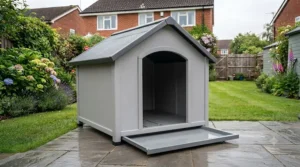
The Easipet Plastic Kennel strips weatherproofing back to its simplest form: a single moulded plastic shell with no seams, no timber, and nothing to treat, ever. At 750mm x 590mm x 660mm, it suits small-to-medium dogs and, going by real listings, gets used almost as often for outdoor cats as dogs.
Here’s what the “needs no additional treatment” claim actually means in practice: plastic doesn’t absorb water the way timber does, so there’s no annual resealing, no rot risk at the base joints, and no felt roof to eventually perish in UV light. The raised floor built into the moulding does the same job as a wooden kennel’s stilted base — lifting bedding away from puddled ground — without a separate structural step.
This is the honest pick for renters, owners who move house often, or anyone who’s tried and failed to keep up with timber maintenance schedules. Real customer reviews report it holding up through “pouring rain” reliably once assembled, alongside a genuinely common complaint that assembly requires more force than expected to click panels into place.
Pros:
- ✅ No timber means no ongoing maintenance
- ✅ Easy to clean and fully hygienic surface
- ✅ Raised floor built into the design
Cons:
- ❌ Assembly needs more force than instructions suggest
- ❌ Less insulating than wood in cold snaps
Sitting under £100, this is genuinely hard to beat on value if low maintenance matters more to you than kerb appeal.
5. PawHut Weatherproof Plastic Dog House — best small-dog plastic pick
The PawHut Plastic Dog House covers similar ground to the Easipet at a slightly larger 71 x 60 x 63cm, with a removable floor for cleaning and an integrated waterproof roof rather than a separate shingle layer. It’s marketed for indoor-outdoor flexibility, which is a fair claim given the sealed construction.
The removable floor is the detail worth dwelling on: rather than scrubbing an entire fixed base, you lift the tray out, hose it down, and slot it back in — a genuinely useful trick for muddy paw traffic that timber kennels can’t replicate without an openable roof and awkward reaching. The raised design again keeps the interior clear of standing water on flagstone or grass.
Good for small breeds in gardens that flood easily, or households wanting something they can wipe down after every walk rather than deep-clean monthly. Aggregated reviewer sentiment (currently a modest sample size on this specific listing) leans positive on ventilation and ease of assembly, with the main criticism being that “extra large” variants of the same range run tighter than their stated dimensions suggest.
Pros:
- ✅ Removable floor tray simplifies cleaning
- ✅ Fully sealed roof needs no separate treatment
- ✅ Raised, ventilated design suits damp gardens
Cons:
- ❌ Interior space runs tight for the stated size
- ❌ Limited insulation compared with wood
Priced under £120, it’s a sensible mid-tier plastic option if the Easipet feels a size too small.
6. vidaXL Galvanised Steel Dog House — best for chewers and coastal gardens
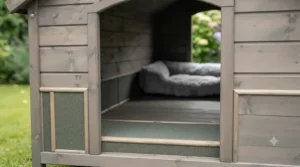
The vidaXL Galvanised Steel Dog House changes material entirely: 116.5 x 103 x 81.5cm of galvanised steel panelling with a weather-resistant roof, built for dogs and gardens that punish softer materials. Galvanisation means the steel is coated in zinc, which is the same anti-corrosion process used on outdoor fencing and roofing elsewhere — it’s not decorative, it’s the entire point.
What that means in real-world terms: no chewing damage, no rot, and meaningfully better resistance to salt-air corrosion than untreated metal or timber, which matters if you’re near the coast. Steel also won’t warp or swell the way wood can after repeated soak-dry cycles, so the door and roof panel keep sealing properly year after year. The trade-off is thermal — metal conducts heat and cold far more readily than wood or plastic, so this kennel benefits from a thick insulated bed inside, especially through winter.
Best suited to powerful chewers, working dogs, and gardens exposed to salt air or strong coastal wind where timber kennels degrade fastest. It’s a premium step up in price, but for dogs that have destroyed two wooden kennels already, it may be the only weatherproofing spec that actually holds.
Pros:
- ✅ Galvanised steel resists rot, chew damage, and rust
- ✅ Outperforms timber in coastal or salt-exposed gardens
- ✅ Structurally rigid roof seal that won’t warp over time
Cons:
- ❌ Poor natural insulation without added bedding
- ❌ Heavier and pricier than wood or plastic equivalents
Expect to pay in the £200-£350 range — a genuine investment, but one aimed at a specific, demanding use case rather than the average back garden.
7. vidaXL Large Steel Kennel Enclosure (7.37m²) — best for large breeds needing shelter plus a run
The vidaXL Large Steel Kennel Enclosure is less a kennel and more a self-contained outdoor system: 391 x 200 x 228cm of powder-coated steel framing, chain-link mesh sides, and a PE canopy roof engineered to resist sun, rain, and snow, all with a secure latch system.
The distinguishing feature here is scale combined with weatherproofing that doesn’t rely on any single sealed surface. The polyethylene roof canopy is fire-resistant and UV-stable, which matters because UV degradation is quietly one of the biggest causes of roof failure on cheaper kennel covers — plastic sheeting that looks fine in month one can turn brittle and crack by month eighteen under strong summer sun. vidaXL’s own guidance recommends clearing heavy snow build-up from the roof through winter, a sensible reminder that even a well-rated canopy has a load limit.
This is the pick for larger or more active breeds — think working collies, GSDs, or multi-dog households — who need genuine exercise space alongside shelter, not just a place to sleep. It won’t suit small gardens, and the mesh sides mean it’s shelter-plus-run rather than a fully enclosed, insulated house, so it pairs best with a smaller weatherproof sleeping box inside for the coldest nights.
Pros:
- ✅ UV-stable, fire-resistant canopy roof
- ✅ Combines secure run space with weather shelter
- ✅ Galvanised steel frame built for long-term outdoor use
Cons:
- ❌ Mesh sides offer less wind protection than solid walls
- ❌ Large footprint unsuitable for small gardens
At £350-£550, it’s the biggest outlay on this list, but for larger dogs it replaces both a kennel and a secure run in one purchase.
Waterproof Kennel Roofing: What Actually Keeps Rain Out
Ask most owners what makes a kennel waterproof and they’ll point at the walls. That’s the wrong place to look. The roof is where 90% of leaks start, because it’s the surface taking the most direct, sustained rainfall and the most UV exposure that degrades sealants over time. A weatherproof kennel roof needs three things working together: a steep enough pitch to shed water fast, a genuinely waterproof surface layer (not just water-resistant), and sealed, overlapping joints at every seam and fixing point.
Flat or low-pitch roofs are the most common design flaw on budget kennels, because water that doesn’t run off pools instead — and pooled water finds every weak seam eventually, especially around screw holes and joins. A pitch of at least 15-20 degrees gives water somewhere to go before it has time to sit. The second factor, material choice, is where felt-versus-shingle debates come in, which the next section covers properly. The third, sealing, is the bit manufacturers skip in the marketing copy but that determines whether your kennel survives its second winter.
Felt Roofing vs Shingle: Which Wins in a Wet Climate
This is the single most-argued spec in the whole weatherproof kennel category, so it deserves a straight answer rather than marketing spin.
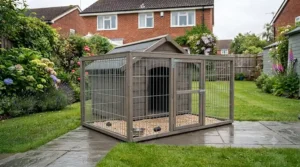
Felt roofing (the black, tar-based or synthetic sheeting used on most budget and mid-range wooden kennels) is cheap, easy to replace, and genuinely waterproof when correctly overlapped and nailed. Its weakness is UV degradation: standard roofing felt becomes brittle after 3-5 years of constant sun and rain cycling, and once it cracks, water gets under the sheet rather than running over it. Shingle roofing — individual overlapping tiles, usually asphalt-based, as used on the PawHut Wooden Dog Kennel — costs more upfront but tends to outlast basic felt by several years, because the overlapping tile structure sheds water more effectively and each tile flexes slightly rather than cracking as one sheet.
For a genuinely wet UK region — the north-west, Wales, or Scotland, where Atlantic weather systems dump considerably more rain than the drier east — the practical advice is: budget felt roofs are fine if you’re prepared to inspect and reseal annually, but asphalt shingle buys you a few extra maintenance-free years for a modest cost difference. If you’re in one of the driest parts of the country, standard felt on a well-pitched roof is perfectly adequate and the cheaper choice makes sense.
Wet Climate Kennel Durability: Why Location Changes the Answer
Durability isn’t a fixed number — it’s relative to where the kennel actually sits. The UK’s rainfall pattern is famously uneven: the Met Office notes that the wettest parts of the country cluster around Snowdonia, the Lake District, and the Scottish Highlands, where mountainous terrain forces moist Atlantic air upward and squeezes out significantly more rain than lowland areas ever see. A kennel that lasts eight trouble-free years in Essex might need serious roof attention by year three in Cumbria.
If you’re gardening in a genuinely wet, exposed region, weight the decision toward the vidaXL Galvanised Steel Dog House or a shingle-roofed timber option over basic felt, and budget for annual maintenance regardless of material. In drier, more sheltered gardens — walled city courtyards, terraces under mature trees — a budget felt-roofed wooden kennel like the VOUNOT Wooden Dog House will comfortably go the distance with far less intervention. Wind exposure matters just as much as rainfall total here: a kennel on an open, elevated plot takes driving rain horizontally, which stresses door seals and side joints that a sheltered garden barely tests.
Practical Usage Guide: Setting Up Your Kennel for Real Weather
Getting a weatherproof kennel right isn’t just about the purchase — the first 30 days of setup determine whether it performs as advertised.
Positioning first. Site the kennel with its back to the prevailing wind (in most of the UK, that’s south-westerly) and its entrance angled away from direct driving rain. Even a technically waterproof kennel will let water in through the doorway if it faces straight into the weather.
Elevate everything. If the kennel doesn’t have a raised base built in, add paving slabs, decking squares, or a simple timber pallet underneath. This single step does more for long-term durability than almost any other single change, because it stops rising damp before it starts.
Check every seam before the first heavy rain. Run a bead of exterior silicone sealant along roof joints, corner seams, and any screw holes on wooden models — most manufacturers leave this step to the buyer, and skipping it is the single biggest cause of first-winter leaks.
Add bedding that manages moisture, not just warmth. Straw (never hay, which holds moisture and moulds) or a raised memory-foam bed lets air circulate underneath, rather than trapping damp against the kennel floor.
Set a maintenance rhythm from day one. Inspect the roof every three months, reseal timber annually before autumn, and clear any debris from guttering or roof edges after storms. Owners who build this into a seasonal habit consistently report far fewer structural problems than those who wait for visible damage.
Common first-month mistakes: skipping the elevation step because the ground “looks dry,” positioning the kennel entrance facing the prevailing wind for a better garden view, and assuming a new kennel needs zero attention for its first year simply because it’s new.
Real-World Scenario: Matching the Kennel to Your Situation
The city terrace owner with a small dog and a compact yard. A Jack Russell in a Manchester terrace with a 2×2 metre paved yard doesn’t need a large structure — the VOUNOT Wooden Dog House or Easipet Plastic Kennel both fit the footprint, and the low-maintenance plastic option suits an owner without much time for annual roof upkeep.
The rural family with a working collie and a large, exposed garden. Here, weather exposure and space both scale up. The vidaXL Large Steel Kennel Enclosure gives the dog room to move plus genuine shelter, and its steel frame shrugs off the kind of driving Pennine rain that would eventually beat a wooden kennel.
The coastal owner with a persistent chewer. Salt air corrodes untreated metal and rots timber faster than inland weather ever does, and a determined chewer will eventually get through softer materials regardless of treatment. The vidaXL Galvanised Steel Dog House solves both problems at once, even though it costs more upfront.
Problem → Solution: Fixing Common Kennel Weather Issues
Problem: Water pooling at the kennel entrance. Solution: raise the threshold slightly with a treated timber strip, or reposition the kennel so the doorway isn’t the low point of the surrounding ground.
Problem: Musty smell after wet weeks. Solution: this is almost always trapped moisture in bedding rather than a structural leak — swap to raised, breathable bedding and leave the roof open (on openable models) on the next dry day to air it out fully.
Problem: Felt roof lifting at the edges. Solution: re-nail or re-glue lifted edges immediately with roofing adhesive; a small lifted corner left through one storm season usually becomes a full leak by the next.
Problem: Timber going grey and soft at the base. Solution: this is early rot from ground contact — lift the kennel onto a raised platform immediately and treat the affected timber with a wood hardener before it spreads.
Problem: Condensation inside a sealed plastic kennel. Solution: crack a ventilation gap or choose a model with built-in air vents; fully sealed plastic traps warm breath and body heat as moisture with nowhere to escape.
Timber Treatment: Keeping a Wooden Kennel Weatherproof for Years
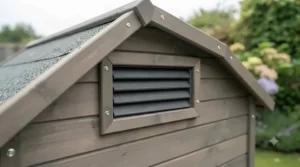
Timber treatment is the single biggest factor separating a wooden kennel that lasts three years from one that lasts twelve, and it’s the maintenance step most owners skip after the first summer. Untreated or under-treated wood absorbs rainwater into its fibres, which causes swelling, warping, and eventually rot — all of which compromise the seals around doors, windows, and roof joints even if the roof itself is sound.
A proper annual treatment routine: clean the kennel down with a stiff brush to remove dirt and algae, let it dry fully over a few clear days, then apply an exterior wood preserver or water-repellent timber treatment, paying particular attention to joints, the base, and any cut edges exposed during assembly (factory-applied treatments rarely reach these). Reapply before autumn each year in wetter regions, or every 18 months in drier ones. This single habit, more than any purchase decision, determines whether a kennel like the PawHut Wooden Dog Kennel or Confidence Pet Wooden Kennel genuinely earns its “weatherproof” label over its full lifespan rather than just its first year.
Kennel Guttering: The Upgrade Nobody Mentions
Almost no kennel — budget or premium — comes with guttering, yet it’s one of the cheapest, highest-impact upgrades available. Without it, rainwater sheets straight off the roof edge and down the walls, saturating the exact seams and base joints that timber treatment is trying to protect, and eroding the ground directly around the kennel’s footings into a permanent mud ring.
A simple length of plastic guttering (the kind sold for sheds) fixed along the lower roof edge, angled slightly toward a downpipe or splash block, redirects that water away from the walls entirely. For a DIY version, even a length of half-pipe guttering cut to size and screwed under the roof overhang makes a measurable difference after one winter. It’s a 20-minute job that meaningfully extends the life of any wooden or felt-roofed kennel, and it’s genuinely surprising how rarely it gets mentioned anywhere in kennel marketing.
How to Choose a Weatherproof Dog Kennel
- Match material to your garden’s exposure. Exposed, windy, or coastal gardens favour steel or sealed plastic; sheltered gardens can comfortably run timber.
- Check the roof pitch, not just the material. A steep pitch on cheap felt often outperforms a flat roof in premium shingle.
- Size for movement, not just sleeping. The dog should be able to stand, turn, and stretch fully inside — cramped kennels trap more condensation too.
- Prioritise a raised or elevated base. This single spec does more for long-term dryness than almost any roofing choice.
- Factor in maintenance willingness honestly. Plastic if you won’t maintain timber; wood if you’re happy with an annual treatment routine.
- Look for ventilation alongside waterproofing. A sealed box that keeps rain out but traps moisture inside isn’t actually weatherproof, just watertight.
- Budget for guttering and sealant as day-one extras, not optional upgrades — they’re part of the real cost of a genuinely weatherproof setup.
Common Mistakes When Buying a Weatherproof Kennel
The most frequent mistake is buying by price alone and treating “weatherproof” as marketing shorthand rather than checking the actual roof pitch and material. A close second is undersizing — a kennel that fits a dog’s current size but not their adult size, or one bought without accounting for bedding thickness eating into interior space. Owners also regularly skip positioning entirely, placing the kennel wherever fits the garden rather than considering wind direction and drainage, which undermines even a well-built kennel. Finally, many buyers assume any wooden kennel is maintenance-free because it arrived pre-treated — factory treatments are a starting point, not a permanent seal.
What to Expect: Real-World Performance Through a UK Winter
Specs on a listing page don’t tell you what a kennel actually feels like to live with through a full wet season, so here’s the translation. A well-elevated, properly sealed timber kennel like the Confidence Pet Wooden Kennel should keep bedding fully dry through sustained rain, with the interior noticeably warmer than outside air thanks to the wood’s natural insulation — dogs will often choose it over indoor floors on cold nights once they trust it’s dry. A sealed plastic option like the Easipet Plastic Kennel will stay bone dry with almost no upkeep, but expect a colder interior in a hard frost unless bedding is thick. Steel options run coldest of all without added insulation, but the trade-off is near-total immunity to the rot and warping that eventually catches up with timber in the wettest regions.
Weatherproof Dog Kennels for Different Audiences
For first-time outdoor-kennel owners: start with a smaller, budget wooden or plastic option and learn your garden’s specific weather patterns before investing in a premium structure — you’ll make a much better second purchase with a year’s experience behind you.
For owners of powerful or anxious chewers: steel is close to essential; timber and even most plastics won’t survive sustained chewing, and a partially destroyed kennel stops being weatherproof the moment its seals are broken.
For multi-dog households: the vidaXL Large Steel Kennel Enclosure or an equivalent run-plus-shelter combination gives space to avoid the crowding that causes tension between dogs, alongside genuine weather protection.
Long-Term Cost & Maintenance: What You’re Really Paying
The sticker price is only part of the real cost. A budget wooden kennel at under £150 that needs annual timber treatment (roughly £15-£25 per litre of preserver, lasting a couple of seasons) and a felt roof replacement every 3-5 years works out to a genuine ongoing cost over a decade, even before factoring in your own time. A sealed plastic kennel costs more relative to its size but needs essentially nothing beyond an occasional wipe-down, so its total cost of ownership can undercut timber over a long enough horizon despite the higher upfront price. Steel sits at the other extreme: highest initial outlay, but close to zero recurring maintenance cost and a working life that can outlast several cheaper kennels bought back to back. Buyers focused purely on the lowest sticker price often end up spending more over five years than if they’d bought once, properly, at the outset.
Safety, Regulations & Compliance for UK Kennels
There’s no single UK law dictating exact kennel dimensions for a pet owner’s back garden, but welfare standards are well established and worth following closely. The RSPCA’s guidance on keeping dogs outside is explicit that any outdoor kennel must be large enough for a dog to stand, turn around, and stretch out fully without touching the walls, and that shelter from rain, wind, and direct sun is non-negotiable rather than a nice-to-have. The same guidance notes that temperature and ventilation matter as much as basic shelter, recommending conditions are kept broadly between 10°C and 26°C where possible, and that heating or cooling additions must be genuinely safe, with no trailing cables a dog could chew or trip on.
Practically, this means checking any electric kennel heater is rated for outdoor use and properly weatherproofed itself, keeping bedding dry and changed regularly rather than left to compress and hold damp, and never treating a kennel as a substitute for real social contact and exercise. A weatherproof structure solves the physical shelter problem; it doesn’t solve loneliness or boredom, both of which the RSPCA flags as genuine welfare concerns for outdoor-housed dogs.
✨ Don’t Miss These Exclusive Deals!
🔍 Ready to give your dog a genuinely dry, comfortable spot outdoors? Check current pricing and availability on the kennels above — a few extra minutes of research now saves a soggy surprise come November.
Frequently Asked Questions
❓ What makes a dog kennel actually weatherproof rather than just water-resistant?
❓ How often should I treat a wooden dog kennel in the UK?
❓ Is a plastic or wooden kennel better for a rainy climate?
❓ Do dog kennels need guttering?
❓ What size kennel does my dog actually need?
Conclusion
A weatherproof dog kennel isn’t a single spec you tick off — it’s a combination of roof pitch, material choice, elevation, and ongoing maintenance that either works together or quietly fails one piece at a time. The seven kennels here cover genuinely different needs: the Easipet Plastic Kennel and PawHut Weatherproof Plastic Dog House for owners who want to set it up once and forget it, the PawHut Wooden Dog Kennel, VOUNOT Wooden Dog House, and Confidence Pet Wooden Kennel for those happy to put in an annual hour of timber care in exchange for better insulation, and the vidaXL Galvanised Steel Dog House and vidaXL Large Steel Kennel Enclosure for gardens or dogs that punish softer materials hardest.
Whichever you land on, the details covered here — roof pitch over roof material, elevation as non-negotiable, timber treatment on a real schedule, and guttering as a cheap add-on — matter more to long-term dryness than the price tag alone. Get those right, and a kennel bought this year should still be doing its job comfortably through winters several years from now.
Recommended for You
- Apex Roof vs Pent Roof Dog Kennel: 7 Best Picks for 2026
- Raised Floor Wooden Kennel for Large Dogs: 7 Best Picks 2026
- Insulated Wooden Dog Kennel UK: 7 Best Winter Picks 2026
Disclaimer: This article contains affiliate links. As an Amazon Associate, I earn from qualifying purchases. If you purchase products through these links, we may earn a small commission at no additional cost to you.
✨ Found this helpful? Share it with your friends! 💬🤗
