
In This Article
There’s a particular kind of stress that comes with starting a dog-related business on a tight budget — you know exactly what a proper, licence-ready kennel setup should look like, and you also know your bank balance has opinions about that. This is the gap most people hit when they start googling an affordable commercial kennel setup under £800: pricing pages built for established boarding kennels with five-figure budgets, next to flimsy garden pens that wouldn’t survive a determined Labrador for a fortnight.
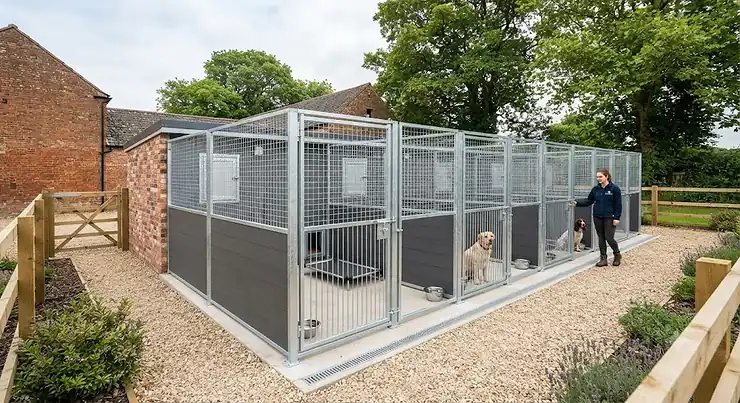
An affordable commercial kennel setup under £800 is a combination of durable outdoor runs, secure crates, and weatherproof housing built from materials rated for daily professional use — galvanised steel, welded wire, or treated timber — rather than the lighter-gauge products designed for occasional home use. The distinction matters because commercial use means daily cleaning, daily animal turnover, and, in England, meeting the physical standards set out under the dog kennel boarding licensing statutory guidance if you’re boarding dogs commercially.
We’ve researched seven genuinely available UK products — from budget folding crates through to a premium wooden kennel sitting right at the top of the £800 ceiling — pulling real specifications, real aggregated review sentiment, and honest commentary on where each one earns its keep. No invented five-star reviews, no fictional durability claims. Just what actually holds up under daily use, what a mobile dog walker or home boarder genuinely needs versus what’s nice-to-have, and where corners can and can’t be cut on a startup budget. This article contains affiliate links, and if you’re mid-spreadsheet trying to make a kennel budget work, you’re exactly who it’s for.
Quick Comparison Table
Here’s the shortlist before the full breakdown. These seven products span budget mobile-friendly crates through to a near-£800 premium wooden kennel, covering the realistic range a small dog business actually shops across.
| Product | Type | Price Range | Best For |
|---|---|---|---|
| Amazon Basics Large Metal Dog Crate | Indoor/mobile crate | Under £100 | Budget starting point, single-dog setups |
| Straame Heavy-Duty Folding Dog Crate | Foldable mobile crate | £70-£120 range | Mobile dog services, van transport |
| VEVOR Outdoor Dog Kennel Run | Galvanised steel run with roof | £150-£250 range | Single-dog outdoor commercial run |
| Garden Store Direct Dog Kennel House Shelter | Weatherproof shelter | £100-£180 range | Budget all-weather housing add-on |
| YITAHOME Outdoor Dog Kennel with Feeders | Modular run with roof | £300-£450 range | Multi-dog daycare or boarding setups |
| PawHut Heavy Duty Dog Run Galvanized Chain Link | Large-capacity chain-link run | £450-£550 range | Larger commercial exercise runs |
| Rowlinson Large Dog Kennel | Wooden kennel structure | £650-£800 range | Premium, near-ceiling standalone kennel |
Looking at this table, the real trade-off isn’t cheap-versus-expensive so much as coverage-versus-capacity. The two crates at the top handle one dog at a time and matter most for mobile dog services and transport, the mid-range runs from VEVOR and YITAHOME give you a genuine outdoor exercise space, and the PawHut and Rowlinson options sit near or at the £800 ceiling because they’re built to hold larger dogs or multiple animals daily rather than occasionally. Most realistic £800 setups combine two or three of these rather than buying just one.
💬 Just one click — help others make better buying decisions too!😊
Top 7 Affordable Commercial Kennel Setups: Expert Analysis
We picked these seven because they’re genuinely available on the UK market right now and represent the realistic spread a small dog business actually considers — no invented brands, no filler products.
1. Amazon Basics Large Metal Dog Crate — best budget starting point
Amazon Basics Large Metal Dog Crate is the obvious first purchase for anyone building a commercial setup from nothing, and its standout feature is simply how little it asks of your budget to get started. The crate folds flat for storage and transport, uses a welded wire-mesh construction with a removable plastic tray underneath, and comes in a large 91cm size suitable for medium-to-large dogs. Based on the spec sheet, this is a genuinely serviceable indoor holding crate for short-stay boarding, vet-run waiting periods, or as a settling-in space before a dog goes into an outdoor run — but it’s worth being upfront that this isn’t rated for permanent daily commercial housing the way a purpose-built kennel unit is. What most buyers overlook is that a single crate like this rarely forms your whole setup; it’s the flexible, cheap component you add several of once the rest of your infrastructure is in place. Reviewers consistently report the fold-flat design and tray are the most-used features day to day, while a recurring theme in aggregated feedback is that the wire gauge, while adequate for most dogs, isn’t marketed as chew-proof and shouldn’t be relied on for anxious or destructive chewers without supervision.
Pros:
- ✅ Extremely low cost of entry for a first commercial crate
- ✅ Folds flat, making storage and van transport genuinely easy
- ✅ Removable tray simplifies daily commercial-grade cleaning
Cons:
- ❌ Not rated for permanent outdoor or heavy chewer use
- ❌ Single-dog capacity means you’ll need several for a real setup
At under £100, Amazon Basics Large Metal Dog Crate earns its place as the cheapest genuine building block in this list — the value case is strongest when it’s one part of a wider setup rather than the whole solution.
2. Straame Heavy-Duty Folding Dog Crate — best for mobile dog services
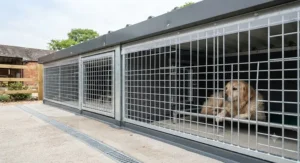
Straame Heavy-Duty Folding Dog Crate is specifically worth highlighting for anyone running mobile dog services rather than a fixed premises, and that mobility is the genuine standout here. The 30-inch model uses a black metal wire frame with two doors — front and side — secure sliding latches, and a removable leak-proof tray, all wrapped in a fold-flat design built around quick setup and breakdown rather than permanent installation. Here’s what to weigh: a mobile groomer or dog walker moving between multiple properties in a day needs equipment that survives being loaded and unloaded from a van repeatedly, which is a genuinely different durability requirement from a crate that sits in one spot. Based on the dual-door design, this formula also suits transport safety better than single-door alternatives, since it allows loading from whichever side is accessible in a cramped van boot. Aggregated customer sentiment consistently praises the carry handle and quick-release latches as the features that matter most for repeated daily use, while a smaller recurring note in feedback flags that, like most folding crates, the frame is less rigid than a welded commercial cage under sustained heavy use.
Pros:
- ✅ Genuinely built around repeated fold-and-transport daily use
- ✅ Dual front and side doors suit tight van loading spaces
- ✅ Sliding latches and leak-proof tray speed up daily turnaround
Cons:
- ❌ Less structurally rigid than a permanent welded cage long-term
- ❌ Best suited to medium dogs rather than very large breeds
Priced in the £70-£120 range, Straame represents strong value specifically for the mobile side of the “mobile dog services” market, where portability matters as much as raw durability.
3. VEVOR Outdoor Dog Kennel Run — best single-dog outdoor commercial run
VEVOR Outdoor Dog Kennel Run, in its 7.55 x 7.55 x 7.05 ft configuration, is the entry point into genuine outdoor commercial infrastructure, and the standout feature worth expanding on is the galvanised steel tube frame paired with a UV-resistant, waterproof roof cover. That roof detail matters more than it sounds: exposed exercise runs without shade or rain cover are a common welfare complaint in outdoor boarding setups, and a covered run addresses that directly rather than as an afterthought. On paper, the welded wire panel construction and rust-resistant coating position this as genuinely built for long-term outdoor use rather than a seasonal garden accessory, though buyers should note the clamp-and-screw assembly is rated for standard outdoor exposure rather than extreme coastal or industrial environments. What most buyers overlook about this size category is that it suits one dog, or occasionally two closely bonded dogs, comfortably — treating it as multi-dog daycare infrastructure will undersell the space per animal. Aggregated reviews commonly describe assembly as straightforward with labelled parts, while a recurring theme notes the roof cover benefits from periodic re-tensioning after heavy wind, which is a fair trade-off for a product at this price point.
Pros:
- ✅ Galvanised steel frame genuinely rated for long-term outdoor use
- ✅ UV-resistant waterproof roof addresses shade and rain welfare needs
- ✅ Straightforward clamp assembly with labelled parts
Cons:
- ❌ Comfortable for one dog rather than a multi-dog daycare setup
- ❌ Roof cover needs occasional re-tensioning after strong wind
At roughly £150-£250, VEVOR Outdoor Dog Kennel Run offers a solid value entry into proper outdoor commercial infrastructure without eating far into an £800 total budget.
4. Garden Store Direct Dog Kennel House Shelter — best budget weatherproof housing add-on
Garden Store Direct Dog Kennel House Shelter fills a specific gap the outdoor runs above don’t: an actual enclosed sleeping shelter rather than just a covered run. The standout feature is straightforward — a weather and water-resistant housing structure designed for easy assembly, positioned as a shelter that pairs with an open run rather than replacing one. Based on the spec comparison with the wooden Rowlinson kennel further down this list, this is the budget route to the same basic function: a dry, insulated space where a dog can retreat from wind and rain during the day. What’s worth weighing honestly is that “easy assembly” and “commercial-grade daily durability” aren’t automatically the same thing — this shelter suits a genuine budget commercial setup, but a business running high dog turnover and heavy daily cleaning will likely outgrow it faster than the premium wooden option. Reviewers consistently note the shelter is straightforward to put together within an hour or two, and aggregated feedback commonly describes it as good value for the price bracket, with the honest caveat that verified long-term durability data beyond a season or two of feedback isn’t yet extensive for this specific listing.
Pros:
- ✅ Genuine enclosed shelter, not just an open covered run
- ✅ Straightforward assembly suited to non-tradesperson buyers
- ✅ Strong value relative to premium wooden kennel alternatives
Cons:
- ❌ Less proven long-term durability data than established brands
- ❌ Best suited to lighter commercial use than high-turnover boarding
At around £100-£180, this shelter is the sensible budget add-on once you already have a run in place and need genuine weatherproof housing rather than just shade.
5. YITAHOME Outdoor Dog Kennel with Rotating Feeder Bowls — best for multi-dog daycare setups
YITAHOME Outdoor Dog Kennel with Rotating Feeder Bowls steps up in both size and functionality, and the standout feature here is genuinely practical rather than cosmetic: built-in rotating feeder bowls set into the panel itself. That detail matters more than it first appears for a working daycare or boarding setup, since it means staff can top up food and water from outside the enclosure without opening the door — a small design choice that meaningfully reduces the daily risk of a dog slipping past an open gate. At 10ft x 10ft with a roof, the run gives considerably more usable space than the VEVOR entry above, making it a realistic option for two dogs from the same household or a rotation of daycare dogs across a working day. Here’s what to weigh: the larger footprint means it needs more available outdoor space than a business operating from a small yard may have, so this is very much a product for buyers who’ve already confirmed they have the room. Aggregated feedback consistently highlights the feeder bowl detail as the most-appreciated practical feature, while a recurring theme notes the roof, like most panel-and-tarp designs at this price point, benefits from periodic inspection after storms.
Pros:
- ✅ Built-in rotating feeders reduce daily gate-opening risk
- ✅ Genuinely usable space for two dogs or daycare rotation
- ✅ Roof cover included as standard, not a separate purchase
Cons:
- ❌ Larger footprint requires more available outdoor space
- ❌ Roof tarp needs periodic post-storm inspection like similar designs
Sitting in the £300-£450 range, YITAHOME represents solid mid-range value for anyone whose commercial setup genuinely needs to house more than one dog at a time.
6. PawHut Heavy Duty Dog Run Galvanized Chain Link — best for larger commercial exercise runs
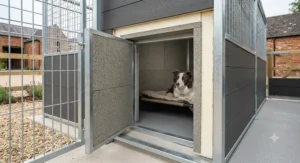
PawHut Heavy Duty Dog Run Galvanized Chain Link, in its larger configurations around 9.8ft x 9.8ft x 7.7ft, is built for buyers who need genuine exercise-run capacity rather than a compact holding pen, and that scale is the standout worth explaining. The frame uses galvanised chain-link fencing over solid galvanised steel railings, with the brand specifically noting sprayed, smooth-finished rails designed to avoid sharp edges — a detail that matters for daily safety inspections under licensing standards. Based on the spec comparison with the mid-range YITAHOME run, the extra height and floor area here genuinely change what’s possible: taller, more athletic breeds have room to move rather than just stand, which is directly relevant to the exercise-run space requirements under UK boarding regulations. What most buyers overlook is that a run this size needs a level, well-draining base prepared before assembly, since an uneven surface undermines the frame’s stability far more than with the smaller VEVOR unit. Reviewers consistently describe the steel quality as noticeably sturdier than budget alternatives at this price point, while aggregated feedback also flags that a project of this scale genuinely benefits from two people during assembly rather than one.
Pros:
- ✅ Genuinely spacious exercise-run capacity for larger or multiple dogs
- ✅ Smooth-finished galvanised rails reduce daily safety-check concerns
- ✅ Noticeably sturdier steel quality than budget-tier alternatives
Cons:
- ❌ Requires a properly prepared, level base before assembly
- ❌ Eats a substantial share of an £800 total setup budget alone
At roughly £450-£550, PawHut‘s larger run is a serious chunk of an £800 budget on its own, so it suits buyers prioritising one excellent exercise run over several smaller components.
7. Rowlinson Large Dog Kennel — best premium standalone kennel near the £800 ceiling
Rowlinson Large Dog Kennel is the most complete single product on this list, and its standout feature is being an actual finished wooden kennel structure rather than a run, crate, or shelter add-on that needs pairing with something else. Constructed from timber rather than steel mesh, the kennel is designed as an integrated sleeping and shelter unit, which on paper means better natural insulation against cold than an open metal-framed run — genuinely useful for year-round commercial use in the UK climate rather than fair-weather only. Based on the spec comparison with the metal alternatives above, wood requires different long-term maintenance: periodic re-treatment against weathering and rot, versus the rust-resistance-by-coating approach of galvanised steel, so the durability trade-off is maintenance effort rather than raw structural weakness. What’s worth being honest about is price positioning: at the very top of an £800 budget, this product alone can consume the entire allocation, which only makes sense if you’re prioritising one high-quality permanent structure over a combination of run-plus-shelter-plus-crate. Aggregated customer sentiment consistently describes the build as solid and well-finished for the price bracket, with a recurring note that, like all wooden outdoor structures, the timber benefits from a weatherproofing treatment reapplied roughly annually to maintain its resistance to the elements.
Pros:
- ✅ Complete integrated structure, not a run needing separate housing
- ✅ Timber construction offers genuine natural insulation benefits
- ✅ Solid, well-finished build quality reported consistently in feedback
Cons:
- ❌ Consumes most or all of an £800 budget as a single purchase
- ❌ Timber needs periodic re-treatment, unlike galvanised alternatives
Priced in the £650-£800 range, Rowlinson Large Dog Kennel is the choice for buyers who’d rather have one excellent permanent structure than several smaller components working together.
Practical Usage Guide: Setting Up Your Commercial Kennel Infrastructure
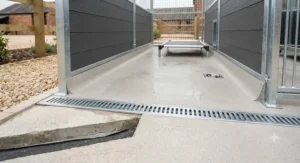
Buying the right components is only the first half of the job — correct setup and a maintenance routine determine whether your infrastructure survives daily commercial use or needs replacing within a year. Start with the base: any outdoor run, whether the VEVOR, YITAHOME, or PawHut option, needs a level, well-draining surface before assembly. Grass alone turns to mud within weeks under daily paw traffic, so a gravel, paving slab, or concrete base — even a budget version — dramatically extends the lifespan of both the enclosure and your own cleaning routine.
Common mistakes in the first 30 days include under-securing panel joints because assembly “looks finished” without every clamp fully tightened, skipping a daily visual inspection of latches and mesh integrity, and positioning shelters or crates without considering drainage, so water pools against the base during heavy rain. Establish a simple daily routine from day one: a quick structural check of gates and panels before any dog goes in, tray or floor cleaning between uses for crates like the Amazon Basics or Straame models, and a monthly deeper inspection of roof tarps and timber treatment on structures like the Rowlinson kennel.
For maintenance scheduling, galvanised steel components genuinely need very little beyond an occasional rinse and rust-spot check, while timber structures need a weatherproofing reapplication roughly once a year to maintain the manufacturer’s stated resistance. If you’re running a licensed boarding setup, keep basic maintenance records — a simple dated log is enough — since inspectors under the current licensing framework will want to see evidence of ongoing upkeep, not just a one-off assembly.
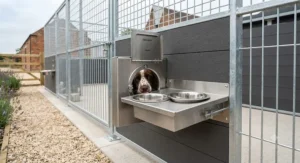
Real-World Scenarios: Matching Kennel Setups to Your Dog Business
Different dog businesses need genuinely different infrastructure, and matching your setup to your actual model saves both money and wasted capacity.
If you’re a mobile dog walker or pet sitter who occasionally needs secure short-term holding between clients or during a van journey, the Straame Heavy-Duty Folding Dog Crate paired with an Amazon Basics crate as backup gives you flexible, transportable capacity for well under £250 combined — the mobility matters more than permanent outdoor infrastructure for this business model.
If you’re launching a small home boarding operation for one or two dogs at a time, a VEVOR Outdoor Dog Kennel Run paired with the Garden Store Direct shelter gives you a genuine outdoor exercise space plus dry housing for a combined spend comfortably inside £800, with budget to spare for bedding and safety equipment.
If you’re building toward licensed daycare or small-scale boarding for multiple dogs, the YITAHOME run’s larger footprint and built-in feeders make it the stronger single purchase, potentially paired with the Rowlinson kennel if your budget stretches slightly beyond £800 for a second, more permanent structure added later.
What Counts as a “Commercial” Kennel Setup?
A commercial kennel setup is outdoor and indoor dog housing infrastructure — runs, shelters, and crates — built from materials rated for daily professional use rather than occasional home use, and used as part of a business activity such as boarding, daycare, breeding, or mobile pet services. In England, if that activity involves boarding dogs for money, it typically needs a licence from your local authority under current animal activities regulations, regardless of how small the setup is.
The word “commercial” specifically triggers licensing obligations rather than being a marketing term. As the home boarding for dogs licensing statutory guidance sets out, the deciding factor is whether the activity is carried out to make a profit, not the scale of your setup — so even a single-dog home boarding operation on a budget kennel needs to meet the same regulatory bar as a larger business.
How to Choose an Affordable Commercial Kennel Setup Under £800
Working through this order will save you from buying the wrong component first and having to backtrack.
- Confirm your business model first. Mobile services need transportable crates; fixed-premises boarding needs permanent outdoor runs and shelter — these are genuinely different budget priorities.
- Check your licensing category before buying anything. Home boarding, kennel boarding, and day care each have slightly different physical standards, so confirm which applies to you first.
- Prioritise materials rated for daily use, not occasional use. Galvanised steel and treated timber are built for repeated commercial wear; lighter garden-grade metal typically isn’t.
- Calculate space per dog, not just enclosure size. A run rated for “large dogs” in marketing copy may only comfortably suit one animal at a time — check floor area against your actual dog capacity plans.
- Budget for a base and accessories, not just the enclosure. A level, well-draining surface and secure latches often cost more in practice than buyers initially plan for.
- Read durability claims against maintenance requirements. A cheaper product that needs frequent replacement often costs more over two years than a pricier one that doesn’t.
- Leave headroom in your £800 for licensing and insurance costs. Council licence fees and public liability insurance are separate, ongoing costs that a kennel budget shouldn’t ignore.
Low-Cost Commercial Infrastructure: Building a Setup Without Overspending
Assembling low-cost commercial infrastructure isn’t about buying the cheapest single item — it’s about sequencing purchases so each pound adds genuine capacity rather than duplicating what you already have. A sensible £800 allocation for a small home boarding start-up might look like this: a mid-range outdoor run such as the VEVOR Outdoor Dog Kennel Run for roughly £150-£250, a budget shelter like the Garden Store Direct kennel house for £100-£180, one or two Amazon Basics crates for indoor holding at under £100 each, and a modest reserve of £150-£250 left over for a proper base surface, secure latches, and bedding.
| Budget Allocation | Component | Approximate Spend |
|---|---|---|
| Outdoor exercise run | VEVOR Outdoor Dog Kennel Run | £150-£250 |
| Weatherproof shelter | Garden Store Direct Dog Kennel House Shelter | £100-£180 |
| Indoor holding crates (x2) | Amazon Basics Large Metal Dog Crate | £120-£180 combined |
| Base, latches, bedding reserve | Various | £150-£250 |
| Total | £520-£860 |
This breakdown makes the trade-offs explicit: a leaner version of this plan comfortably clears the £800 ceiling with room for insurance costs, while stretching to the higher end of each range pushes close to or slightly past it. The lesson from this table is that low-cost commercial infrastructure is achievable under £800, but only if you resist the temptation to buy the premium version of every single component.
✨ Ready to Start Building Your Setup?
🔍 Compare the seven products above against your business model and available outdoor space. Check current pricing and availability before committing your budget.
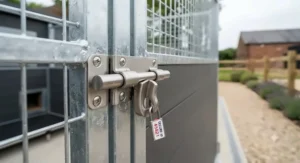
Mobile Dog Services: Kennel and Crate Options for Vans and On-the-Go Work
Mobile dog services — grooming, walking, transport, and pet taxi work — have a genuinely different equipment problem from fixed-premises boarding. The priority isn’t permanent outdoor infrastructure at all; it’s secure, foldable, lightweight equipment that survives being loaded and unloaded from a vehicle multiple times a day without degrading. This is where the Straame Heavy-Duty Folding Dog Crate earns its specific recommendation over the outdoor runs covered elsewhere in this guide — its dual-door design and fold-flat frame are built around exactly this repeated-transport use case, not around staying in one place.
For mobile operators, a few extras matter more than they do for fixed premises: a non-slip mat or liner to stop a crate sliding during transit, a secure tie-down point in the vehicle itself, and a spare crate in reserve for days when two dogs need separate transport. Van space is almost always the real constraint rather than budget, so measuring your actual load area before choosing crate dimensions saves an expensive mismatch. Combining one Straame crate for transport with an Amazon Basics crate as a static holding option at a base location covers most mobile business models comfortably within a few hundred pounds, leaving budget headroom for the insurance and DBS checks mobile pet businesses commonly need.
Kennel Durability for Daily Use: What Actually Holds Up
Durability claims on kennel product listings are everywhere, but what actually determines whether a structure survives daily commercial use comes down to a short list of genuine factors rather than marketing language. Material matters most: galvanised steel, as used in the VEVOR, YITAHOME, and PawHut runs, resists rust through a zinc coating that bonds to the steel itself, giving it a meaningfully longer functional life under repeated outdoor exposure than painted or powder-coated alternatives, which can chip and expose bare metal to rust over time. Under the technical standards set out in the Animal Welfare (Licensing of Activities Involving Animals) (England) Regulations 2018, exercise runs used for licensed boarding must have a secure, waterproof roof over at least half their total area — a specification that directly affects which of the seven products here are genuinely licence-ready versus which need an added roof cover to qualify.
Joint and latch quality is the second major durability factor, and it’s where cheaper unbranded products most often fail first — a rusted or bent latch is usually the actual point of failure long before the panel mesh itself gives way. Base preparation, covered earlier in the practical usage guide, is the third factor most buyers underestimate: even the sturdiest frame degrades faster when set on uneven, waterlogged ground than one installed on a proper level base. Timber, as used in the Rowlinson kennel, holds up differently — its durability depends on consistent re-treatment rather than avoiding rust, so “durable” means something structurally different for wood than it does for galvanised steel, and buyers should judge each material against its own maintenance requirements rather than a single universal standard.
Commercial Kennel Setup vs DIY or Improvised Enclosures
It’s worth addressing directly why purpose-built commercial products, even budget ones, tend to outperform DIY or improvised alternatives like garden fencing repurposed as a dog run.
| Approach | Durability Under Daily Use | Licensing Compliance |
|---|---|---|
| Purpose-built runs (e.g. VEVOR, YITAHOME) | Rated for repeated commercial wear and weather exposure | Roof coverage and mesh specs typically meet regulation standards |
| DIY garden fencing | Not rated for animal containment; wear varies widely | Rarely meets specific roof, latch, or floor-area requirements |
| Repurposed livestock panels | Reasonably durable but gaps often unsuited to dogs | Usually fails secure-containment and roof-coverage standards |
| Premium wooden structures (e.g. Rowlinson) | Very durable with regular maintenance | Meets sleeping-area standards; may need added run coverage |
Reading this table, the pattern is consistent: purpose-built products cost more upfront than improvised alternatives, but they’re specifically designed around the containment, safety, and roofing standards that licensing inspectors check for, which improvised solutions usually aren’t. For a business that needs to pass a council inspection, the extra spend on a genuine commercial product is rarely optional in practice, even if it feels like the harder upfront cost on a tight £800 budget.
Common Mistakes When Buying a Commercial Kennel Setup
A handful of recurring errors show up again and again in how new dog businesses approach this purchase. First, buying based purely on enclosure size in square feet without checking floor area per dog against licensing minimums, which can mean a run that looks spacious on paper actually falls short of regulation. Second, skipping the roof or shade element entirely to save money, when covered exercise space is a specific, checked requirement rather than a nice-to-have. Third, underestimating base preparation costs and time, which regularly turns into the most expensive “hidden” line item in a kennel budget. Fourth, buying one premium item and leaving nothing in the budget for latches, bedding, and a base, resulting in a beautiful kennel that can’t actually be used safely yet. Finally, assuming a product marketed for home use will hold up to genuine daily commercial wear — the distinction between occasional and daily use is exactly why this guide separates the two categories throughout.
Long-Term Cost & Maintenance
Thinking purely in terms of the initial £800 spend misses the real cost picture for a commercial kennel setup. Galvanised steel components like the VEVOR, YITAHOME, and PawHut runs typically need minimal ongoing spend beyond occasional latch replacement and roof tarp checks, keeping annual maintenance costs low, often under £50 a year across a modest setup. Timber structures like the Rowlinson kennel carry a higher ongoing cost, since annual weatherproofing treatment and periodic repairs to joints exposed to the elements add a genuine recurring line item, typically £30-£60 a year in materials.
The more useful long-term calculation is total cost against avoided problems: a cheap, poorly maintained enclosure that fails a licensing inspection costs far more in lost business and re-inspection delays than the extra spend on a properly rated product upfront. Similarly, factoring public liability insurance and licence renewal fees into your ongoing budget from day one, rather than treating the £800 kennel spend as the whole financial picture, avoids the common trap of being fully equipped but not legally able to operate.
Safety, Licensing and Regulations Guide
Any commercial dog boarding activity in England — whether from a fixed premises or a home setup — generally requires a licence from your local authority under the current animal activities licensing framework, regardless of how small the operation is. The specific physical standards vary slightly depending on whether you’re running kennel boarding, home boarding, or day care, but common threads include secure containment, adequate floor area per dog, and covered exercise space, all of which directly inform which products on this list genuinely suit a licensed setup versus which need modification.
Beyond licensing, most local authorities and councils reference the wider Animal Welfare Act 2006 framework as the baseline welfare standard underpinning these specific regulations, so it’s worth reading both the general welfare principles and the activity-specific guidance before finalising your setup. Public liability insurance, while a separate requirement from licensing itself, is strongly advised by most councils and often expected before a licence application will even be considered complete. Budgeting time to contact your local authority’s animal welfare or environmental health team early in the process — before finalising your kennel purchase — can save costly rework if your planned setup doesn’t meet a requirement you weren’t aware of.
Features That Actually Matter (And Those That Don’t)
Cutting through the marketing noise on kennel product listings: material and coating quality matter enormously, since that’s the genuine difference between a structure that lasts years and one that needs replacing within a season. Roof coverage matters both for animal welfare and for licensing compliance, as covered above, so it’s never a feature to skip to save money. Latch and lock quality matters more than most buyers initially weight it, since it’s the single most common failure point across all the products reviewed here. What matters considerably less than packaging implies: cosmetic colour options, “designer” styling on shelters, and vague claims like “indestructible” without a specific, checkable spec behind them. Genuinely useful signals of a more rigorous product include disclosed gauge thickness on steel mesh, as seen with the PawHut and VEVOR listings, and clear assembly documentation, both of which correlate with fewer daily maintenance headaches down the line.
Commercial Kennel Setups for Different Business Types
Different dog businesses genuinely need different infrastructure priorities, so it’s worth being specific rather than offering one-size-fits-all advice. Mobile groomers and dog walkers should prioritise the Straame and Amazon Basics crates covered in the mobile dog services section, since transportability outweighs permanent outdoor capacity for this business model. Home boarders working with one or two dogs at a time get the strongest value from pairing the VEVOR run with the Garden Store Direct shelter, giving genuine outdoor and indoor coverage within a modest budget. Small daycare or multi-dog boarding operations should prioritise the YITAHOME or PawHut runs for their larger floor area and daily-use feeder or safety features. Breeders, who typically need more permanent, insulated structures for whelping and puppy-rearing periods, are the group most likely to find the Rowlinson wooden kennel’s natural insulation properties worth its larger share of the £800 budget.
Frequently Asked Questions
❓ Do I need a licence for a small commercial kennel setup?
❓ Can I build a licence-ready setup entirely under £800?
❓ Is galvanised steel or timber more durable for daily commercial use?
❓ What's the biggest hidden cost in a kennel setup budget?
❓ Can mobile dog services skip outdoor kennel infrastructure entirely?
Conclusion
Building an affordable commercial kennel setup under £800 comes down to matching real components to your actual business model rather than chasing the single most impressive-looking product. For mobile dog services, the Straame Heavy-Duty Folding Dog Crate and Amazon Basics Large Metal Dog Crate cover transport and short-term holding without eating your budget. For small home boarding setups, pairing the VEVOR Outdoor Dog Kennel Run with the Garden Store Direct shelter delivers genuine outdoor and weatherproof indoor coverage well within budget. For multi-dog daycare or boarding, the YITAHOME and PawHut runs offer the floor area and daily-use features larger operations need. For breeders or anyone prioritising one permanent, insulated structure, the Rowlinson Large Dog Kennel is worth allocating most of your £800 toward.
None of these seven products alone constitutes a full licence-ready commercial setup — that takes the right combination, a properly prepared base, and confirmation against your local authority’s specific licensing standards. But researched, matched to your business model, and budgeted honestly against the low-cost commercial infrastructure table above, an £800 ceiling is a genuinely realistic starting point rather than a compromise.
Recommended for You
- Commercial Kennels Under £1000: 7 Real Options for 2026
- Double Dog Kennel for Breeders: 7 Brilliant Picks for 2026
- Block of Kennels vs Single Kennel for Breeders: 2026 Guide
Disclaimer: This article contains affiliate links. As an Amazon Associate, I earn from qualifying purchases. If you purchase products through these links, we may earn a small commission at no additional cost to you.
✨ Found this helpful? Share it with your friends! 💬🤗
