In This Article
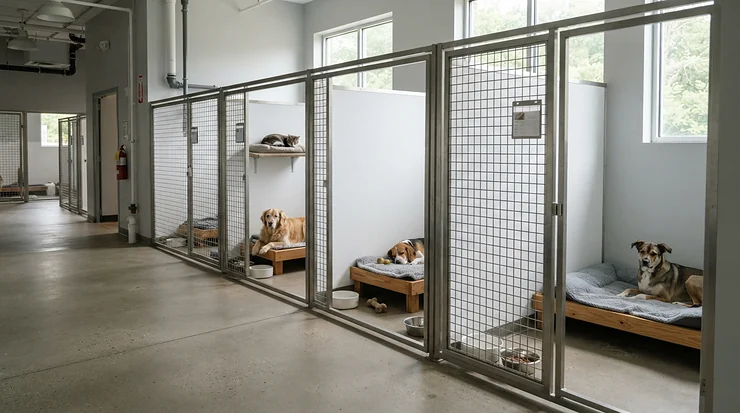
Boarding kennel equipment is every item a licensed dog-boarding business uses to house, clean, feed, handle, monitor and protect other people’s dogs, from disinfectant and bedding to temperature gauges and fire alarms. In England, the right kit isn’t just about comfort. It’s what a council inspector checks before granting your licence.

Here’s the thing first-timers rarely hear. Boarding businesses seldom stumble because the kennels look shabby. They stumble on the unglamorous stuff. The disinfectant misses a virus. The bedding can’t survive a hot wash. The thermometer lives in the office while the sleeping area quietly drops below the minimum.
This guide pulls together seven real, buyable items and the rules that shape them. It also covers boarding kennel licensing, boarding kennel setup, boarding kennel biosecurity, dog boarding kennel supplies and the wider cost of kennel business equipment. The rules come from the statutory guidance published on gov.uk for local authorities, and I’ve translated them into a shopping list.
This is research-based analysis built on manufacturer specifications, retailer listings and the Defra guidance. It is not a hands-on test, and I won’t pretend otherwise.
One caveat: the licensing detail here applies to England. Scotland, Wales and Northern Ireland run different regimes, so check with your own council before you spend a penny.
Quick Comparison: Boarding Kennel Equipment at a Glance
| Product | Job it does | Key spec | Price range | Best for |
|---|---|---|---|---|
| Virkon S | Disinfection | 1% dilution; one 5 g tablet makes 500 ml | Under £25 | Every kennel and isolation unit |
| Kärcher K 4 Compact | Run cleaning | 130 bar max, 420 l/h | £170-£250 | Small to mid-sized sites |
| Vetbed Original | Bedding | Machine washable, up to about 90°C | £15-£35 | High-turnover units |
| Baskerville Ultra Muzzle | Safe handling | Six sizes, heat-mouldable | Around £10-£25 | Vet visits, nervous dogs |
| KONG Classic | Feeding enrichment | Six sizes, natural rubber | From around £5 | Daily enrichment |
| ThermoPro TP50 | Climate log | -50 to 70°C, min/max memory | Around £10-£15 | Sleeping-area checks |
| FireAngel FA3820 | CO safety | Sealed 10-year battery, 85 dB | £25-£40 | Any building with heating |
Prices are ranges at the time of research and change often, so check current prices before buying. Looking at the table, the Virkon S, ThermoPro TP50 and KONG Classic deliver the most compliance value per pound. If you only budget for one big-ticket item, the Kärcher K 4 Compact saves the most labour, but only if your site is small enough for it. The FireAngel FA3820 is the one you can’t skip, because an alarm is the cheapest insurance on this list.
💬 Just one click — help others make better buying decisions too!😊
Top 7 Boarding Kennel Equipment Picks: Expert Analysis
1. Virkon S — broad-spectrum virucidal for kennel turnarounds
The standout is breadth. Virkon S is sold as a virucidal, bactericidal and fungicidal disinfectant in one product. That matters because the Defra kennel guidance expects disinfectants to be virucidal as well as bactericidal.
Supplier literature gives a 1% working dilution. A 50 g sachet makes 5 litres, a 500 g tub makes 50 litres, and each 5 g tablet makes 500 ml, so a 50-tablet jar fills 25 litres. In practice, one small tub covers weeks of weekly kennel disinfection at a modest site. Tablets also remove the guesswork of scooping powder.
Based on the spec comparison, Virkon S is the sensible default for a first-time operator. The formulation includes a surfactant, so it cleans and disinfects in one pass. It isn’t magic, though. Disinfectant needs pre-cleaned surfaces, and the label’s contact time is not a suggestion. If you run an isolation room, buy a separate bucket and sachets just for it.
Verified review volume on the pages I could access was thin. One UK stockist showed a single five-star comment praising ease of use. The stronger signal is its long use around stables and farms, as described in supplier literature rather than customer reviews.
Pros:
- ✅ Cleans and disinfects in a single step
- ✅ Tablets and sachets store compactly
- ✅ Stated efficacy across viruses, bacteria and fungi
Cons:
- ❌ Irritant, so gloves and eye protection are essential
- ❌ Mixed solution has a limited life; check the label
Small packs typically sit under £25 (check current price), which is excellent value given how far one sachet stretches.
2. Kärcher K 4 Compact — compact pressure washer for daily run cleaning
The headline feature is adjustability. The Kärcher K 4 Compact runs from 20 to 130 bar, so you can dial down for delicate surfaces or up for baked-on mess.
The wider specs are 420 litres per hour, a 1.8 kW motor, a 6 m high-pressure hose and a weight of around 11 kg. The flow works out at roughly 7 litres a minute. That’s enough to shift mess from a run without flooding corridors, which matters because the guidance says waste water must not run into neighbouring units. The integrated filter and a maximum inlet temperature of 40°C round out the practical details.
Kärcher itself positions this model for occasional cleaning of moderate dirt. Read that as a warning. For a site hosing down daily, treat this as the small-site or first-year choice, with a heavier-duty machine as the upgrade. Keep dogs out of the area while you work, as the guidance requires. The noise alone can unsettle neighbours in adjacent units.
I couldn’t find a usable review sample on the retailer pages I accessed, and one independent consumer test I found sits behind a paywall. Treat this entry as spec-based rather than review-backed.
Pros:
- ✅ Pressure adjustable from 20 to 130 bar
- ✅ Compact and light enough to move between blocks
- ✅ Water-cooled motor and integrated inlet filter
Cons:
- ❌ Positioned for occasional, moderate dirt rather than daily commercial use
- ❌ Rinses surfaces but doesn’t disinfect them
Expect around £170-£250 depending on retailer (check current price). That’s fair value for a small site and poor value for a large one.
3. Vetbed Original — drains fast, machine-washable bedding
Its standout is drainage. Liquid passes through the pile rather than pooling, which suits a kennel bed that will meet the odd accident.
Vetbed Original is a double-woven polyester bedding. Retailer care notes say 40°C for routine washing and up to about 90°C for occasional disinfection, with no fabric softener and no tumble drying. The guidance says bedding must be washable or disposable and cleaned and disinfected between dogs. The real buying question is therefore how many sets you need to turn a full kennel block in a day.
My rule of thumb is at least two sets per unit, one in use and one in the wash, plus more for holiday peaks. Limit those hot cycles, though. One retailer warns that disinfecting washes should only happen when necessary, to avoid damaging the fabric.
Reviewers on retailer pages repeatedly praise its resistance to chewing compared with sewn beds. One reviewer reported grey fluff clinging to a black dog’s coat.
Pros:
- ✅ Drains and dries quickly after accidents
- ✅ Washes hot enough for occasional disinfection
- ✅ Double-woven pile resists chewing better than sewn beds
Cons:
- ❌ Fibres can shed onto dark coats
- ❌ Repeated hot washing shortens fabric life
Prices run from roughly £15 to £35 depending on cut size (check current price). It’s strong value if you rotate sets sensibly.
4. Baskerville Ultra Muzzle — pant-and-drink muzzle for safe handling
The standout is welfare-friendly design. Dogs wearing the Baskerville Ultra Muzzle can pant, drink and take treats, which is essential for a hot or stressed dog.
The Defra guidance says a range of muzzle sizes and a dog-catching device must be kept on site. The specs suit that. It’s made from thermoplastic rubber, comes in six sizes, has no metalwork on the face, and can be heat-shaped in warm water for a closer fit. The Ultra 2.0 version adds a third attachment point to reduce slipping.
Analytically, think of this as handling insurance rather than a daily tool. It’s for vet handovers, emergency capture and short supervised moments, not for leaving a dog muzzled in a kennel. Retailers also advise introducing it gently, so practise with treats before you need it on a frightened dog.
The few buyer comments I found praised the fit and noted that dogs could still eat, drink and pant. Review volume on the pages I accessed was small, so don’t treat that as a large sample.
Pros:
- ✅ Dogs can pant, drink and take treats
- ✅ Six sizes, plus heat-mouldable fit
- ✅ No metalwork against the dog’s face
Cons:
- ❌ Buying a full size range multiplies the cost
- ❌ Needs gradual introduction and isn’t a catching tool
Prices vary by size and seller, but expect roughly £10-£25 per muzzle (check current price). It’s fair for compliance-critical kit.
5. KONG Classic — stuffable enrichment toy that doubles as feeding enrichment
The standout is versatility. The KONG Classic is a natural-rubber toy you can stuff with a dog’s own food and even freeze for four to six hours, according to the manufacturer.
That fits the guidance neatly. Each dog needs toys or feeding enrichment, supervised enrichment at least daily, daily safety checks, and cleaning and disinfection between dogs and weekly. It comes in six sizes, with the small for dogs up to about 9 kg and the XXL for dogs from about 38 kg. Match size to dog, and size up for strong chewers.
Based on the spec comparison, the cavity is the hygiene weak point. Care notes allow washing in the top rack of a dishwasher without heated drying, but keep a bottle brush handy for stubborn residue. Also note the guidance says enrichment items must not be left with dogs when staff aren’t on the premises. A stuffed KONG Classic is a supervised-hours tool only.
UK retailer reviewers describe it as one of the few toys their strong chewers couldn’t destroy. The manufacturer itself says no toy is indestructible and recommends supervised use.
Pros:
- ✅ Doubles as feeding enrichment, with optional freezing
- ✅ Durable natural rubber for average chewers
- ✅ Six sizes to match dog weight
Cons:
- ❌ Power chewers need a size up or a tougher version
- ❌ Cavity needs scrubbing between dogs
It starts from around £5 and rises with size (check current price). That’s superb value per enrichment session.
6. ThermoPro TP50 — min/max thermometer and hygrometer
The standout is memory. The ThermoPro TP50 records its lowest and highest temperature and humidity readings, so you see the overnight dip you weren’t there to witness.
The guidance wants some part of each sleeping area kept above an absolute minimum of 10°C, with ventilation that avoids excess humidity. The listed range is -50 to 70°C, with humidity from 10 to 99%. Humidity accuracy is quoted at about ±2% in the 30-80% band. Temperature accuracy appears as ±1°C on some listings and ±1°F on others, so treat it as roughly one degree either way. Some retailers now list the same model under the TempPro name, so match the TP50 model number rather than the brand.
Place it at dog height in the coldest unit, not in the office. Its limitation is obvious: it’s a logger, not an alarm, with no alert and no remote notification.
A retailer summary of buyer feedback noted that some customers reported accuracy concerns and the need for manual resets. Cross-check readings against a second unit before you rely on them.
Pros:
- ✅ Min/max recall reveals overnight lows
- ✅ Cheap enough to fit in every block
- ✅ Stand and magnet mounting options
Cons:
- ❌ No alerts or remote notification
- ❌ Some buyers report accuracy concerns
Typically around £10-£15 (check current price), which makes it a low-risk purchase.
7. FireAngel FA3820 — sealed 10-year carbon monoxide alarm
The standout is longevity. The FireAngel FA3820 has a sealed lithium battery rated to last the alarm’s ten-year life, so there are no 3am low-battery chirps.
The guidance expects smoke detection on each level and at least one carbon monoxide detector, plus a written emergency plan and safely maintained electrics. The listed specs are an 85 dB alarm at 3 m, an operating range of -10°C to +40°C and a five-year warranty. Retailers also describe it as Kitemark-approved, so verify that on the product label. Gas and paraffin heaters are common CO sources, which makes this relevant to any heated kennel building.
My analytical caution is that 85 dB is a local sounder. It won’t alert a keyholder at home, so pair it with a proper emergency plan. It also detects CO only, so smoke detection is a separate purchase.
The retailer listings I accessed carried no user reviews, so there is no review sentiment to report. Rely on the certification markings and warranty instead.
Pros:
- ✅ Sealed 10-year battery needs no replacing
- ✅ Retailer-listed Kitemark approval
- ✅ Five-year manufacturer’s warranty
Cons:
- ❌ Detects carbon monoxide only, not smoke
- ❌ Local sounder won’t alert off-site keyholders
Expect around £25-£40, with display models costing more (check current price). It’s the cheapest line on this list for the risk it covers.
✨ Ready to Build Your Kit?
🔍 Take your boarding kennel equipment from patchwork to inspection-ready with the seven items above. Click any highlighted product name to check current pricing and availability. A well-chosen basic kit makes licensing day far less stressful for you and far
safer for every dog in your care!
Boarding Kennel Licensing: What Your Council Will Check
Who needs a licence?
In England, commercial dog kennel boarding needs a licence under the Animal Welfare (Licensing of Activities Involving Animals) (England) Regulations 2018. Your local authority issues it. Boarding kennel licensing isn’t a box-ticking exercise: inspectors work through detailed conditions on staffing, space, hygiene, enrichment, emergencies and records.
The star rating shortcut
Businesses meeting higher standards can reach four or five stars. According to the guidance, that earns a longer licence of two or three years rather than one, and a lower fee. Higher standards include one full-time attendant per 15 dogs and a Level 3 qualified person present during the working day. The baseline guide for established businesses is around one staff member per 25 dogs.
Where boarding kennel equipment fits
Much of the checklist is physical. Smoke detection on every level and at least one CO detector, a written emergency plan, an isolation facility, a fridge for medicines, muzzles in varied sizes and a catching device all appear in the guidance. Your licence number must also appear prominently on your website, and records must be kept for at least three years.
Treat this as your shopping brief, then confirm specifics with your own council. Wording gets revised, and your inspector has the final say.

Boarding Kennel Setup: Layout, Units and Floor-Space Rules
Space and structure
A sound boarding kennel setup starts with geometry. For new builds, each sleeping area needs at least 1.9 square metres, and the higher standard is 2.85 square metres. Whatever the size, it must allow at least twice the floor area a dog needs to lie flat. Runs need a waterproof roof over at least half their area, and the guidance suggests headroom of 1.8 m.
Surfaces, gaps and drainage
Floors should be smooth, impervious, non-slip and coved at the junctions. Gaps in mesh or bars must stop a 50 mm sphere passing through, and wire should be at least 2 mm in diameter. Drainage should fall at roughly 1:80 so urine never pools or crosses corridors, and any drain covers must not trap toes or claws.
Circulation and separation
Indoor corridors serving facing units should be at least 1.2 m wide. Each unit must be numbered, and each dog needs an area where it can avoid seeing other dogs or people. Only dogs from the same household may share a unit, and only with written consent. A holding kennel may be used only in an emergency and for no more than 12 hours in any 24.
Every one of these rules changes what you buy. Washable bedding, fast-draining floors, hand-friendly latches and a monitor for the sleeping area are all downstream decisions from this layout. Settle the building first, then fit the boarding kennel equipment around it.
How to Choose Boarding Kennel Equipment: 6 Steps
- Start from the licence conditions, not the catalogue. The Defra guidance tells you what inspectors look for, so reverse-engineer your list from it. Anything that doesn’t map to a condition is a luxury.
- Count dogs and turnover, not just kennels. A 10-unit site that turns half its dogs daily needs far more bedding and bowls than one with long stays.
- Prioritise cleanability. Surfaces and fabrics must withstand frequent washing and disinfection, because that’s what the guidance expects between dogs.
- Buy for the worst day. Think cold snaps, power cuts and fire, not average Tuesdays.
- Check the label, not the marketing. Look for dilution rates, wash temperatures, certification marks and warranties in the manufacturer’s information.
- Plan the replacement cycle. Disinfectant, bedding and toys are consumable, while alarms and pressure washers have service lives. Budget accordingly.
The pattern across these steps is simple. Start with risk, then match each item to a clear job. The Virkon S, Vetbed Original and ThermoPro TP50 all earn a place because each maps directly to a condition. A shiny extra without a mapped condition does not.
Boarding Kennel Biosecurity: The Gear That Stops Outbreaks
How infection actually travels
PDSA’s kennel cough guidance explains that the condition spreads by direct contact, through the air and on surfaces such as food bowls and leads. Symptoms usually take 3-14 days to appear and last one to three weeks. Affected dogs should stay away from other dogs for two to three weeks afterwards. The vaccine lasts 12 months and, like any vaccine, doesn’t give guaranteed protection.
That timeline is why boarding kennel biosecurity can’t rest on vaccination paperwork alone. A dog can arrive apparently healthy and develop symptoms days later.
What the guidance requires
The Defra guidance wants up-to-date vaccination records covering parvovirus, distemper, adenovirus and leptospirosis, with primary courses completed at least two weeks before boarding. It also allows kennels to require kennel cough vaccination. Isolation must be separate and self-contained, with dedicated protective clothing, bowls, bedding and cleaning tools. Staff should visit isolated dogs after the others, and dogs showing infectious signs must stay out of shared exercise areas.
The kit that supports it
Disinfectants must be virucidal as well as bactericidal, which is where Virkon S earns its place. Kennels should be disinfected at least weekly and at every change of occupant, and faeces removed at least twice daily. Pair that with Vetbed Original for bedding you can launder hot between dogs. Colour-coding your tools and keeping isolation equipment physically separate costs little and prevents accidents.
Dog Boarding Kennel Supplies: The Consumables Checklist
Feeding and water
The guidance asks for at least one water bowl per adult dog, and bowls must be non-porous. They should be cleaned daily and disinfected weekly and between dogs. It also expects multiples of every resource, meaning food bowls, water bowls and sleeping areas, to equal or exceed the dogs in a unit. That helps avoid competition.
Cleaning and waste
Soiled bedding and excreta need a clearly marked bin, emptied daily or when full, and stored away from animals and food. A staff hand-wash basin with hot and cold water, soap and hygienic drying is also required where staff are employed. Dog boarding kennel supplies in this category are cheap, but running short mid-turnaround causes real trouble.
Handling, identity and enrichment
Each dog walked outside the premises must wear an identity tag carrying the licence holder’s details, and walked dogs must stay on leads. Muzzles and a catching device sit alongside these supplies. For enrichment, the KONG Classic covers the feeding-toy requirement.
Medicines need a locked cupboard and a fridge where required, and feed needs refrigeration space too. These are modest purchases, but inspectors notice their absence. Treat the list as a living inventory and check it weekly rather than waiting for the inspection.
Kennel Business Equipment: Long-Term Cost and Maintenance
Cheap items fail loudly. Expensive ones fail quietly. Total cost of ownership is where kennel business equipment decisions are really won or lost, so look beyond the shelf price.
| Product | Typical price range | Main recurring cost | Best For |
|---|---|---|---|
| Virkon S | Under £25 | Restocking as you disinfect | Weekly and changeover disinfection |
| Kärcher K 4 Compact | £170-£250 | Servicing and accessories | Small sites hosing regularly |
| Vetbed Original | £15-£35 | Extra sets, wear from hot washes | High-turnover units |
| Baskerville Ultra Muzzle | Around £10-£25 | Extra sizes | Handling kits |
| KONG Classic | From around £5 | Replacing worn toys | Daily enrichment |
| ThermoPro TP50 | Around £10-£15 | Batteries | Logging temperature |
| FireAngel FA3820 | £25-£40 | Replace at end of life | Long-term safety |
Consumables dominate the running costs, while alarms are close to a one-off. Spread over its ten-year life, a FireAngel FA3820 costs only a few pounds a year, which is a remarkable ratio for what it protects. The Kärcher K 4 Compact is the only big capital item here, so its value depends on whether you’d otherwise spend hours hosing by hand. For most buyers, the best returns come from the smallest purchases: Virkon S, ThermoPro TP50 and KONG Classic.
Maintenance rhythm
Test alarms regularly, reset the ThermoPro TP50 on a schedule, and wash Vetbed Original according to the care label. Replace worn enrichment toys promptly, because damaged items should be discarded under the guidance.

Professional-Grade vs Domestic Kit: Does the Upgrade Pay Off?
| Task | Domestic or traditional approach | Boarding kennel equipment pick | Best For |
|---|---|---|---|
| Disinfection | Household antibacterial spray | Virkon S | Meeting virucidal requirements |
| Run cleaning | Hose and stiff brush | Kärcher K 4 Compact | Faster, lower-effort washdowns |
| Bedding | Sewn padded dog beds | Vetbed Original | Washing between dogs |
| Monitoring | Wall thermostat | ThermoPro TP50 | Recording overnight lows |
The pattern is that the professional option wins on documentation and repeatability rather than raw performance. A household spray may sound reassuring, but many make bactericidal claims only, so always check the label for a virucidal claim. The Kärcher K 4 Compact saves time, though it won’t replace a disinfectant step.
For a small site, the biggest wins are the Virkon S swap and the Vetbed Original upgrade, because both directly serve cross-contamination control. A pressure washer is a labour decision, not a compliance one. The ThermoPro TP50 costs little and settles arguments with data.
Common Mistakes When Buying Boarding Kennel Equipment
Buying before reading the guidance
Spending first and reading later is the classic error. If your supplier’s kennel units or runs don’t meet the dimensions and drainage conditions, you pay twice.
Under-buying bedding
One bed per kennel means dogs sleep on damp fabric or bare floor. The guidance says bedding must be changed and disinfected between dogs, so plan for a washing cycle.
Sharing tools across zones
Using the same mop in isolation and the main block defeats the point of isolation. Colour-code and store tools separately.
Treating a thermometer as an alarm
A ThermoPro TP50 tells you what happened, not what’s happening. If you need alerts, you need a different system, and you still need a written emergency plan.
Skipping the muzzle size range
The guidance asks for a range of sizes. A single Baskerville Ultra Muzzle in one size covers only a fraction of your clientele.
Leaving toys with dogs overnight
A KONG Classic is a supervised-hours tool. The guidance specifically says items must not be left when staff aren’t on the premises.
Overspending on appearance
Fancy signage and fittings don’t help an inspection. Drainage, surfaces and hygiene do.
Your First 30 Days: A Practical Usage Guide
Days 1-3: Install and test
Fit your FireAngel FA3820, test it with the test button, and note the date. Place the ThermoPro TP50 at dog height in your coldest and warmest units, then reset the memory so you start clean. Mix a trial batch of Virkon S following the label, so you know the dilution before the first real changeover.
Week 1: Build the routine
Settle on a repeatable sequence: remove dogs, clean off organic matter, rinse, apply disinfectant for the label’s contact time, dry, then return dogs. If you own a Kärcher K 4 Compact, rinse with the lance dialled down near drains so waste doesn’t run into neighbouring units.
Week 2: Laundry rhythm
Wash Vetbed Original at the routine temperature and keep hot disinfection washes for when they’re needed. Dry without fabric softener and without a tumble dryer, as the care notes advise. Rotate sets so none is ever missing.
Week 3: Read your data
Review the min and max readings. If a unit dips close to the 10°C floor, improve insulation or heating before winter bites.
Week 4: Audit enrichment
Check every KONG Classic for damage, scrub cavities, and replace worn items. Common mistakes in the first month include mixing disinfectant too weak, forgetting contact time and under-washing bedding. A weekly checklist taped inside the store room prevents most of them.
Real-World Scenarios: Three Operator Profiles
These are illustrative profiles, not real customers.
The converted-barn start-up
Eight kennels, a tight budget and occasional bookings. Prioritise Virkon S, Vetbed Original (two sets per unit), a KONG Classic per dog, a ThermoPro TP50 and a FireAngel FA3820. Skip the pressure washer in year one and use hose and brush. Total spend on these items is modest, with the consumables doing most of the work.
The 20-kennel purpose-built site
Higher footfall, daily turnover and a clear licence plan. Add the Kärcher K 4 Compact only if you accept its limits, and plan to upgrade if daily hosing wears it down. Buy a full size range of Baskerville Ultra Muzzle and put a ThermoPro TP50 in every block. Staffing matters here too, since the guidance benchmark is around one attendant per 25 dogs.
The cautious five-star chaser
Aiming for a longer licence. The extras here are process rather than purchases: a documented daily enrichment plan with two or more sessions, a managed ventilation system and tighter staffing. Equipment-wise, this operator spends on more Vetbed Original sets, more enrichment toys and better logging, then relies on paperwork to prove it.
Across all three profiles, budget, frequency of use and environment drive the choices. Heavy turnover favours more bedding and more disinfectant. Cold, exposed sites favour more monitoring.
Problem → Solution Guide: Five Kennel Headaches Fixed
1. Damp, musty kennels. Poor ventilation raises humidity. Place a ThermoPro TP50 inside and watch the humidity reading. The guidance wants ventilation that avoids excess humidity, so improve airflow before blaming the bedding.
2. Chewed bedding. The guidance says to replace bedding if a dog destroys it. Vetbed Original resists chewing better than sewn beds, according to reviewers, but no bedding is chew-proof. Swap for an alternative promptly.
3. A cough spreading through the block. Isolate suspected dogs immediately, use dedicated kit, and clean with Virkon S. Researchers at UC Davis School of Veterinary Medicine note that signs can take time to appear after exposure, so a clean record on arrival doesn’t guarantee a healthy dog. Call your vet.
4. A nervous dog at handover. Move the dog to a quieter part of the site and keep handling calm. If you need a muzzle for a vet visit, a pre-introduced Baskerville Ultra Muzzle is far kinder than a hurried first fitting.
5. A cold snap. Check recorded lows on the ThermoPro TP50. If sleeping areas get close to the minimum, add bedding and heat. Remember that fuel-burning heaters can produce carbon monoxide, which is exactly why the FireAngel FA3820 belongs in the building.

FAQ
❓ How much does boarding kennel equipment cost to get started?
❓ Where can I buy dog boarding kennel supplies in the UK?
❓ Do I need boarding kennel licensing before I order equipment?
❓ Is second-hand kennel business equipment worth buying?
❓ How long must boarding kennel records be kept?
Conclusion
Boarding kennel equipment isn’t glamorous, but it’s the difference between a business that sails through inspection and one that scrambles. Start with the licence conditions, then match each item to a clear job. Virkon S handles disinfection. Vetbed Original handles bedding. The ThermoPro TP50 records your climate, and the FireAngel FA3820 guards against carbon monoxide. The KONG Classic and Baskerville Ultra Muzzle cover enrichment and handling, while the Kärcher K 4 Compact saves labour on a small site.
The honest takeaway is that the cheapest items often deliver the most compliance value. Spend your money where the guidance is explicit, and treat the rest as optional. Check current prices, read the labels, and confirm details with your local authority.
✨ Ready to equip your kennel with confidence?
🐕 Click any highlighted product name to check current pricing and availability, and build your boarding kennel equipment list one sensible step at a time. Your future inspector, and every dog in your care, will thank you!
Recommended for You
- Affordable Breeding Kennels: 7 Smart Budget Picks (2026)
- Multi-Dog Kennel For Breeders: 7 Best Picks For UK Setups (2026)
- Heavy Duty Breeding Kennels: 7 Best Picks For UK Breeders (2026)
Disclaimer: This article contains affiliate links. As an Amazon Associate, I earn from qualifying purchases. If you purchase products through these links, we may earn a small commission at no additional cost to you.
✨ Found this helpful? Share it with your friends! 💬🤗
